PRESENTATION WORKS

Explore more than 215 original works of art spanning the four decades of Szyk’s career. Here is the artist’s full range, from illuminated miniatures to illustration to political caricature and satire.
Click on any thumbnail to view larger image and full description.

Serenade-Aeronautique-thumb

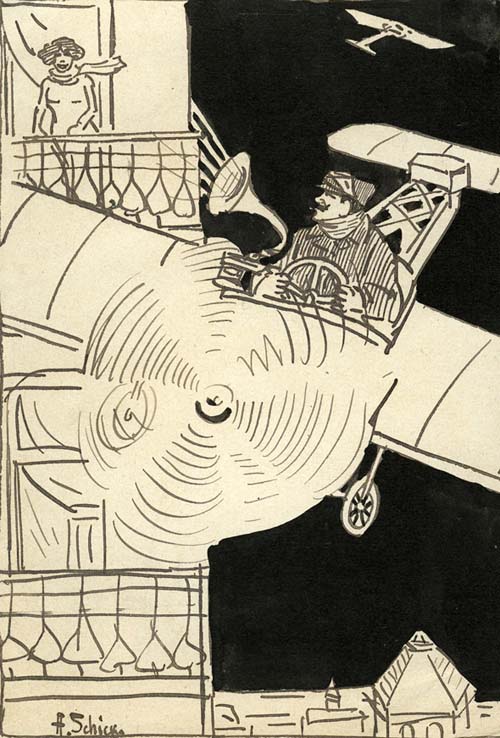
Serenade Aeronautique.
Paris, 1912.
A young lady is serenaded by a pilot when he flies by carrying a phonograph in his airplane.

Program-thumb

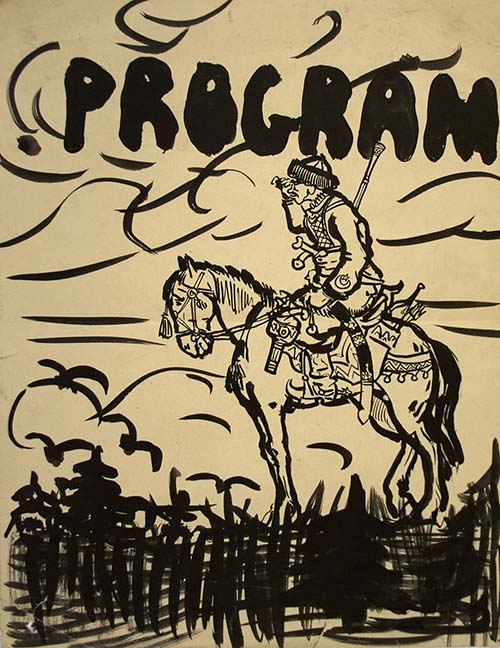
Program.
Paris, 1912.
Szyk’s design for a Russian Program echoes formal elements in the posters created by Toulouse-Lautrec for cabaret venues such as the Moulin Rouge.

Soldier-in-Cloak-thumb

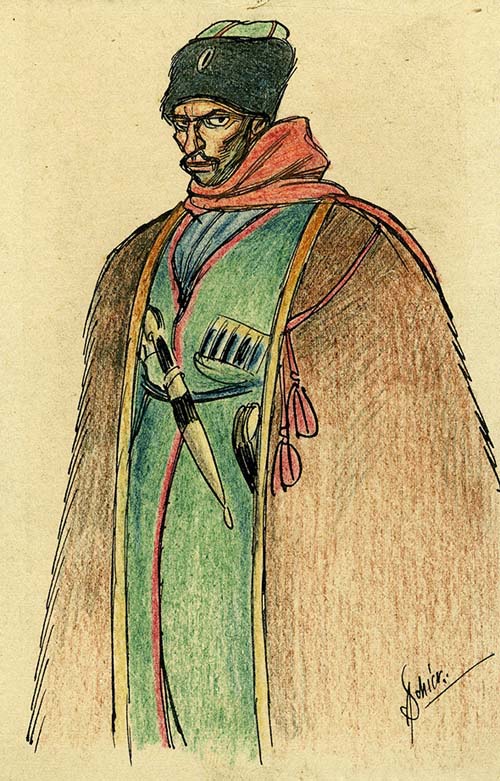
Russian Soldier in Cloak.
Paris, 1912.
A Russian soldier in a woolly brown cloak is ready for winter service.

Soldier-in-Overcoat-thumb

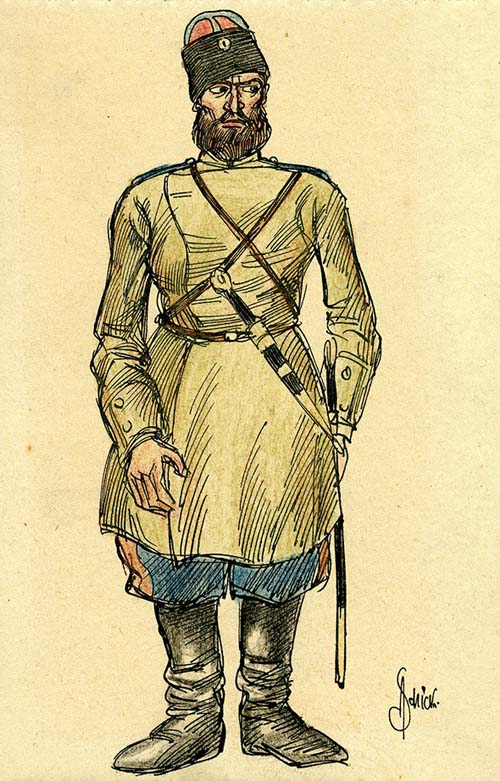
Russian Soldier in Overcoat.
Paris, 1912.
A watchful Russian soldier stands as if at attention.

Tirailler-thumb

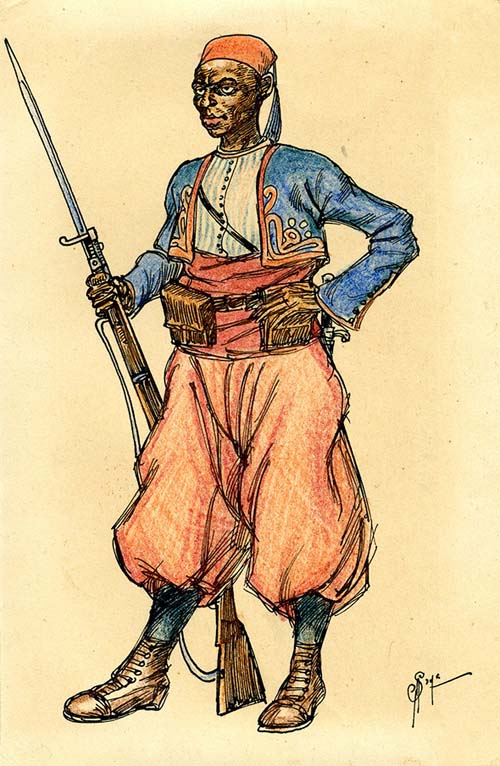
Tirailleur.
Paris, 1912.
A North African infantryman wears a a colorful zouave-style uniform.

Soldier-with-Cap-and-Rifle-thumb

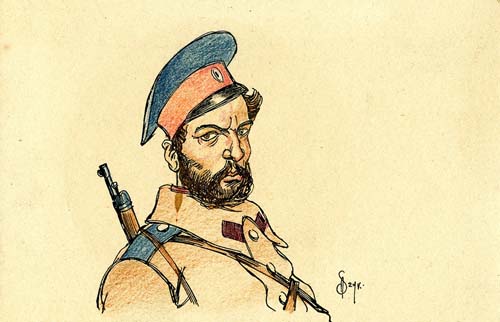
Cossack with Cap and Rifle.
Paris, 1912.
The soldier with a red and blue cap gazes calmly at the observer.

Man-in-Purple-Coat-thumb

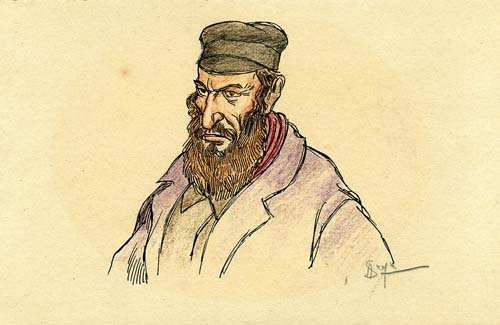
Working Class Man.
Paris, 1912.
His face somewhat careworn, this worker stares straight ahead stoically.

Rumpled-Student-thumb

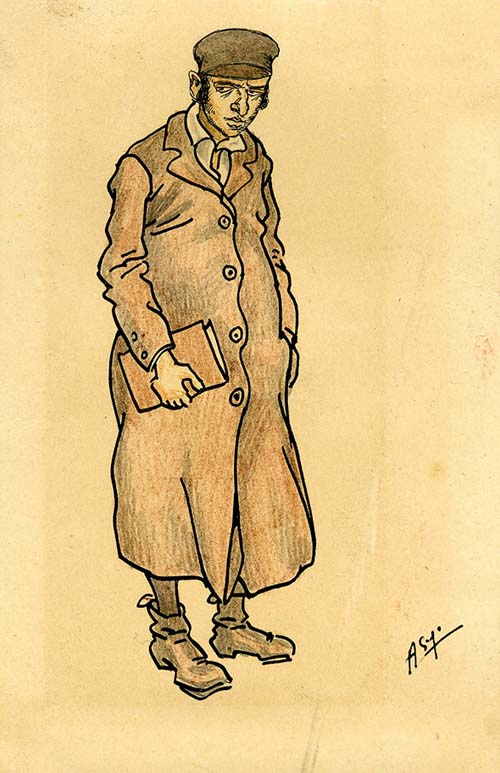
Rumpled Student.
Paris, 1912.
Everything from the muted color palette to the subject’s limp posture and clothes conveys the weariness of a long-studying student.

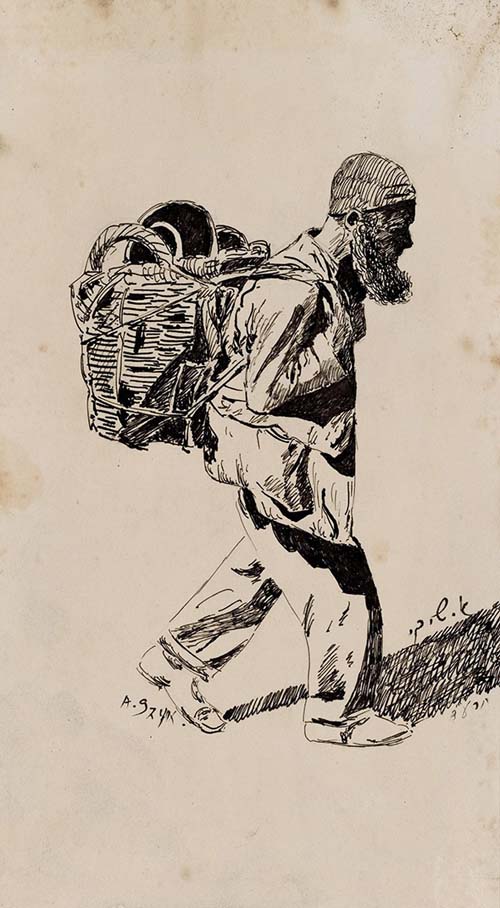
Palestine-Pioneer-thumb

Palestine Pioneer.
Palestine, 1914.
A merchant carries a basket on his back in 1914 Palestine. This was drawn during Szyk’s only visit to the Holy Land.

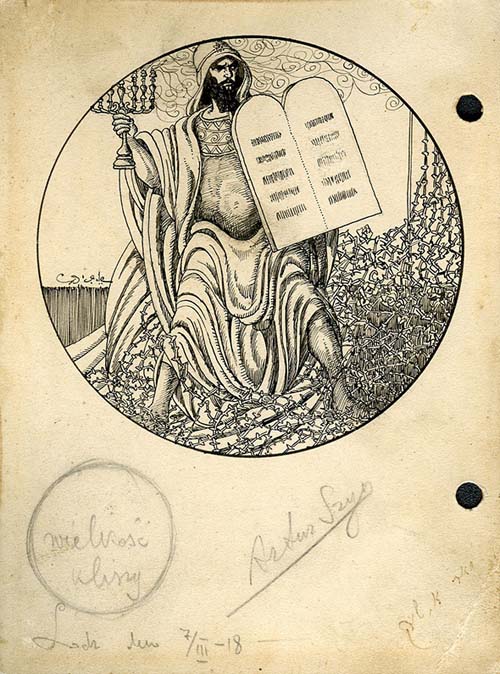
Moses-the-Prophet-thumb

Moses the Prophet.
Lódz, 1918.
A young Moses brandishes a menorah and the Ten Commandments in Szyk’s earliest known drawing of the Hebrew people’s leader.

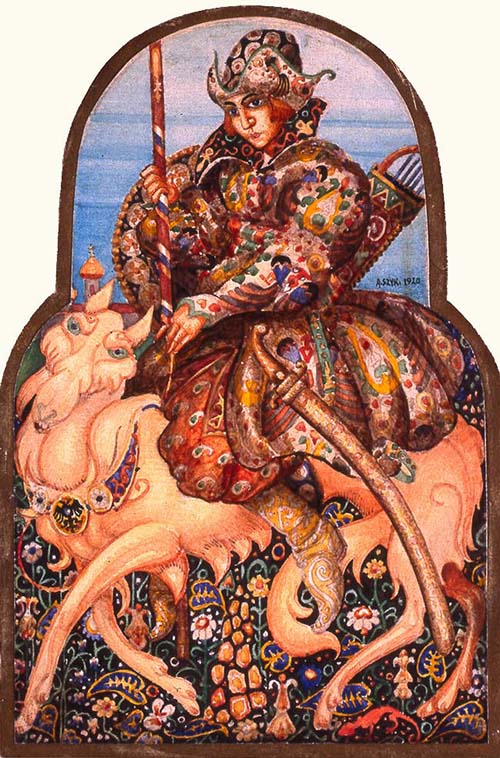
Ivan-Tsarevitch-thumb

Ivan Tsarevitch et le Loup Garou.
Paris, 1920.
Szyk’s “Ivan and the Gray Wolf,” one of Russia’s most beloved folk tales, highlights the artist’s familiarity with the legends of the land of the Tsars.

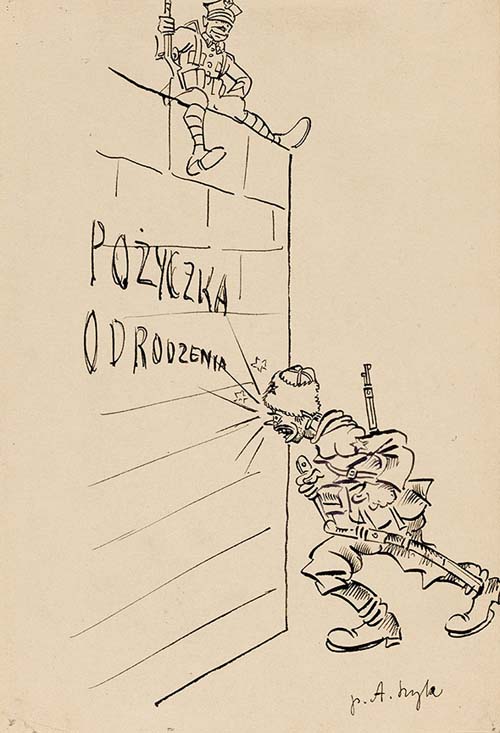
Restoration-Loan-thumb

Pozyczka Odrodzenia [The Restoration Loan].
Lódz, 1920.
“Pozyczka Odrodzenia” (“The Restoration Loan”) is written on the wall against which a Soviet Cossack hits his head while a Polish soldier looks on from above.

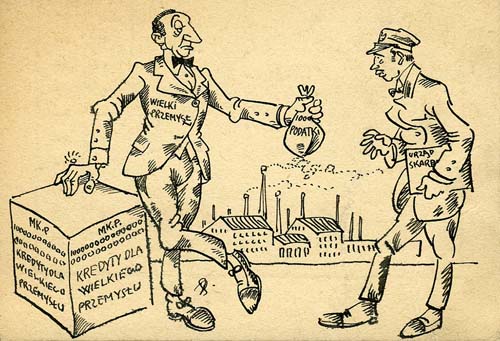
Big-Industry-thumb

Wielki Przemysk [Big Industry].
Lódz, 1920.
A rich business owner hands out taxes to a worker while smokestacks in the background spew offense.

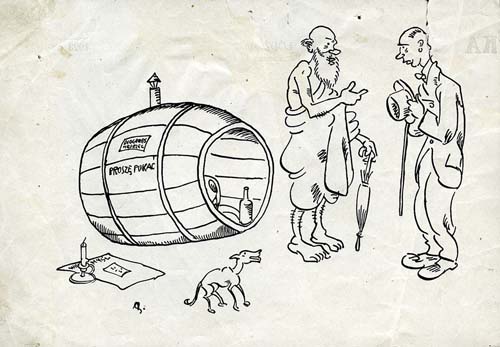
Diogenes-thumb

Diogenes.
Lódz, 1920.
The philosopher Diogenes and his humble abode receive a well-dressed visitor.

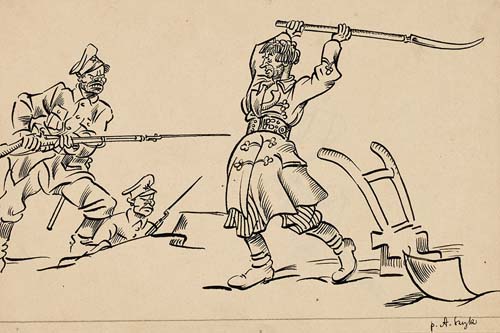
Polish-Peasant-thumb

Polish Peasant Defies Bolsheviks.
Lódz, 1920.
A Polish man wields a weapon traditional for peasant detachments: a modified scythe with its blade set straight on the shaft.

David-and-Saul-square-thumb

David and Saul.
Lódz, 1921.
A red-bearded, angry, and jealous Saul, King of Israel, looms with a lance in his hand over his young successor David, playing the harp.

Ad-Majorem-thumb

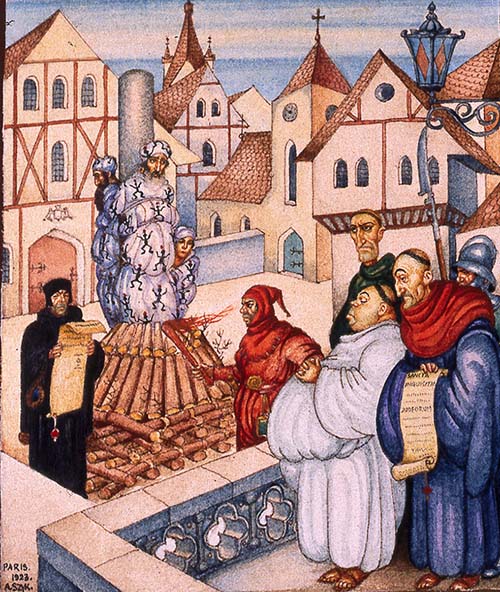
Ad Majorem Dei Gloriam.
Paris, 1923.
Szyk’s earliest works of Jewish persecution and his only known triptych. One panel shows a Spanish Inquisition auto-da-fé; the second the Roman razing of the Second Temple; the third, a Russian pogrom.
Municipal-Plantations-thumb

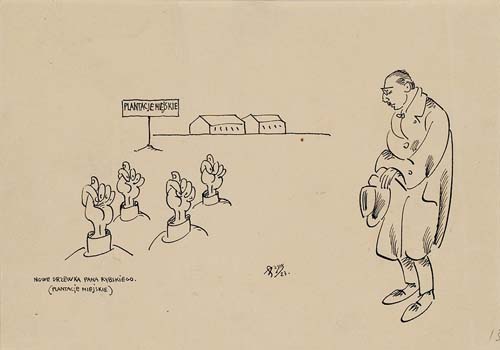
Plantacje Miejskie [Municipial Plantations].
Lódz, 1923.
A stand of “fig” trees have hands whose fingers’ positions express how successfully a Lodz city official completed an urban tree-planting endeavor.

Man-in-Dress-thumb

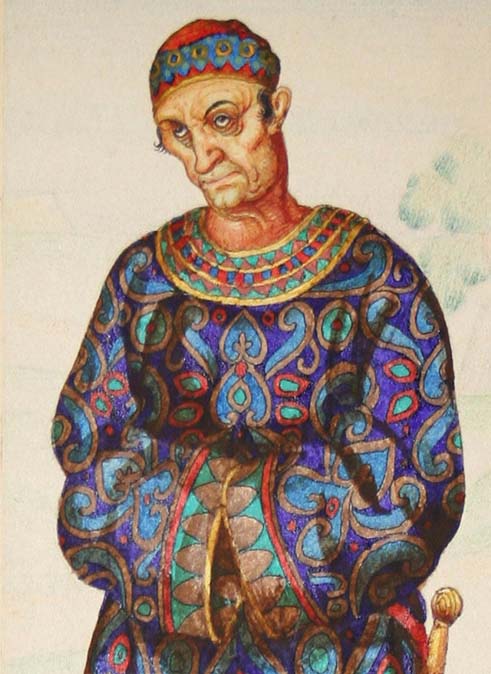
Man in Dress.
Paris, 1923.
In a study for Le Livre d’Esther, a man stands, wearing an outfit rich in detail and the colors of green, blue, purple, red, and gold.

Fantasy-Birds-thumb

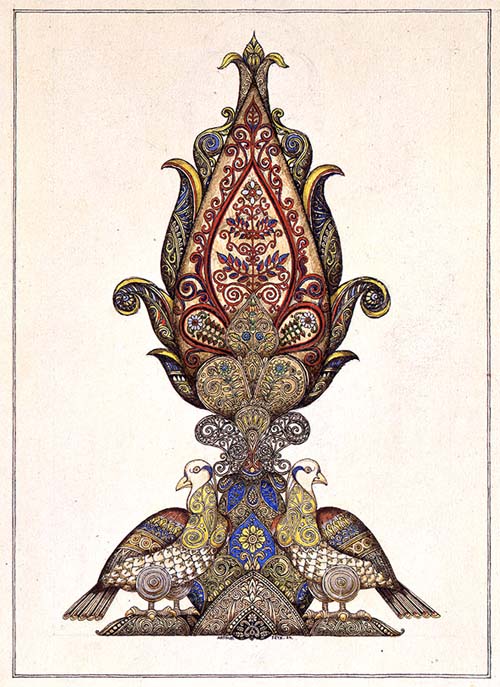
Fantasy Birds and Intricate Flowers.
Paris, 1924.
Filled with details, two birds stand adjacent to a large flower motif referencing medieval illumination.

Lions-Judah-Motif-thumb

Lions of Judah and Star of David Motif.
Paris, 1924.
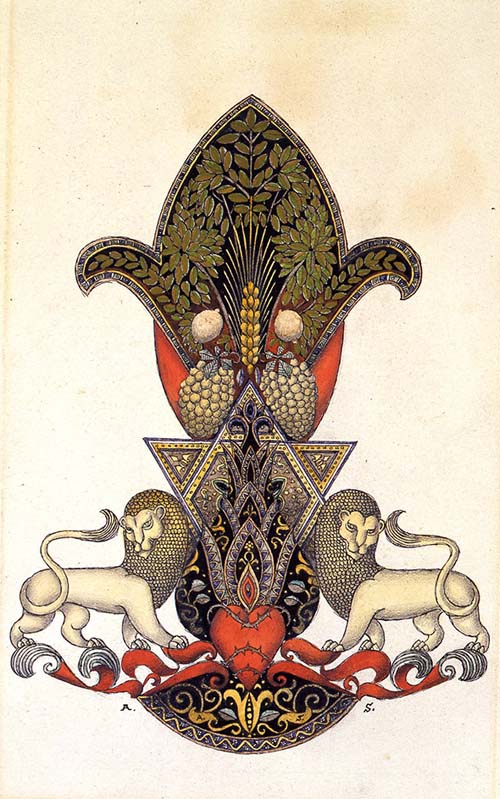
Two lions guard a Star of David, which gives rise to representative flora of the Holy Land.

studies-for-esther-thumb

Studies for Le Livre d’Esther.
Paris, 1924.
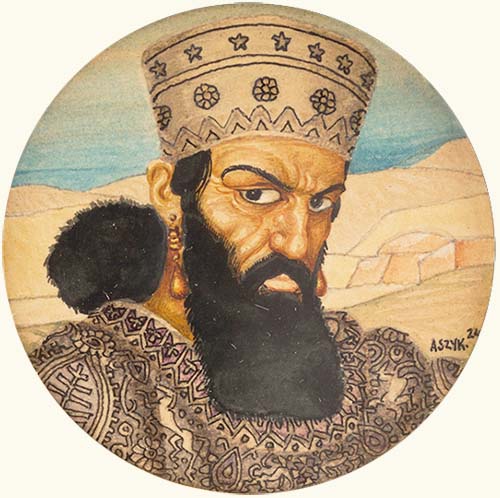
In five circular portraits, men with intricately patterned garments are framed by brown and beige landscapes, accompanied by outlines of large buildings and expanses of blue sky.

Laughing-Jew-thumb

Laughing Jew.
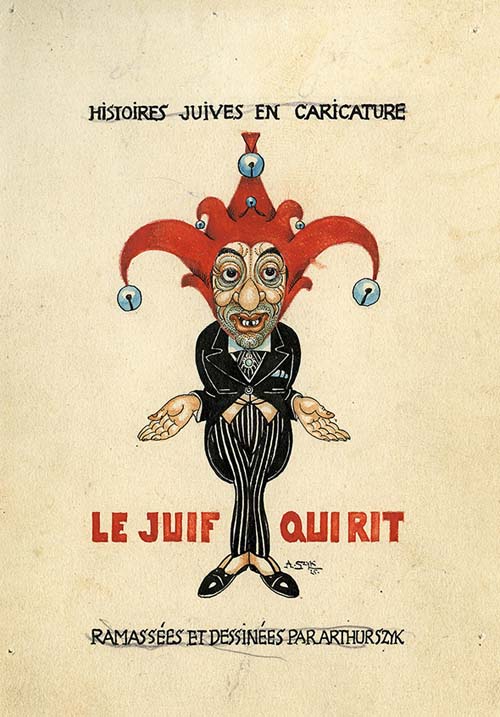
Le Juif Qui Rit.
Paris, 1925.
A well-dressed, yet unshaven and somewhat toothless, Jew wears a bold red jester’s hat.

Shulamith-and-Solomon-thumb

Shulamith and King Solomon.
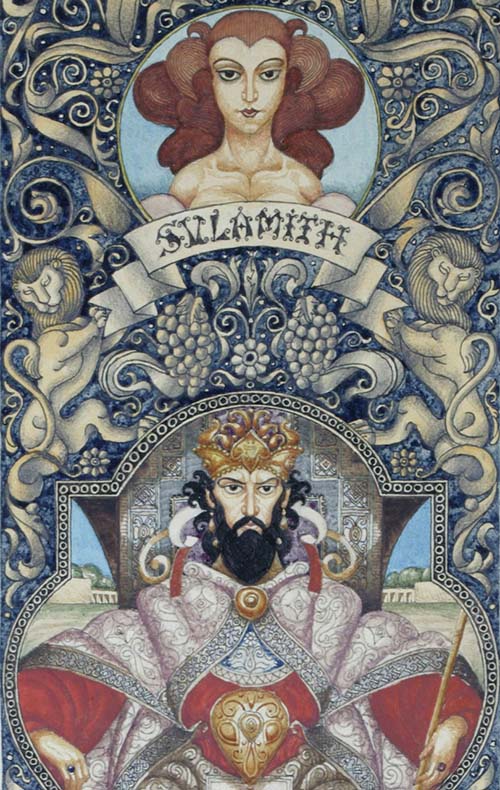
Song of Songs.
Paris, 1925.
This tribute to Shulamith and King Solomon is embellished with grapes, lions, and gazelles mentioned in The Song of Songs.

Julia-Szyk-thumb

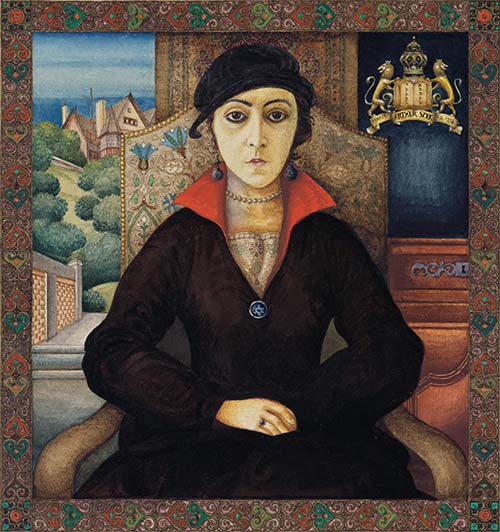
Portrait of Julia Szyk.
Paris, 1926.
In classic Renaissance style, Szyk has seated his wife Julia within intricate textile designs and a richly patterned border. Julia wears a Star of David pinned to her décolletage.

Saint-Anthony-thumb

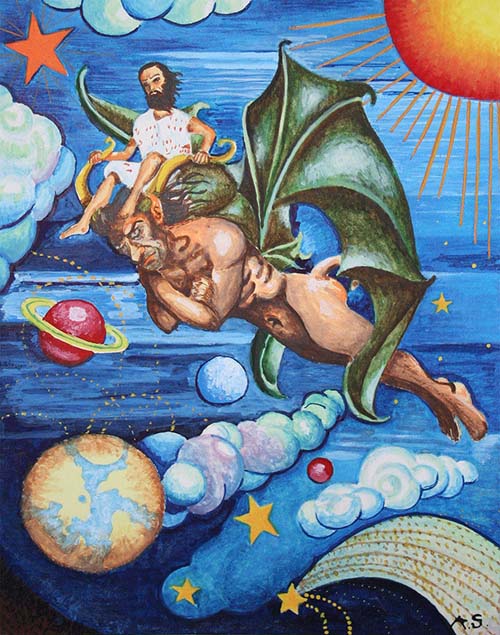
La Tentation de Saint Antoine.
Paris, 1926.
In a surrealistic style, Szyk presents Saint Anthony riding on the horns of a winged Satan as he flies among the planets.

1926-Decours-Greetings-thumb

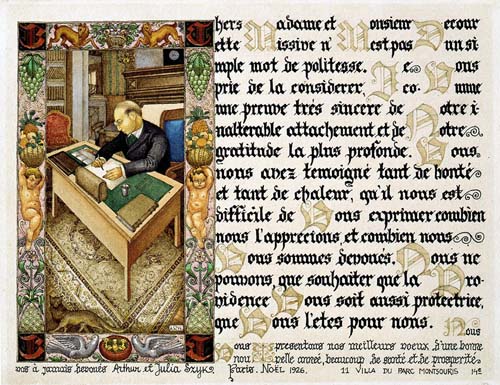
New Year’s and Christmas Greeting to Mr. and Mrs. A. Decour.
Paris, 1926.
A superb example of personal art painted for Lucie and Auguste Decour, an important antiquities dealer who introduced Szyk to art collectors in Paris. The image is a self-portrait of Szyk in the study of his Paris home.

scribe-thumb

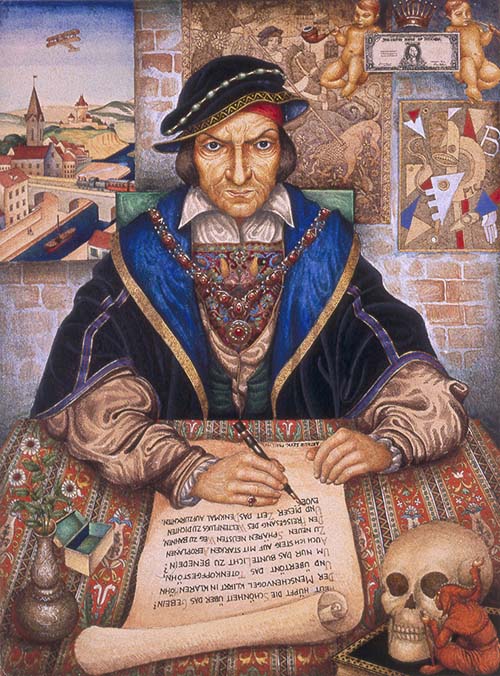
The Scribe.
Paris, 1927.
In this brilliant illumination, Szyk juxtaposes the modern world with the Renaissance. A medieval scholar impossibly contemplates the modern world as he writes an expressionist poem on parchment with a fountain pen.

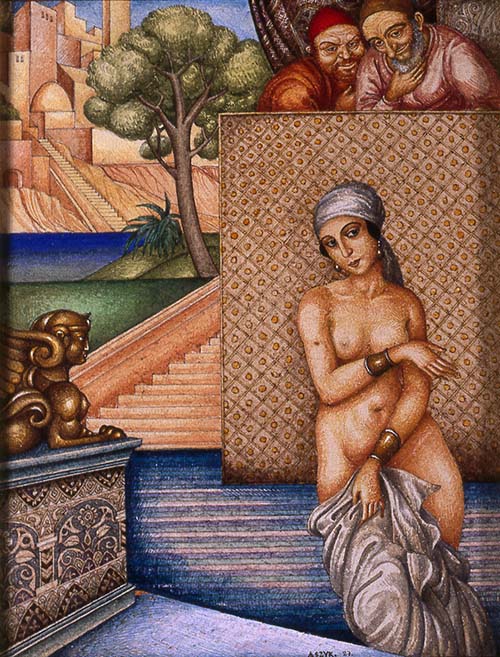
Suzanne-thumb

Suzanne et les Deux Vieillards.
Paris, 1927.
Suzanne is presented in her bath where detailing on the tiles and sphinx exemplify Szyk’s early Parisian period. Unbeknownst to her, two elderly men are watching, plotting their sexual exploits.

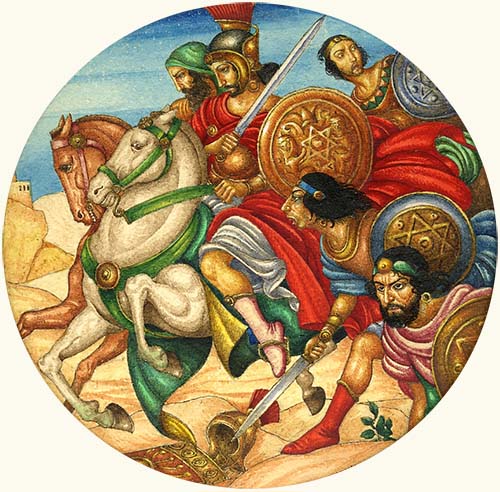
Bar-Kochba-thumb

Bar Kochba.
Paris, 1927.
General Simon Bar Kochba, a heroic military figure, rides a galloping steed, sword raised, leading his men to free Jerusalem from Roman rule. He carries a shield bearing the Star of David.

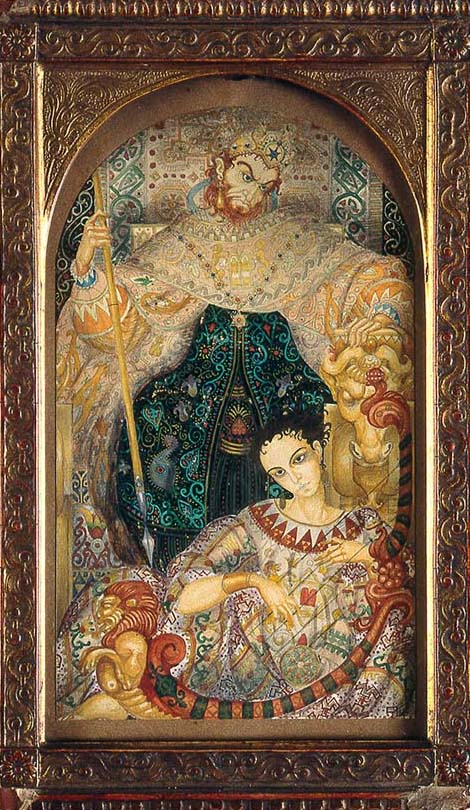
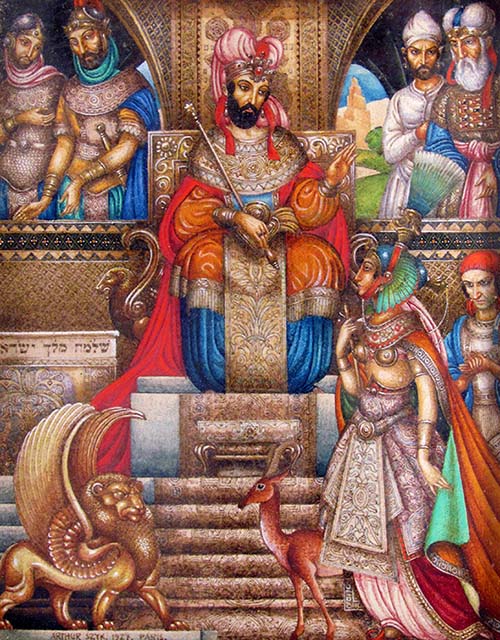
Sheba-before-Solomon-thumb

The Queen of Sheba before Solomon.
Paris, 1927.
The Queen of Sheba visits King Solomon in his court at Jerusalem. In this composition rich with blues, pinks, and oranges, Szyk blends the styles of near-eastern Orientalism and orthodox iconic art.

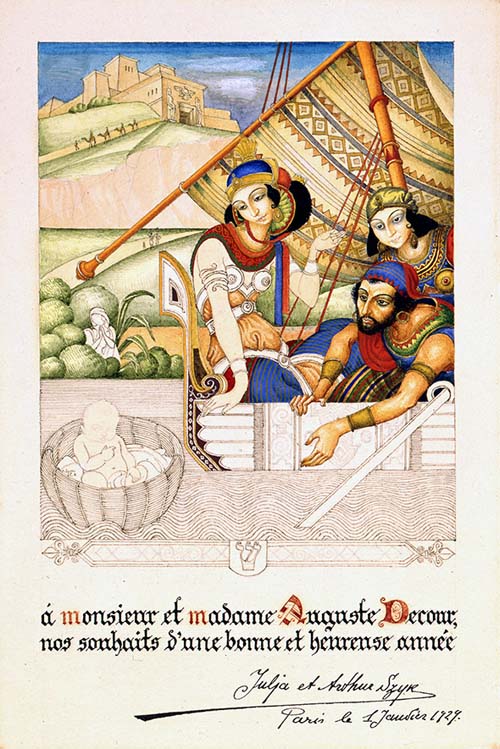
Decour-Greetings-1929-thumb

New Year’s Greeting to Decours.
Paris, 1929.
Szyk incorporates his favorite Biblical hero, Moses, in this holiday greeting for his friend and supporter Auguste Decour. Moses, Miriam, and the river Nile are outlined in pen while the rest of the work is in full color.

Greetings-Decours-1930-thumb

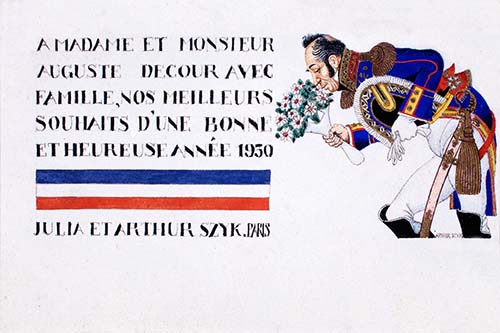
Holiday Greetings to Madame and Monsieur Decour.
Paris, 1930.
A French Imperial Officer in full dress uniform gallantly offers the Decour family a bouquet of flowers in this holiday greeting from the Szyks in 1930.
League-of-Nations-thumb

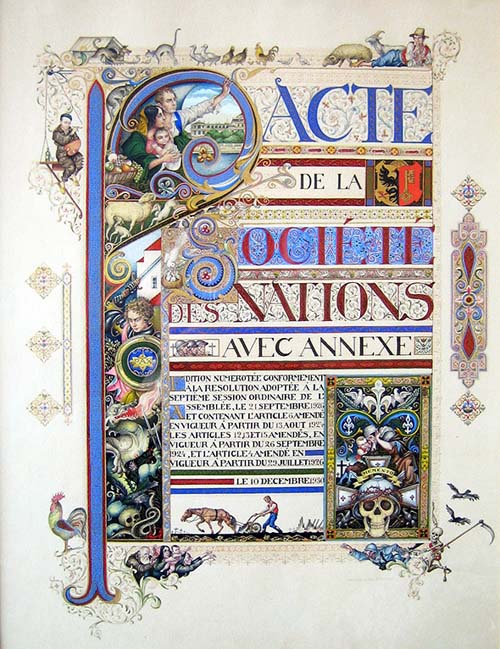
Pacte de la Société des Nations [League of Nations].
Paris, 1931.
This is one of four illuminations that Szyk finished after the League of Nations commissioned him to illuminate its charter. The idyllic images of family and rural life at top are are countered by the memento mori below.

Illuminated-Envelope-Card-Letter-thumb

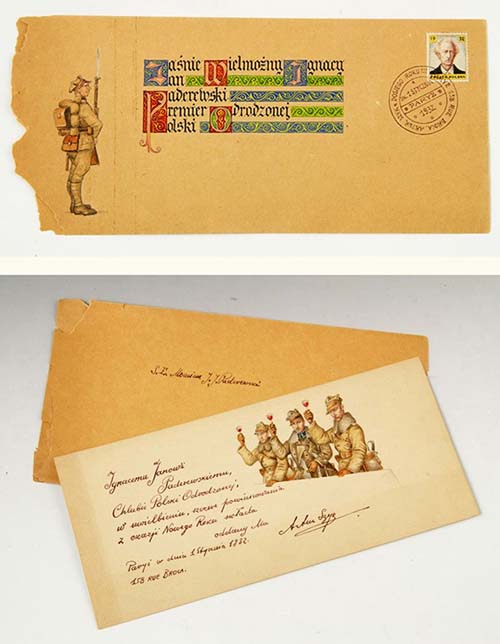
Illuminated Envelope and Greeting Card (with Letter).
Paris, 1932.
The envelope has a painted stamp showing a likeness of the recipient, Poland’s former Prime Minister Ignancy Jan Paderewski. On the greeting card, three Polish soldiers raise wineglasses in a New Year’s toast.

Lwow-Medallion-thumb

Lwów Medallion, Self Portrait.
London, 1933.
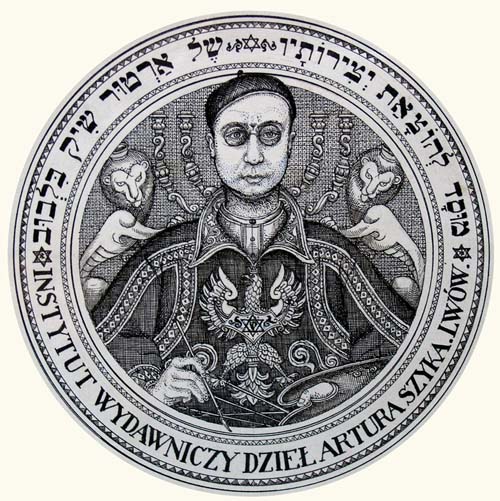
This self-portrait contains icons of Szyk’s identity as a Jew, Pole, and artist: a menorah, lions of Judah, the Star of David, a Polish eagle, and paintbrushes and palette. This was the logo of a society in Lwów that supported the artist’s work.

Kosciuszko-1938-thumb

Tadeusz Kosciuszko.
Polish-American Fraternity series.
London, 1938.
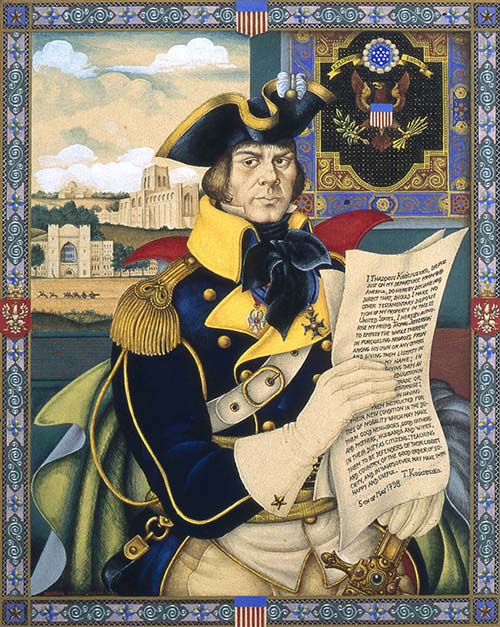
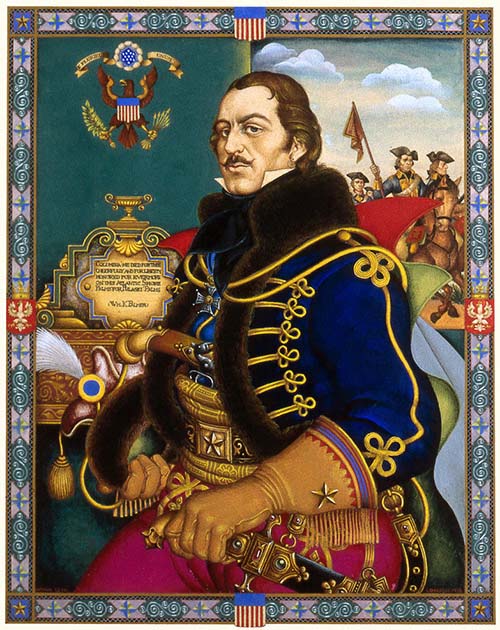
Kosciuszko was hailed as “the Father of American Artillery” in Washington’s Continental Army. Here he holds his will, which grants funds to purchase the freedom of many slaves (including those of his friend Thomas Jefferson).

Pulaski-1938-thumb

Casimir Pulaski.
Polish-American Fraternity series.
London, 1938.
War hero Count Pulaski was exiled from Poland and joined Washington’s army in 1777. Congress later named him Chief of the Calvary. This and the Kosciuszko portrait are among the most important works in Szyk’s Polish-American Fraternity series.
George-VI-thumb

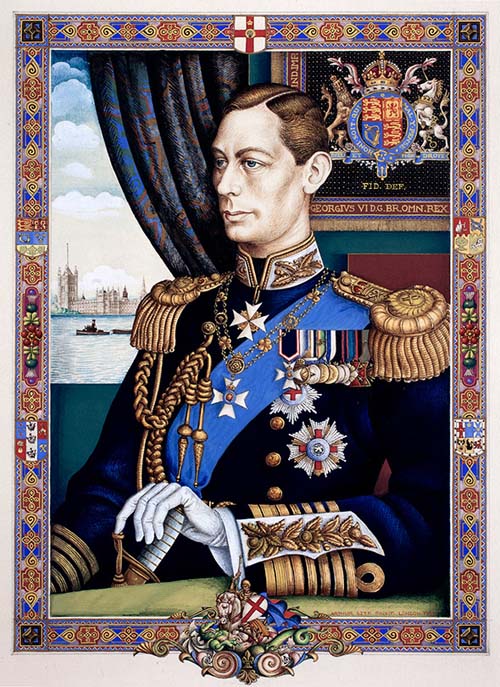
King George VI.
London, 1938.
King George VI reigned when Szyk and his family lived in Great Britain (1937-1940). In this painting, the King sits before a window facing Buckingham Palace and the River Thames. Over his left shoulder is a banner bearing the Royal Coat of Arms.

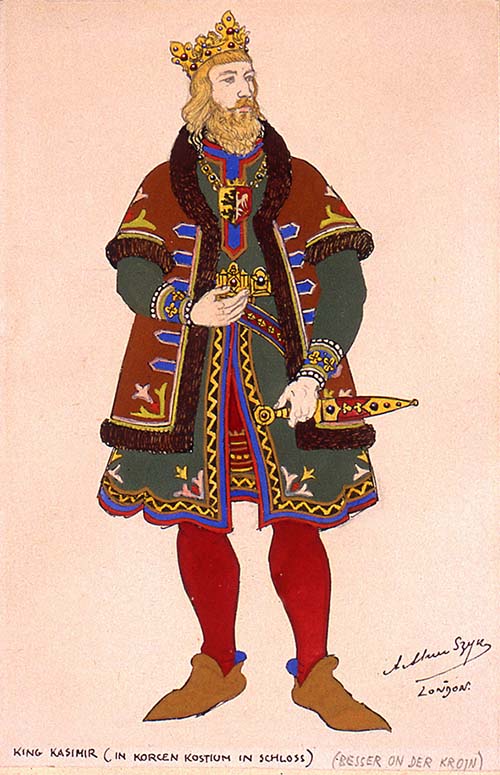
King Kasimir.
London, 1938.
An adept costume designer, Szyk probably created this work for the Yiddish drama Esterke. King Kasimir was revered for admitting Jews into Poland during their exile from other European states.

german-authority-thumb

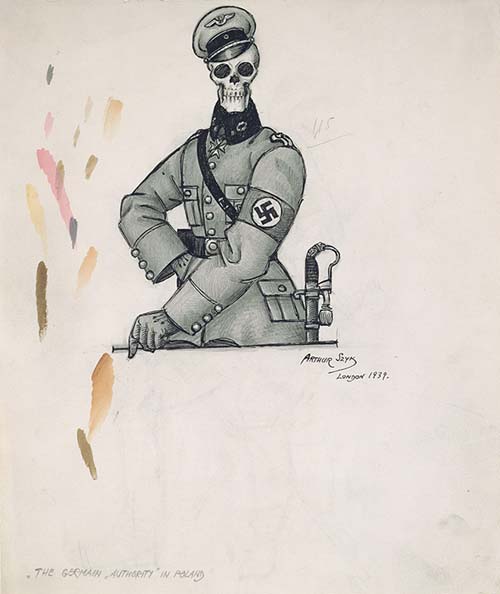
The German “Authority” in Poland.
London, 1939.
Szyk repeatedly depicted Death in Nazi uniform in his WWII works. When this piece was created, hundreds of thousands of Poles — Jews and Gentiles — had perished under Hitler’s Reign of Terror.

tovaritch-thumb

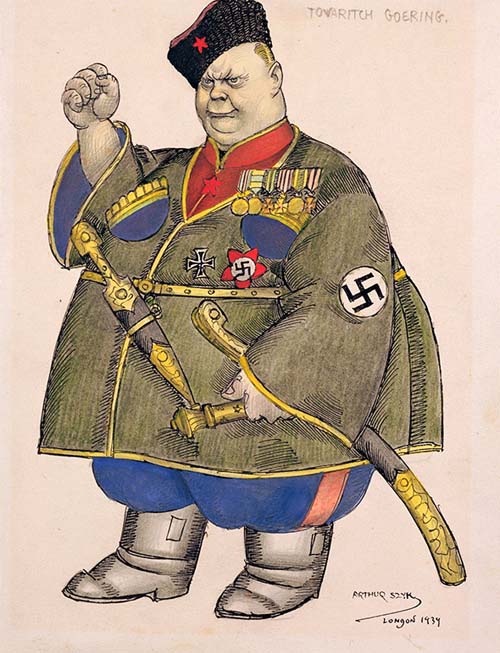
Tovaritch Goering.
London, 1939.
The German Hermann Göring wears a Cossack uniform and Russian fur cap. He receives the moniker “Tovaritch” – Russian for “comrade” or “friend” – after Poland had been invaded by German and Soviet allies.

lebensraum-thumb

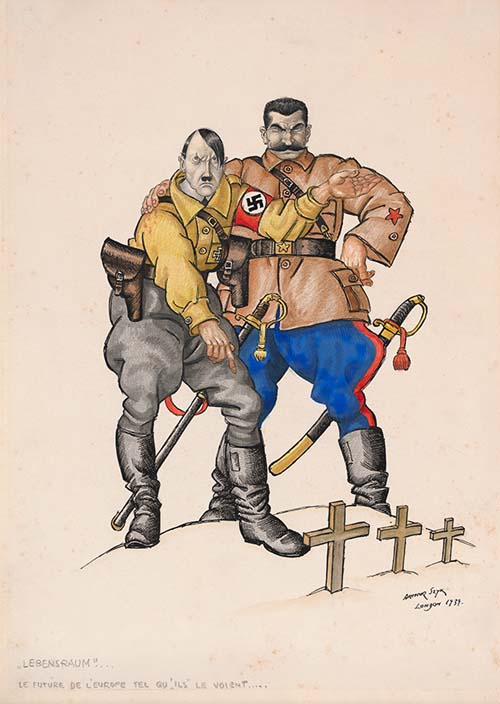
Lebensraum. Le Future de l’Europe…
London, 1939.
Lebensraum was a Nazi expansionist policy whereby “inferior” populations could be exterminated to liberate land for Aryan use. Here Stalin clasps Hitler’s shoulder while they stand together in Poland.

Playing-on-the-Beach-thumb

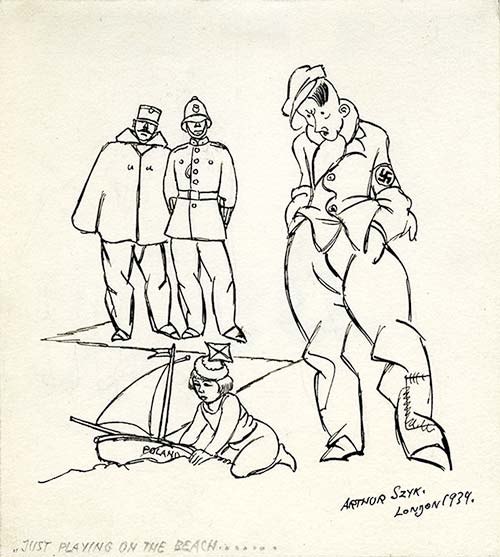
Just Playing on the Beach…Poland.
London, 1939.
On the beach a child plays with a ship labelled “Poland,” unaware of the somewhat tatty Hitler standing hunched behind him.

defenders-of-warsaw-thumb

The Defenders of Warsaw.
London, 1939.
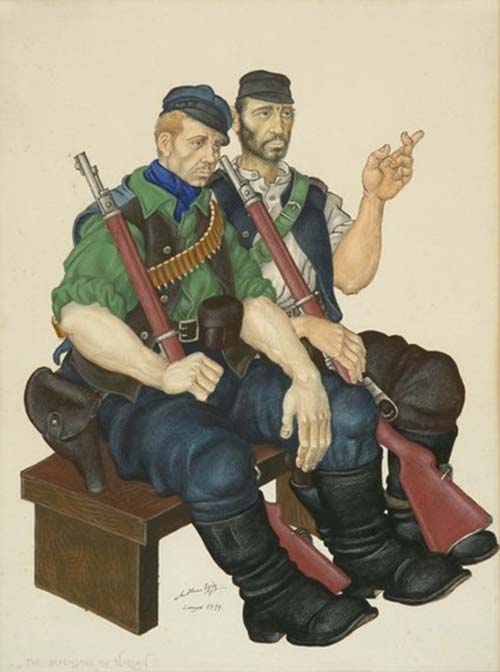
A Pole and a Jew sit together as comrades-in-arms. Though equipped with sidearm, rifles and ammunition, the men wear no military uniform. (Szyk had hoped that his countrymen would successfully join forces against Hitler.)

Song-of-Roland-thumb

La Chanson de Roland [The Song of Roland].
London, September 1939.
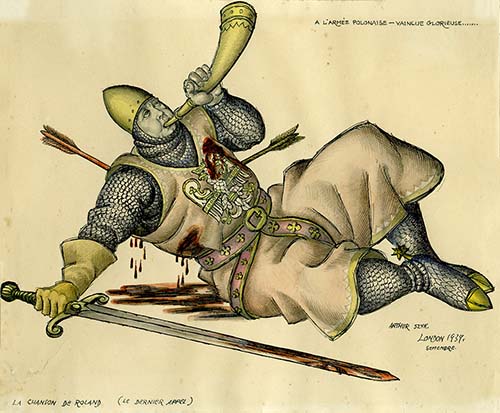
A fallen knight dressed as a warrior from the Middle Ages wears a blood-stained tunic emblazoned with the Polish eagle. He calls for help with his horn.

christ-of-nations-thumb

Polsce, Chrystusowi Narodów.
London, 1939.
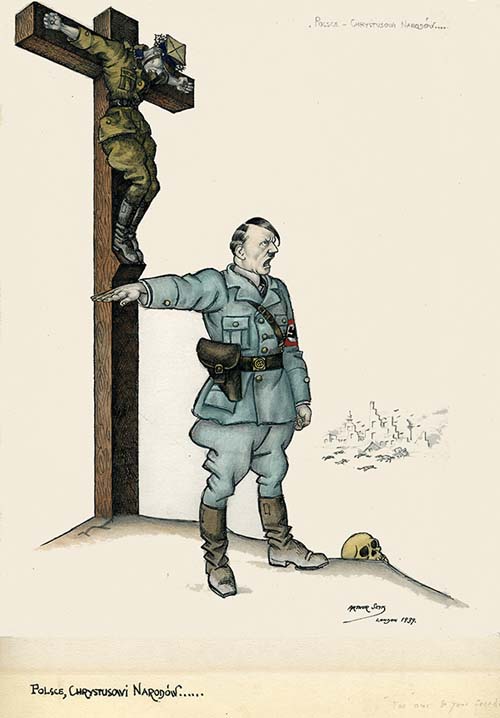
The Nazis’ ruthless destruction of Poland is cast with New Testament imagery in “Poland, The Christ of Nations.” Hitler rigidly salutes, while behind him a Polish soldier is crucified on a cross.

Polish-Free-Corps-thumb

Polish Free Corp.
London, 1940.
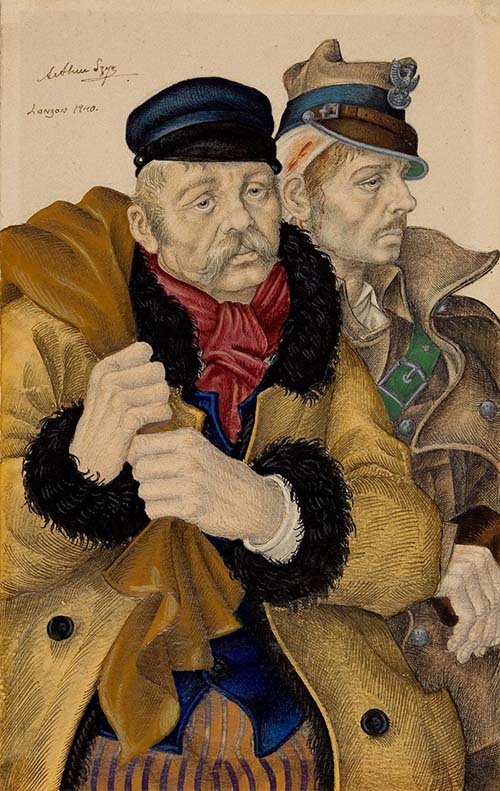
Two beleaguered non-Jewish Poles, a simple worker and a wounded soldier, leave their country carrying their possessions. The ironic title suggests that with Poland free of Poles a new, more productive, German corporation can take shape.

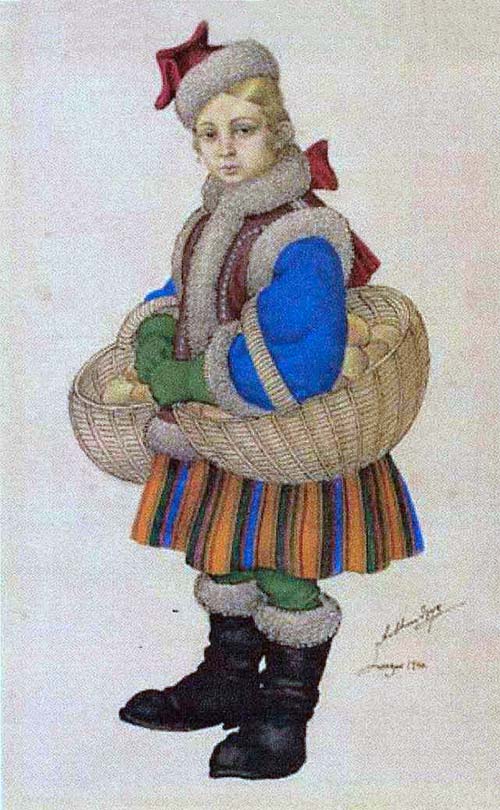
Polish-Maid-thumb

Portrait of a Polish Maiden.
London, 1940.
An idyllic young blonde girl carries her apples to market. She is dressed in a fleece-lined vest and matching hat. Her gaily striped dirndl skirt is worn over bright green leggings and sheep skin boots.

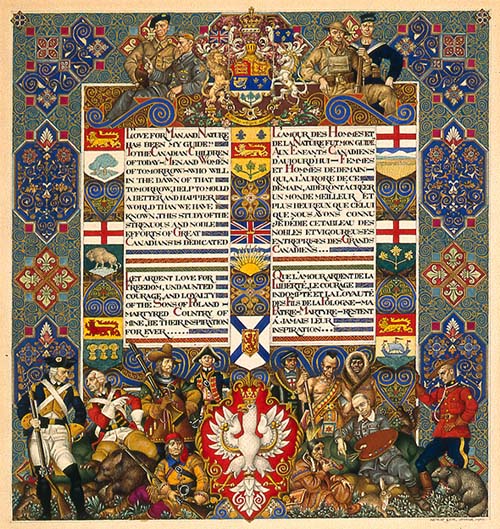
Love-Man-Nature-thumb

Love for Man and Nature.
Ottawa, 1940.
This brilliant illumination presents a visual history of Canada, highlighting Native American tribes and military figures from the colonial era to the present day (World War II), as well as the heraldic shields of each territory.

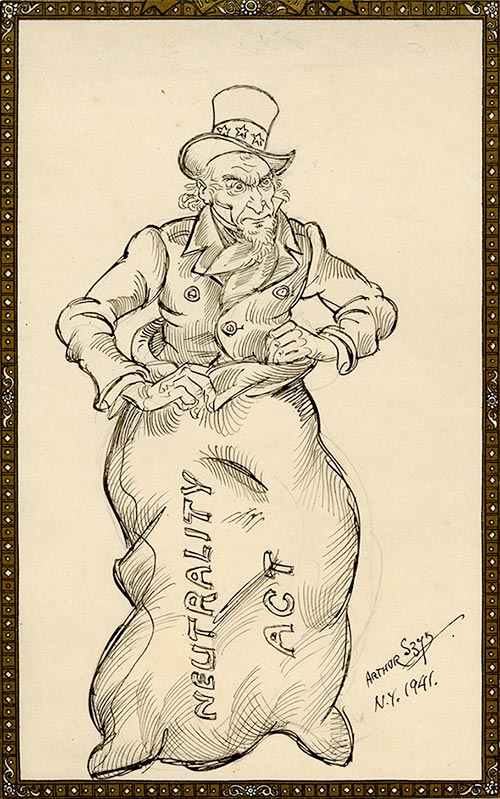
Neutrality-Uncle-Sam-thumb

Neutrality Act (Uncle Sam).
New York, 1941.
A large sack with the words “Neutrality Act” covers Uncle Sam up to his waist, hobbling his ability to act with efficiency.

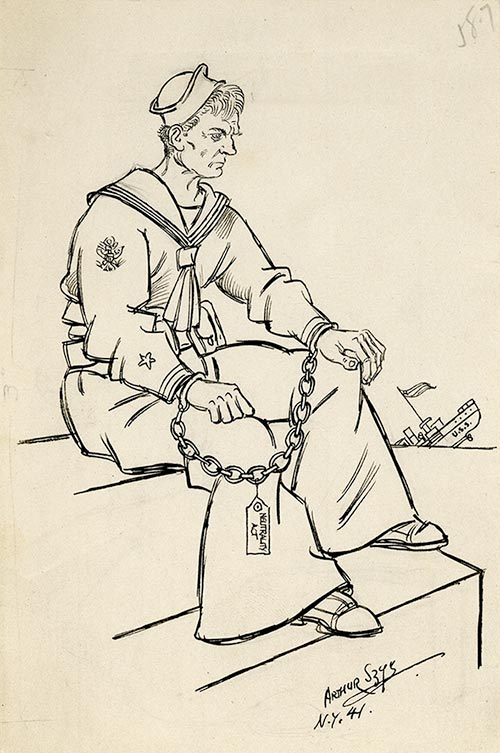
Neutrality-Soldier-thumb

Neutrality Act (Sailor).
New York, 1941.
A shackled sailor watches a ship sink in the distance. Presumably it is the USS Reuben James, the U.S. destroyer that was torpedoed and sunk on October 31, 1941 by a German U-boat.

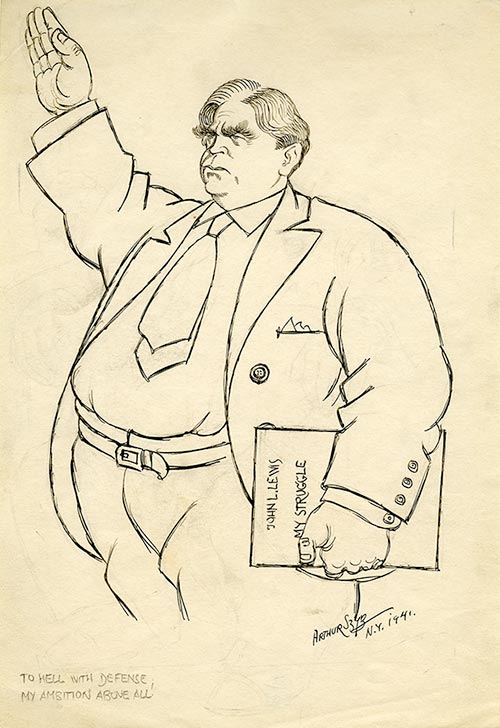
My-ambition-above-all-thumb

To Hell with Defense, My Ambition Above All.
New York, 1941.
John L. Lewis, founding president of the CIO, raises his right arm in a Nazi salute. The book under his other arm is titled My Struggle, playing on Hitler’s infamous autobiography Mein Kampf.

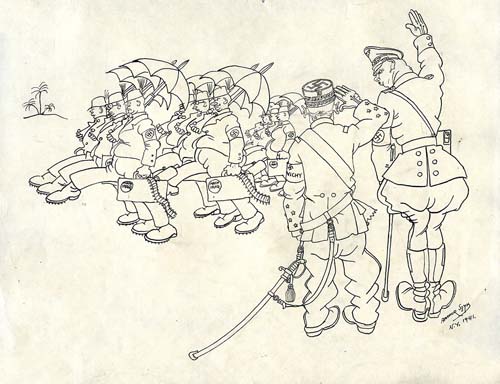
german-tourists-thumb

German Tourists.
New York, 1941.
Hitler and French Vichy General Philippe Pétain review a parade of goose-stepping German troops, who carry parasol-topped bayonets and suitcases stamped “Nach Iraq” [To Iraq].

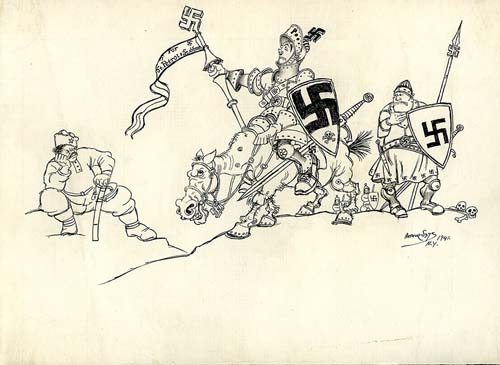
crooked-cross-thumb

Knights of the Crooked Cross.
New York, 1941.
A Russian soldier scowls at the approach of Hitler and his swastika-covered Huns. Dressed as a medieval knight, the Führer carries a banner heralding “For St. Petrol & St. Wheat.”

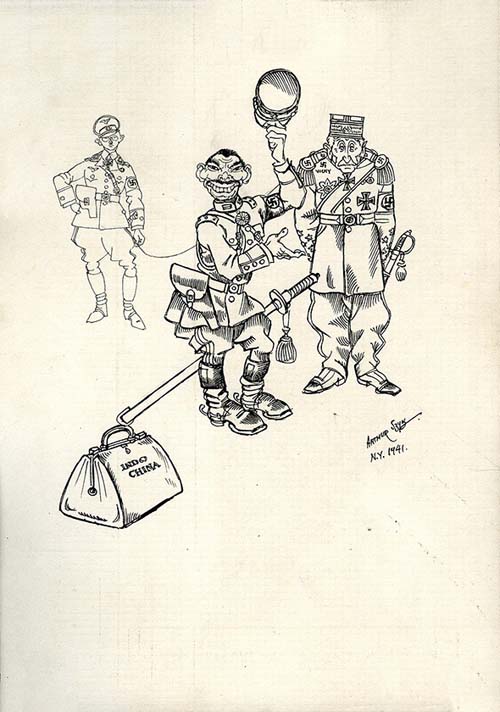
decent-as-he-is-thumb

Why Are Not You Americans as Decent as He Is?
New York, 1941.
Japanese Admiral Isoroku Yamamoto gestures toward a weakened Henri Philippe Pétain, who wears a leash held by Heinrich Himmler, head of the Gestapo.

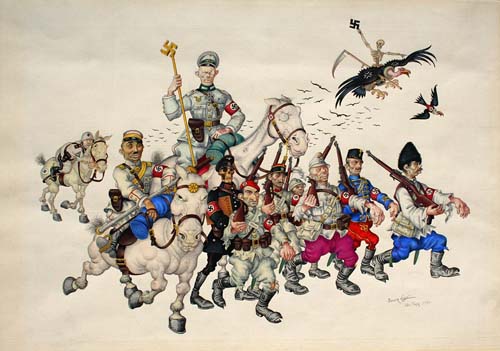
new-orderlies-thumb

The New Orderlies.
New York, 1941.
Leaders of Germany and Japan ride confidently forward, while Italy (Mussolini) struggles to stay atop his horse. From astride a flying vulture, Death rallies Spain, Vichy France, Finland, Hungary, and Romania.

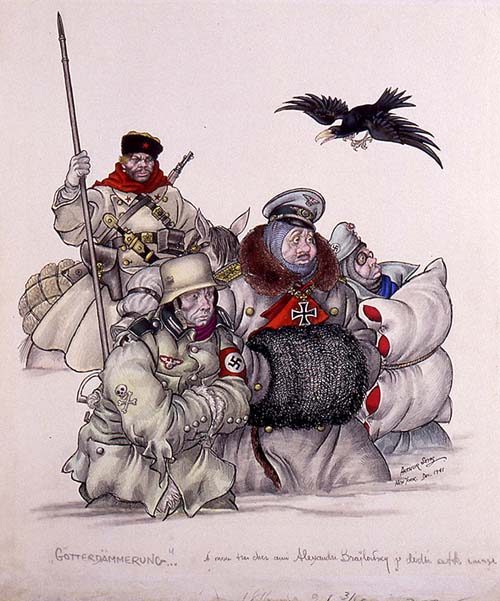
gotterdammerung-thumb

Götterdämmerung.
New York, December 1941.
Germany’s disastrous decision to invade Russia during winter recalls Richard Wagner’s opera “Götterdämmerung” [“Twilight of the Gods”]: the warrior-hero Siegfried (Hitler) is killed by his former ally (Russia) as vengeance for perjury.

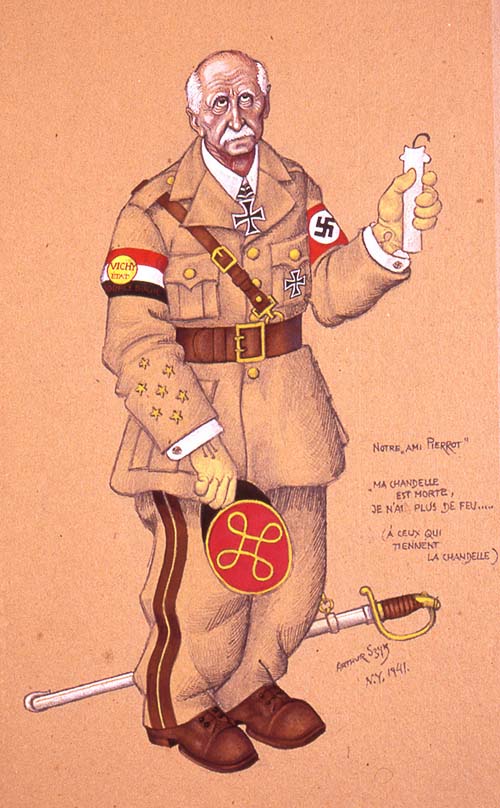
notre-ami-thumb

Notre Ami Pierrot.
New York, 1941.
Henri Philippe Pétain stars in Szyk’s sarcastic revision of a French folk song: “Notre ami Pierrot, ma chandelle est morte, je n’ai plus de feu” (“Our friend Pierrot, my candle has died, I have no more fire”).

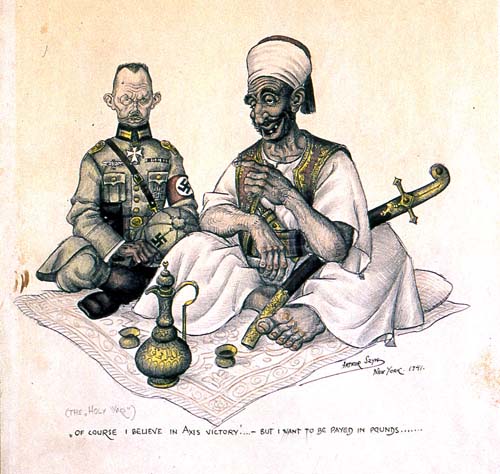
axis-victory-thumb

Of Course I Believe in Axis Victory.
New York, 1941.
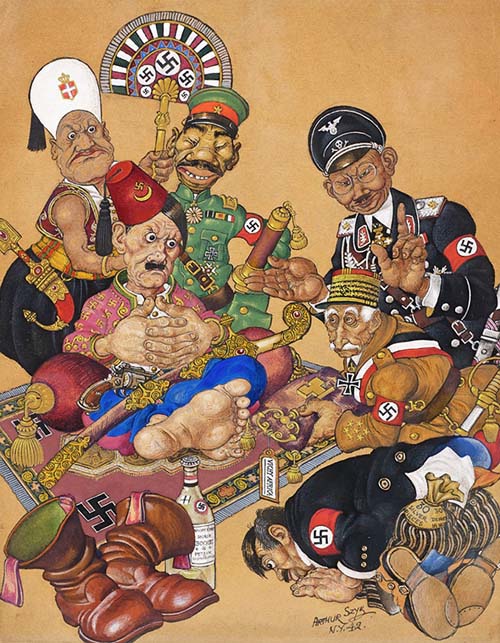
Szyk satirizes the Middle Eastern alliance with the Axis. A sheik bargains with a Nazi leader, offering support on one hand, yet demanding British pounds on the other.

nerfs-thumb

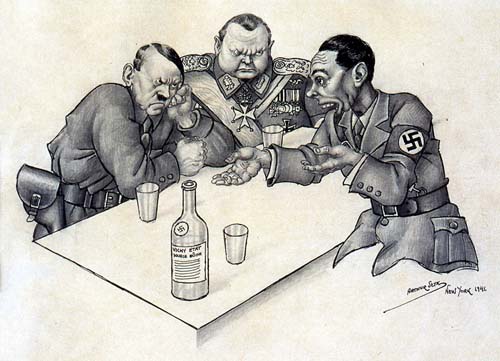
War of Nerfs
The New Order
New York, 1941.
Josef Goebbels, the Nazi Minister of Propaganda, speaks to Reichsmarschall Hermann Göring and the Fühher. “War of nerfs! [nerves] Jawohl! [Yes!]”

high-command-thumb

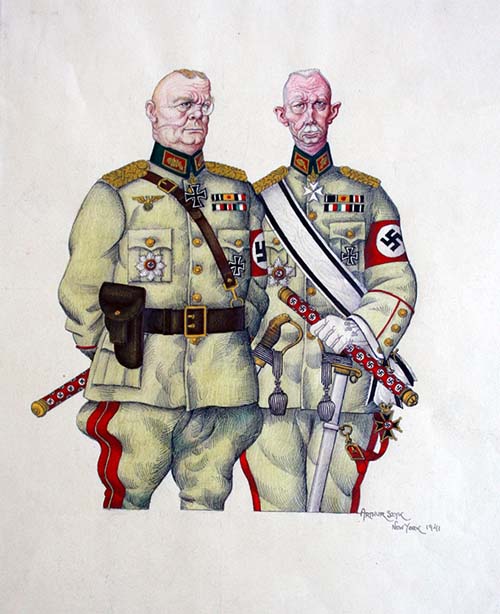
High Command.
The New Order
New York, December 1941.
Two German field marshals hold batons that signify their high rank. Their uniforms are festooned with medals and insignia of both the Prussian and Nazi militaries.

lion-judah-thumb

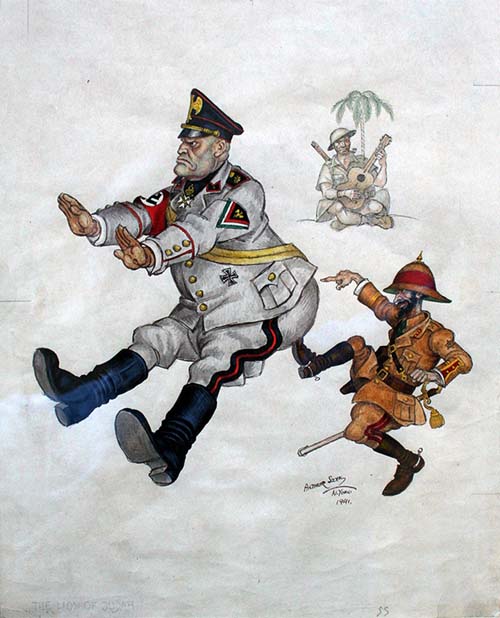
The Lion of Judah.
The New Order.
New York, 1941.
Exiled Ethiopian emperor Haile Selassie (a.k.a. The Lion of Judah) returned home once the Allies drove Italy from East Africa. Here Selassie gleefully kicks Mussolini in the pants.

modern-hamlet-thumb

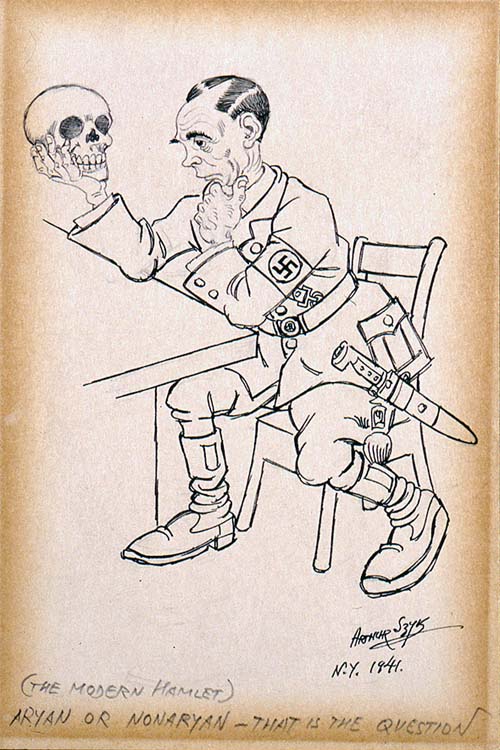
The Modern Hamlet.
New York, 1941.
As Shakespeare’s Hamlet pondered suicide or continuing life, Szyk portrays Joseph Goebbels examining a human skull and questioning whether it looks Jewish or not — that is the question!

British-American-Ambulance-thumb

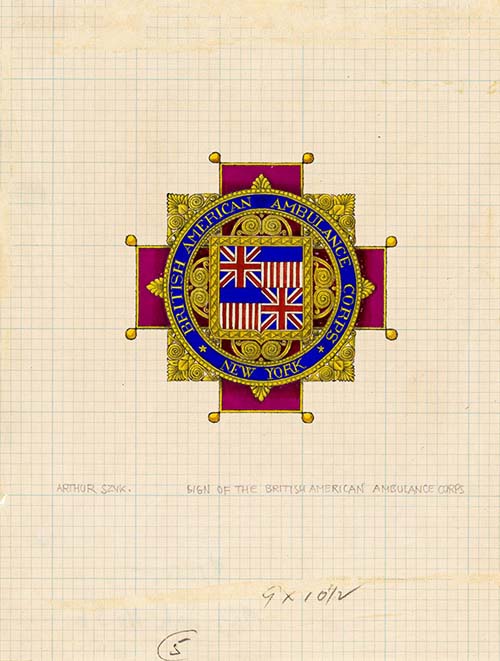
Sign of the British American Ambulance Corps.
New York, 1941.
Szyk designed a cruciform medal (inset with British and American flags) for the British-American Ambulance Corps and later created poster stamps to raise funds for the organization.

supreme-command-thumb

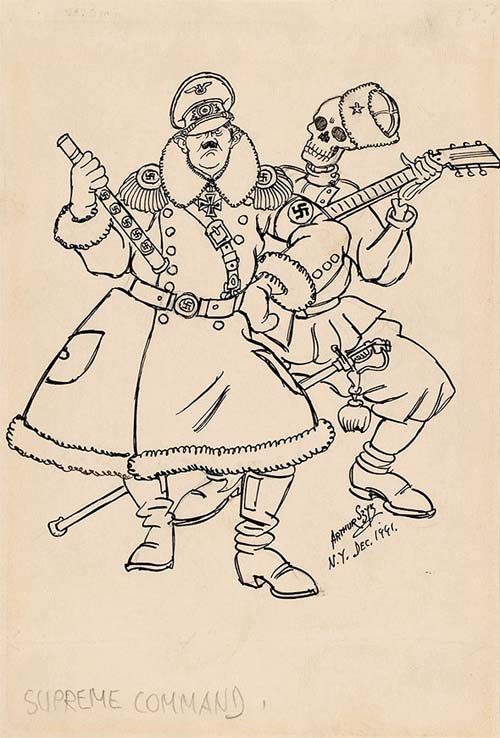
Supreme Command.
New York, December 1941.
Completed six months after German’s invasion of Russia, Szyk shows Hitler holding a decorated field marshal’s baton and prancing to the rhythm of the Supreme Commander, Death.

czar-hitler-thumb

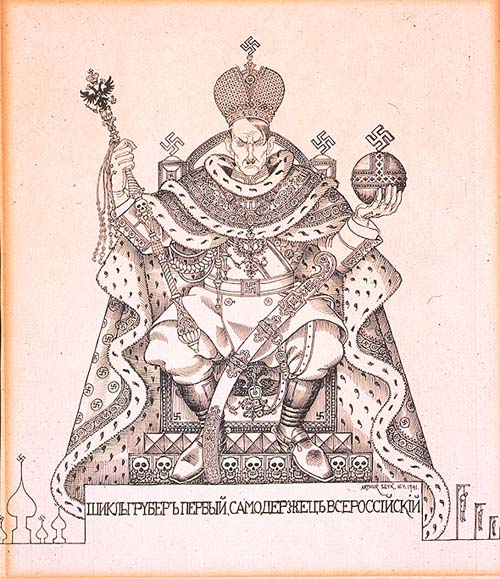
Czar Hitler.
New York, 1941.
Hitler sits menacingly on the Soviet throne, his regalia covered in swastikas. His heavy boots rest on a platform inscribed in Cyrillic: “Schicklgruber — the first omni ruler of the whole of Russia.”

nobody-invited-thumb

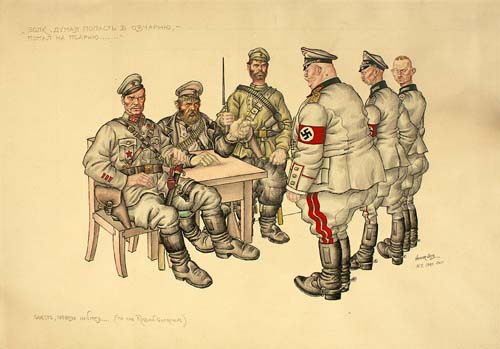
Guests Nobody Invited.
New York, July 1941.
Szyk dramatizes the first weeks of Operation Barbarossa, the Nazi invasion of the U.S.S.R. Three German soldiers stand before three scowling, armed Russians, one of whom points accusingly at the largest, most senior German officer.

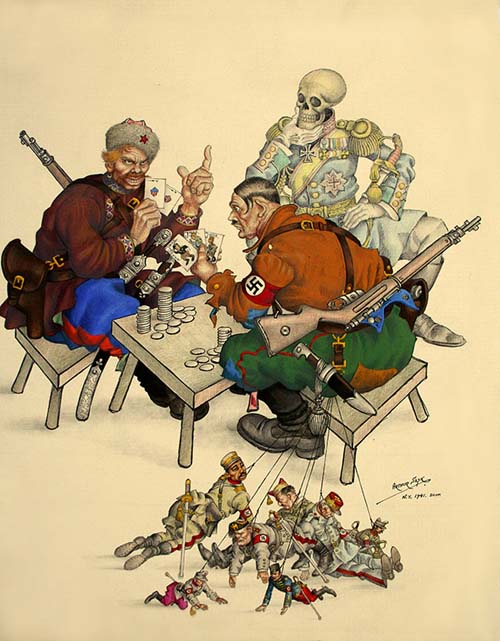
poker-game-thumb

Historic Poker Game.
New York, September 1941.
Germany’s Führer is startled to see that his “better” hand (three Jokers: Italy, Japan, and Vichy France) cannot win against Ivan’s (two aces: the United States and Great Britain). Death observes the match with interest.

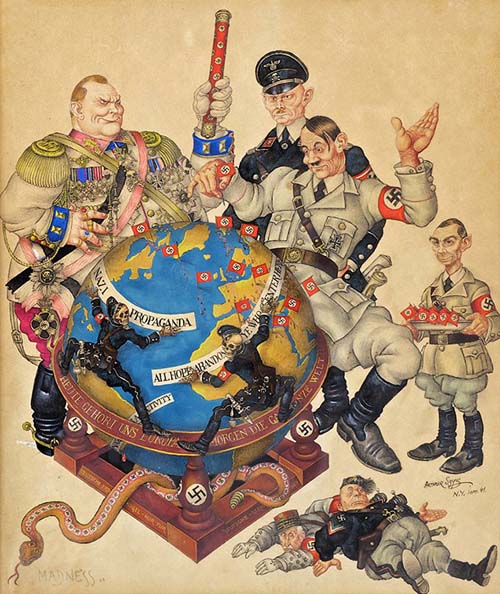
madness-thumb

Madness.
New York, September 1941.
The leaders of Germany stand possessively around a globe. Words from the Hitler Youth anthem encircle the Earth: “Today Europe hears us, tomorrow the whole world.”

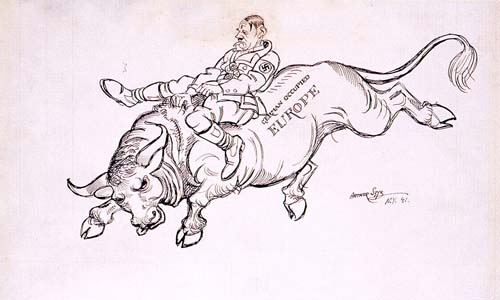
german-occupied-thumb

German Occupied Europe.
New York, 1941.
Hitler holds on tight, trying to ride the bucking bull of German-occupied Europe, which is not going down willingly.

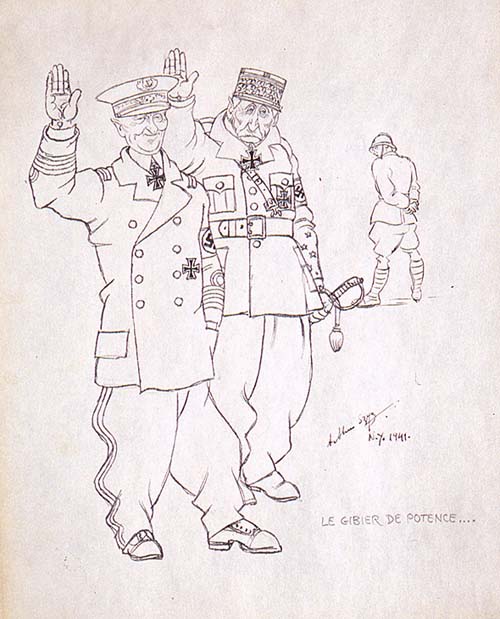
gibier-thumb

Le Gibier de Potence.
New York, July 1941.
Szyk names Nazi sympathizers Pétain (Marshal of France) — and Jean François Darlan (Minister of the French Navy) — “Le Gibier de Potence” (the gallows bird) an idiom for a person who deserves to be hanged.

greetings-russia-thumb

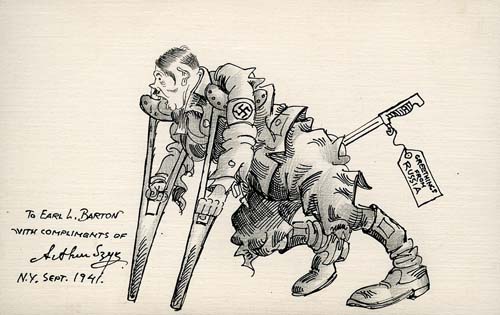
Greetings from Russia.
New York, September 1941.
Hitler staggers on crutches, in a daze. From his exposed rear end protrudes a sword with a tag reading “Greetings from Russia” — a souvenir from his encounter with the U.S.S.R.

Sword-of-Honor-thumb

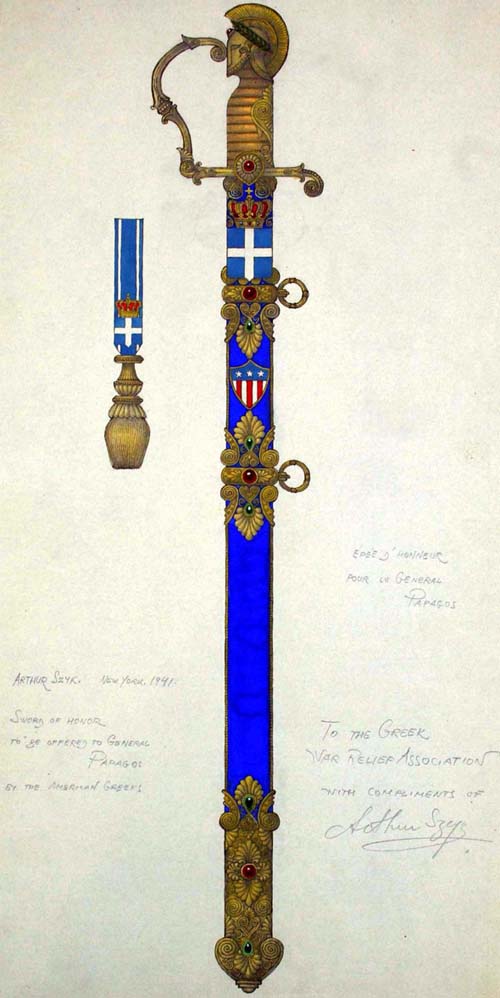
Sword of Honor.
New York, 1941.
Created to honor Greek General Alexander Papagos (1883-1955), this magnificent design is another statement by Szyk in support of Greece during World War II.

goeringo-thumb

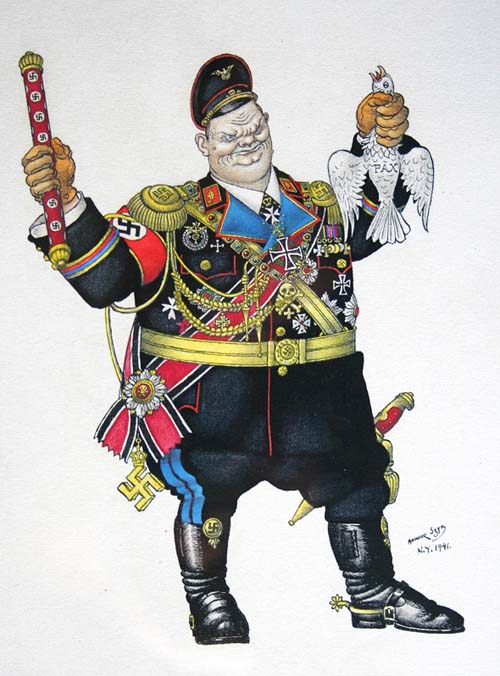
Goeringo Il Magnifico.
New York, 1941.
Göring clutches his Reichsmarshall baton in one hand and wrings the neck of the dove of peace with the other. Szyk mocks Göring’s obsession with medals by blanketing his jacket with all manner of frippery.

doolittle-thumb

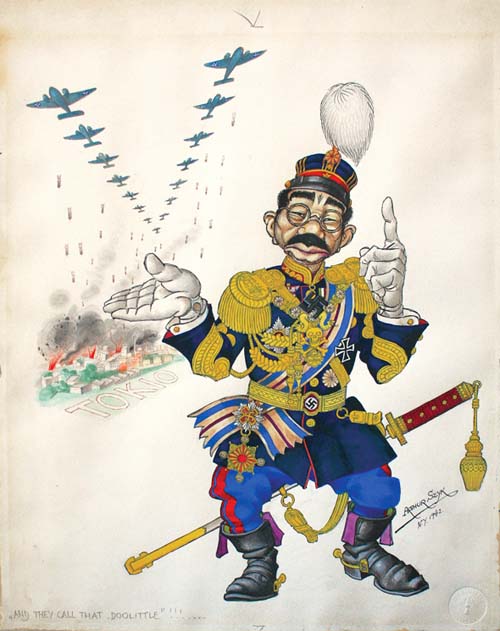
And They Call That Doolittle.
New York, 1942.
Japanese Emperor Hirohito gestures toward the American bombers as the Doolittle Raid unleashes payloads over his capital city “Tokio” [sic]. His military dress uniform bears golden swastikas and a skull and crossbones medal.

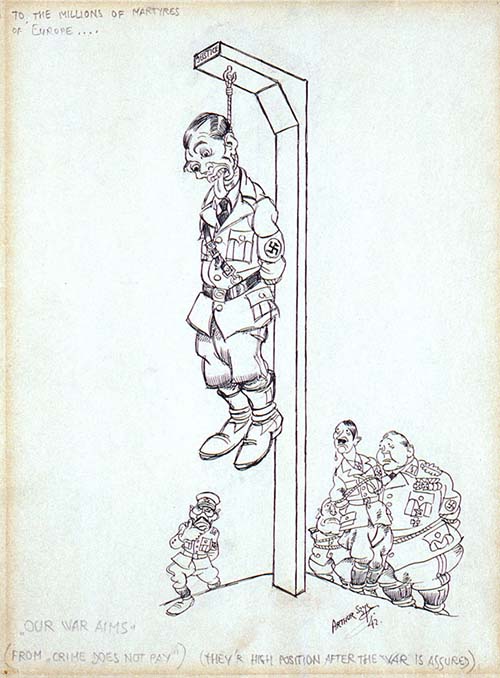
war-aims-thumb

Our War Aims.
New York, 1942.
Joseph Goebbels hangs from the tall gallows of justice as Hitler, Göring, and Mussolini stand awaiting their turn. Szyk makes it clear that the “high position” of the Axis leaders will be assured after the war.

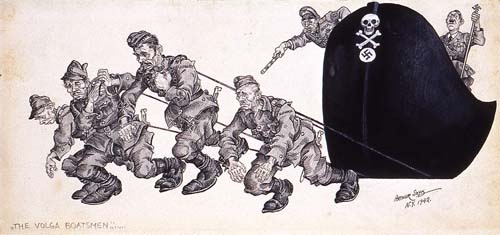
volga-thumb

The Volga Boatsmen.
New York, 1942.
Prior to the 20th century, barges heading up the Volga River required boatmen — laborers to drag the vessels against the current. Here, modern-day boatmen Finland, Romania, Hungary, and Slovakia pull along the Nazi regime, while Field Marshall Fedor von Bock screams from the prow.

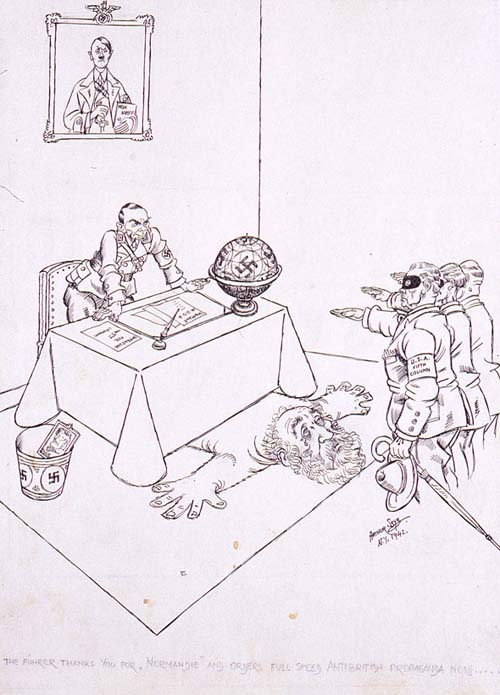
thank-you-thumb

The Führer Thanks You.
New York, 1942.
Goebbels observes three masked men saluting him. Their armbands read “U.S.A. Fifth Column” (that is, traitorous Americans pledging allegiance to Germany). A Jew — labeled “der untermensch” — is a literal rug beneath Goebbels’ desk.

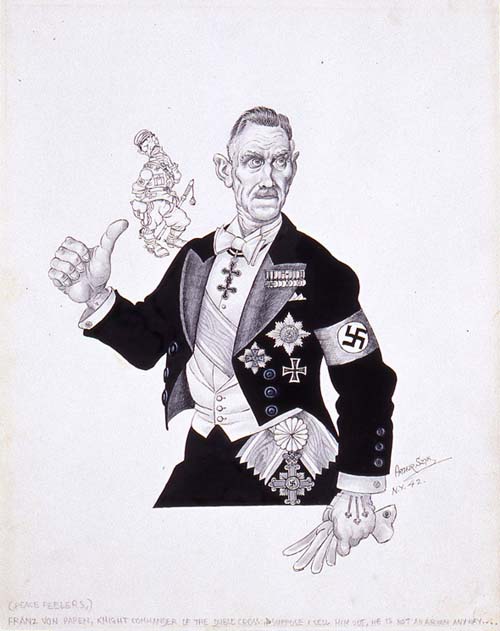
Peace-Feelers-thumb

Peace Feelers. Franz Von Papen.
New York, 1942.
Franz von Papen, former Chancellor of Germany (1932), is “Knight Commander of the Double Cross.” He gestures to the Japanese figure behind him: “Suppose I sell him out, he is not an Aryan anyway.”

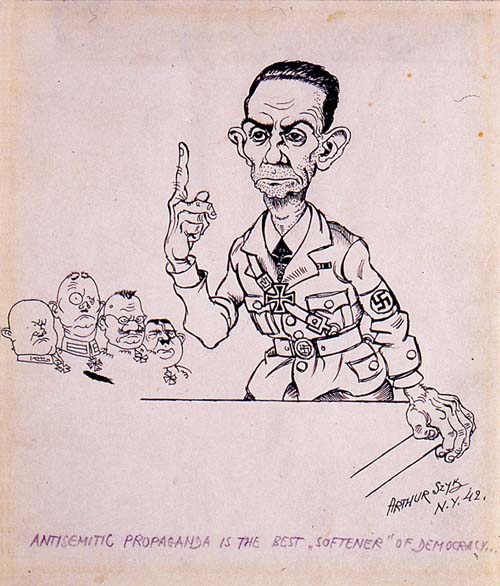
antisemitic-propaganda-thumb

Antisemitic Propaganda is the Best “Softener” of Democracy.
New York, 1942.
Goebbels addresses a group of Nazis, emphasizing that common Jew-hatred is the easiest means by which to gain support and sympathy from the German people.

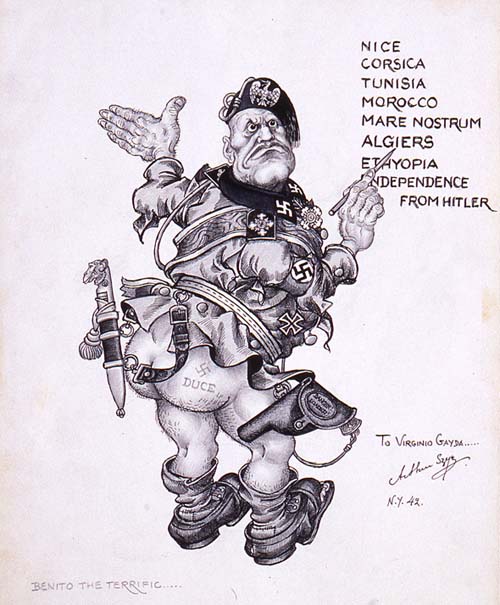
benito-the-terrific-thumb

Benito the Terrific.
New York, 1942.
A bare-bottomed Benito Mussolini — complete with a swastika tattoo — pauses in writing his wish list, which begins with Nice, Corsica, and Tunisia, and concludes with “Independence from Hitler.” His holster has a warning label: “Danger! Loaded.”

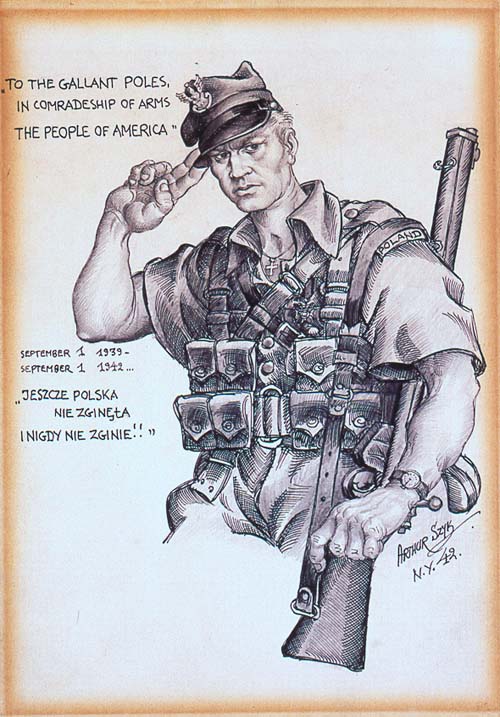
gallant-poles-thumb

To the Gallant Poles.
New York, 1942.
To the left of the saluting Polish soldier is a line from the Polish national anthem: “Jeszcze Polska Nie Zginela” followed by an additional thought from Szyk: “I Nigdy Nie Zginie!!” [Poland is not yet lost – And she will never be lost!!].

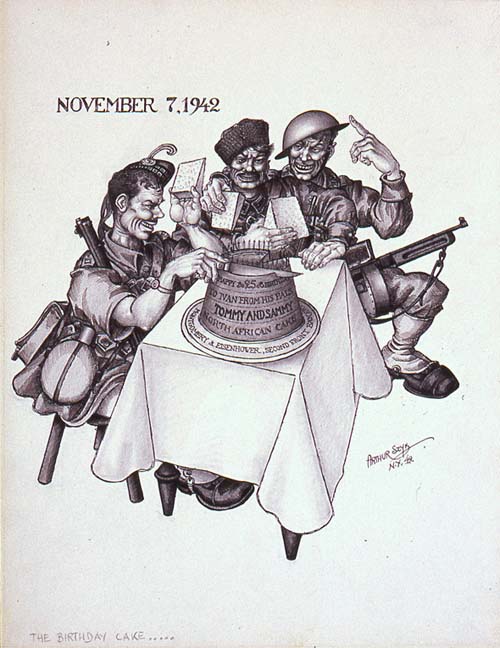
birthday-cake-thumb

The Birthday Cake.
New York, 1942.
Three soldiers (Russian, American and British) sit to eat a cake decorated with the words “Happy 25th Anniversary [of the Bolshevik Revolution] to Ivan, from his pals Tommy and Sammy…” The plate reads “Montgomery & Eisenhower, Second Front Bakery.”

costly-climbing-thumb

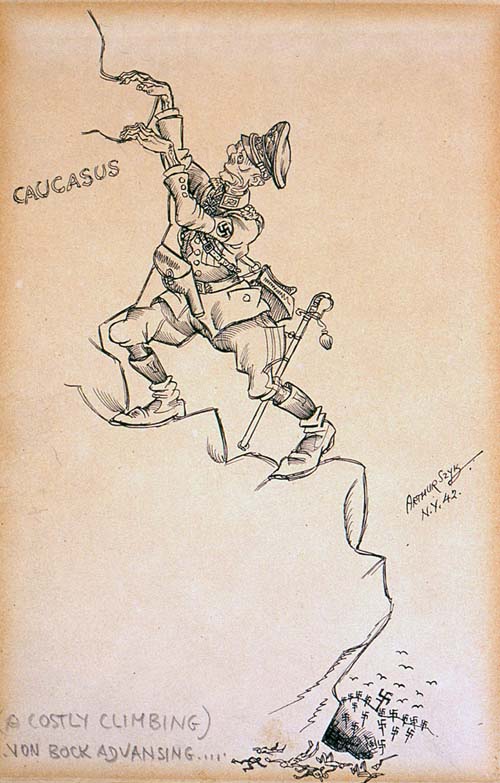
A Costly Climbing.
New York, 1942.
The Germans begin an all-out offensive against Stalingrad and attempt to capture the rich oil reserves of the Caucasus. Here Field Marshal Fedor von Bock has a difficult time, to say the least.

war-effort-thumb

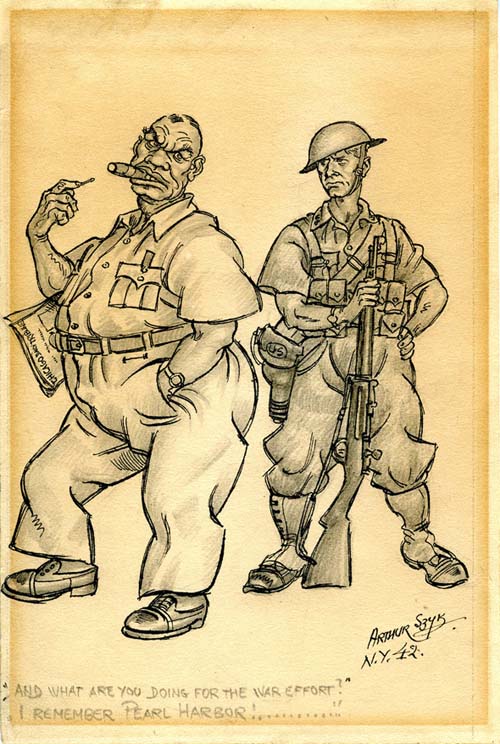
And What Are You Doing for the War Effort?
New York, 1942.
An overweight man, holding the Chicago Daily Tribune, lights a cigar and casts a sidelong glance toward an American G.I. Szyk’s caption asks, “And what are you doing for the war effort?” / “I remember Pearl Harbor!”

commandos-thumb

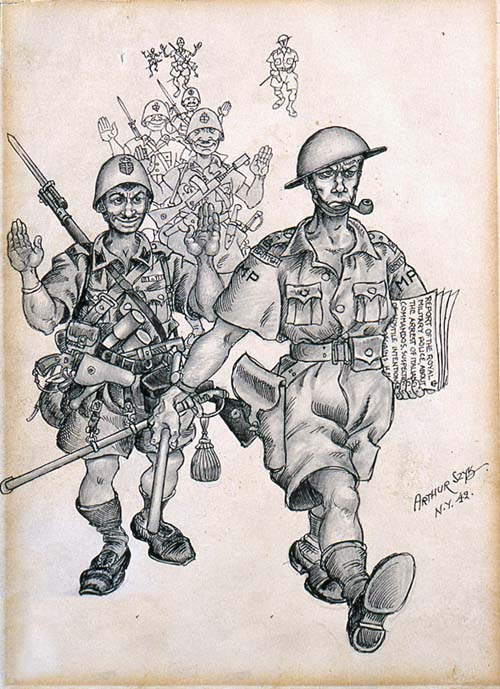
Mussolini’s Commandos.
New York, 1942.
Captured Italian soldiers smile as they march behind British military police. An English officer carries orders which read: “Report of the Royal military police about the arrest of Italian commandos suspected of hostile intentions.”

hopeless-thumb

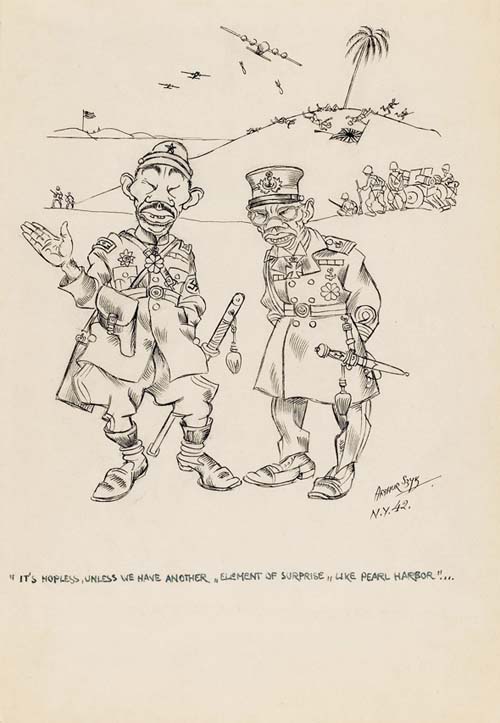
It’s Hop(e)less, Unless We Have Another “Element of Surprise” Like Pearl Harbor.
New York, 1942.
U.S. fighter planes pummel a Japanese beach with bombs. Two Japanese military commanders casually discuss the martial strategy as battle rages behind them.

schiklgruber-thumb

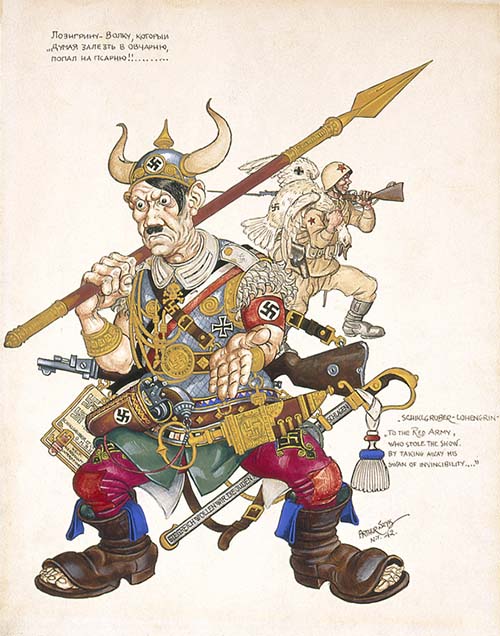
Schiklgruber-Lohengrin.
Ink & Blood.
New York, 1942.
In the medieval tale Knight of the Swan, heroic Lohengrin is empowered until he reveals his name and a swan takes him away. Adolf’s alleged name (Schiklgruber) is revealed — but a Russian has killed his swan.

sportpalast-thumb

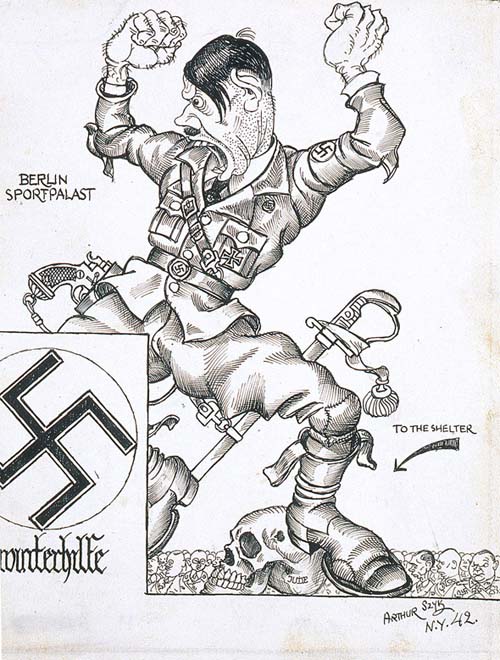
Berlin Sportpalast.
New York, 1942.
Hitler stomps on a human skull marked “Jude” before an audience that includes Hirohito, Goebbels, and Göring. (The New York Post published this work the day after Hitler’s Sportpalast speech.)

finish-the-job-thumb

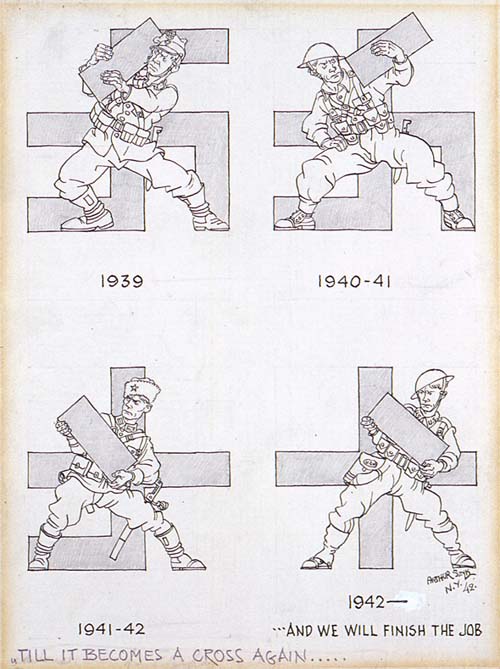
And We Will Finish the Job.
New York, 1942.
Between 1939 and 1942 Allied soldiers from France, Great Britain, Russia, and the United States dismantle a swastika, transforming it into the Christian cross.

Misunderstood-thumb

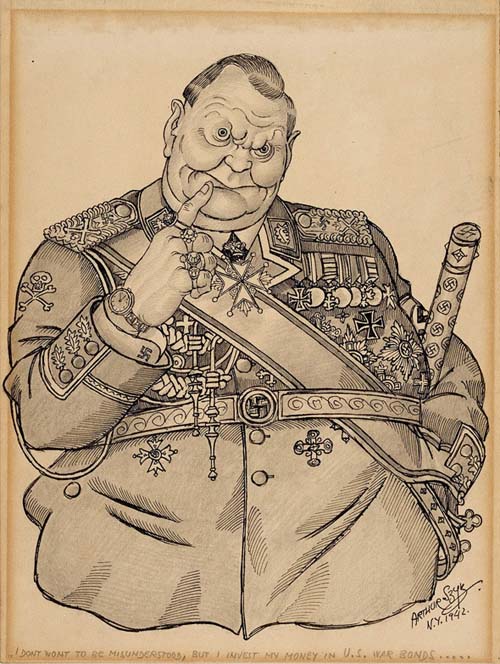
I Don’t Want to be Misunderstood…
New York, 1942.
Göring coquettishly raises a finger to his mouth. A man with expensive habits, he needs to invest where it will pay off: in U.S. War Bonds — but he hopes no one gets the wrong idea!

valhalla-thumb

Valhalla.
The Niebelungen series.
Ink & Blood.
New York, 1942.
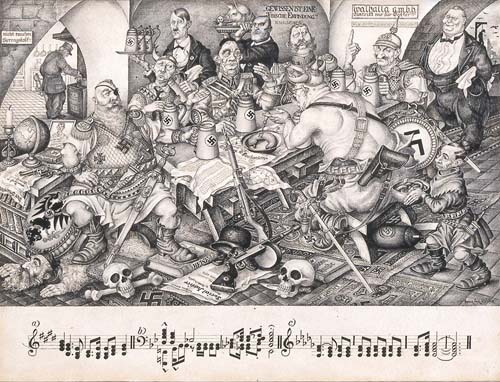
Nazi heaven is a German Bierstube with Axis leaders for waiters: Hitler carries beer, Mussolini hoists a pig head on a platter, Göring fetches napkins and Goebbels serves sausages. (General Pétain cooks alone in the kitchen.)

Valkyries-thumb

Ride of the Valkyries.
The Niebelungen series.
Ink & Blood.
New York, 1942.
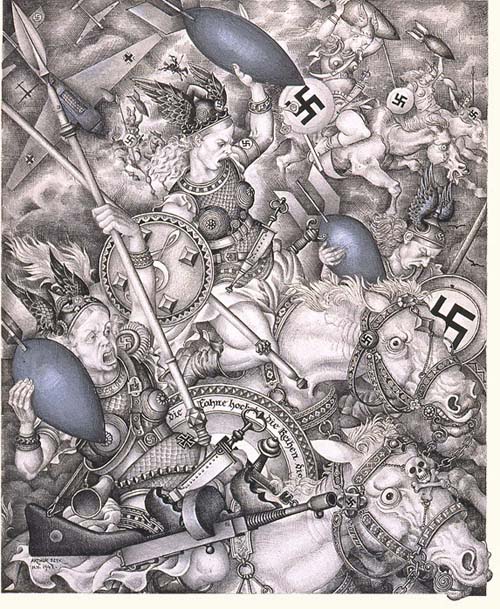
Valkyries shriek as they plunge into battle for their Führer, making sport of the importance Nazi Germans placed upon Scandinavian mythology. NY Times art critic Michael Kimmelman described this work as “more intricate than Swiss watchworks.”

Maintiendrais-thumb

Je Maintiedrais. Some Day My Prince Will Come.
New York, 1942.
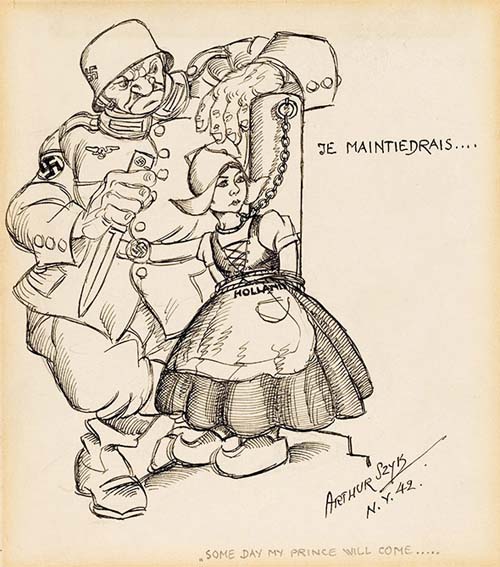
An imposing Nazi figure uses a knife to threaten a traditionally costumed Dutch girl chained to a post. She looks over her shoulder in search of a rescuer.

is-that-all-thumb

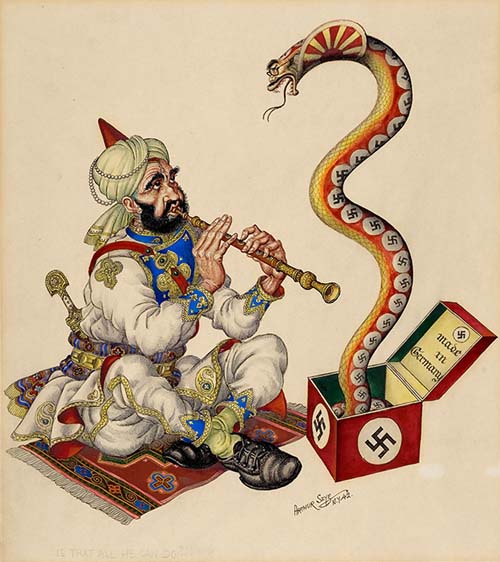
Is That All He Can Do?
New York, 1942.
A turbaned Arab plays snake charmer to a cobra. Its flared hood shows the Japanese rising sun, and its face is that of Japanese Emperor Hirohito. Its swastika-covered body emerges from a box Made in Germany.

tulagi-thumb

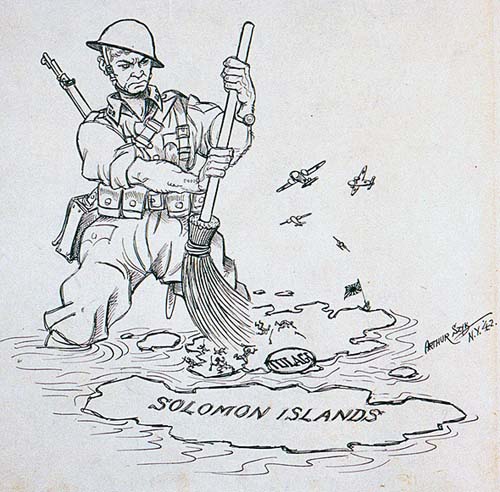
Tulagi. Solomon Islands.
New York, 1942.
An American soldier sweeps the Japanese off the Solomon Islands. In August 1942, the United States’ forces landed on Guadalcanal and two other smaller islands (Tulagi and Kisca) in the Solomon Islands of the Pacific.

french-africa-thumb

The Key to French Africa.
New York, 1942.
Hitler reclines on a pillow as he receives an audience. The Prime Minister of France, Pierre Laval, bends to kiss the ground; Pétain, Chief of the French State, extends a golden key labeled “Vichy Africa.”

jagiello-thumb

Jagiello, King of Poland.
New York, 1942.
In 1410, the Polish King and Grand Duke of Lithuania, Wladyslaw Jagiello famously led a stirring victory of Polish/Lithuanian forces over invading German armies. Szyk suggests that right must triumph over might in World War II as well.

joan-of-arc-thumb

Joan of Arc.
Ink & Blood.
New York, 1942.
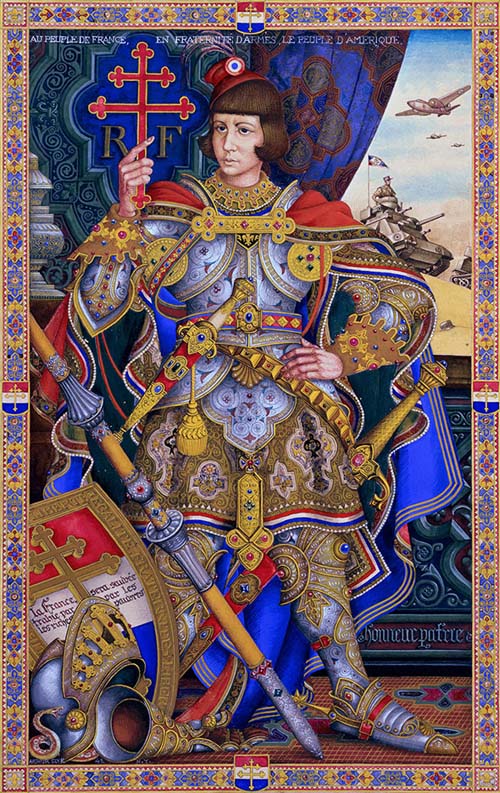
Joan of Arc stands in full armor, holding the Cross of Lorraine (the adopted symbol of the WWII French Resistance) in her right hand. Her battle shield reads (in French) “France, betrayed by the rich shall be saved by the poor.”

peter-the-great-thumb

Peter the Great.
Ink & Blood.
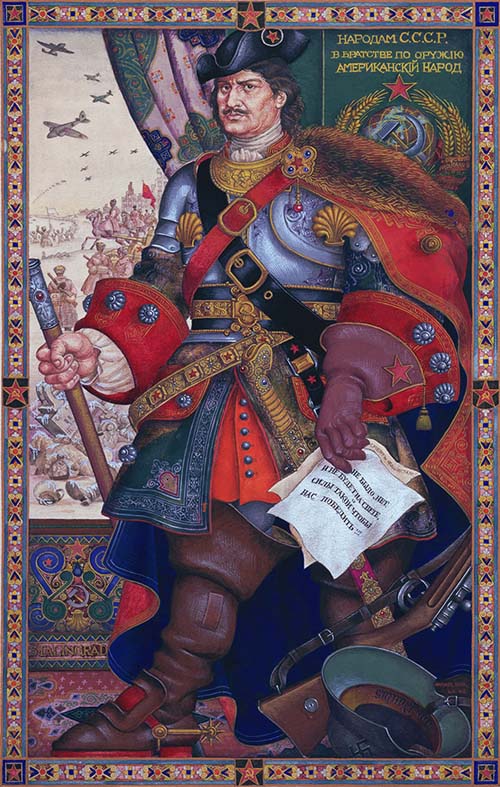
New York, 1943.
Tsar Peter grips an imperial staff and a document stating “There has not been, is not, and shall not be a force on earth that can destroy us.” The Red Star, a symbol of the new Communist regime, appears throughout the image.

hallo-rommel-thumb

Hallo, Rommel!
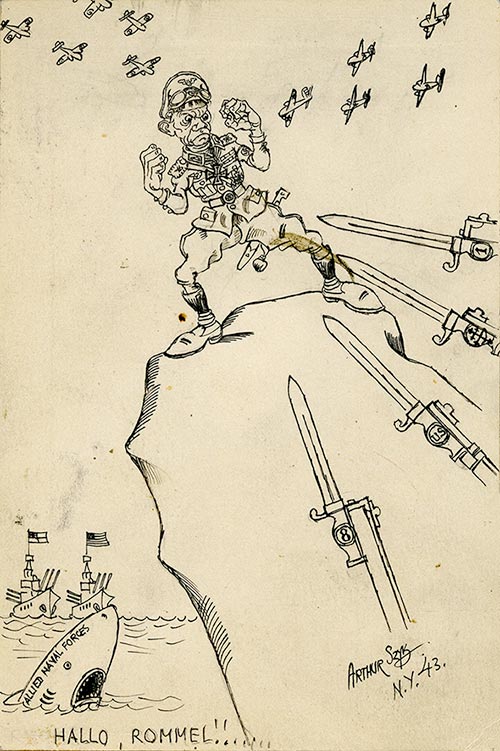
New York, 1943.
On the verge of a cliff, German field marshal Edwin Rommel raises his fists as though to fend off the Allies’ bayonets, planes, and ships which utterly surround him.

hello-thumb

Hello!…
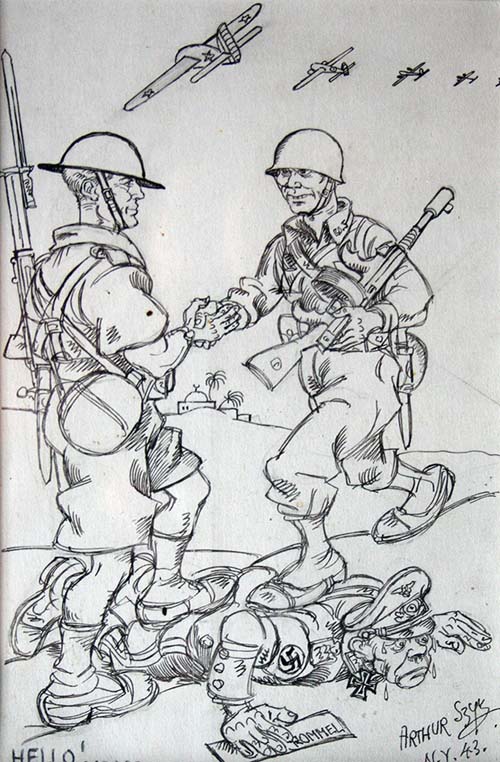
New York, 1943.
Two Allied soldiers step on a prone, sweating German soldier and shake hands as they meet in northern Africa. The fallen German holds a letter addressed to Field Marshal Rommel (aka “The Desert Fox”).

great-claus-thumb

Great Claus and Little Claus.
Andersen’s Fairy Tales.
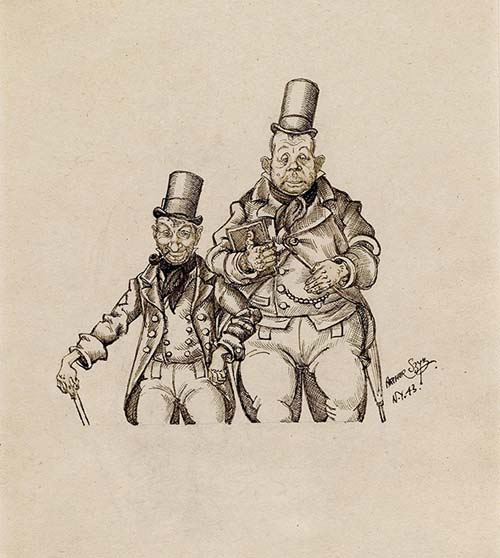
New York, 1943.
Two village farmers embark on a series of adventures with characters driven by pride, greed, wit, and luck. This is the first illustration for Andersen’s Fairy Tales that Szyk undertook, and the only one completed before 1945.

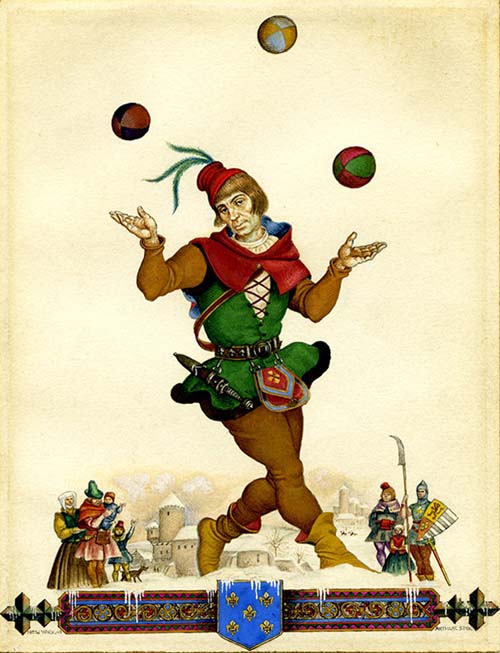
juggler-thumb

The Juggler.
New York, 1943.
In the foreground of this medieval scene, a juggler in garb of red, green, and brown lofts three parti-color balls in the air. Snow-clad castles, peasants, and a soldier stand in the background.

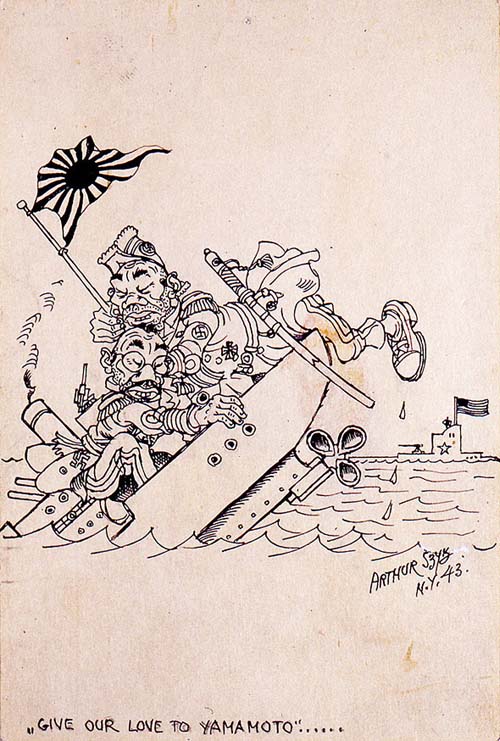
yamamoto-thumb

Give Our Love to Yamamoto.
New York, 1943.
Two Japanese naval officers cling in vain to their vessel as it sinks beneath the south Pacific waves. In the distance stands a U.S. sailor safe and sound aboard his ship.

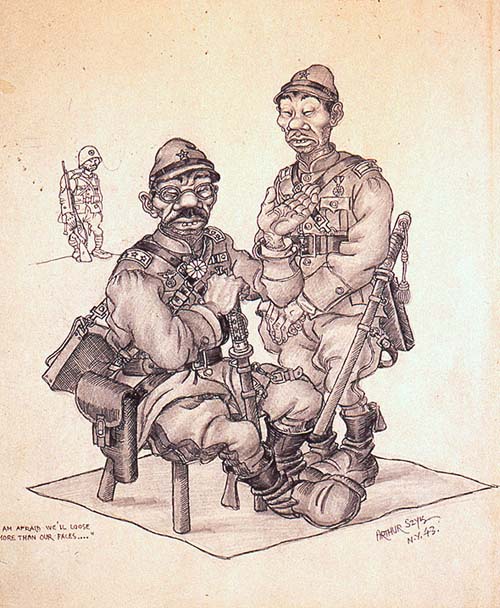
more-than-our-faces-thumb

I Am Afraid We’ll Lose More Than Our Faces.
New York, 1943.
Emperor Hirohito tells a disgruntled soldier, “I am afraid we’ll loose [sic] more than our faces.” (The Americans had won the Battle of Midway, regained Gaudalcanal and expelled the Japanese from the Solomon Islands.)

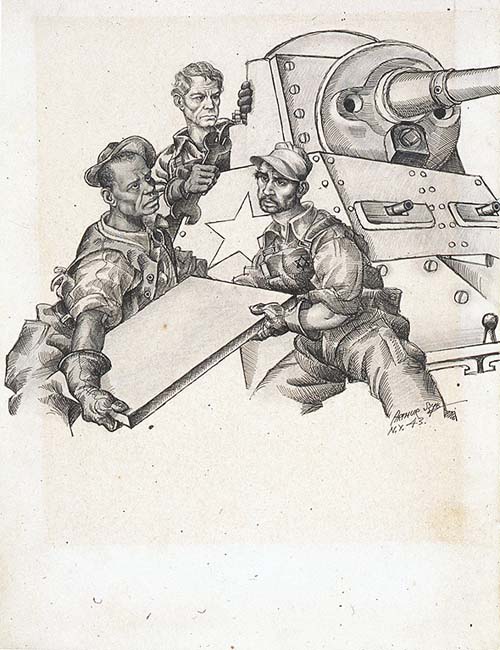
common-cause-thumb

White, Black, and Jew in Common Cause.
New York, 1943.
A black man, a white man, and a Jew work cooperatively at a time when racially segregated units pervaded the U.S. military. Szyk wished Americans to realize that discrimination should be fought at home as well as abroad.

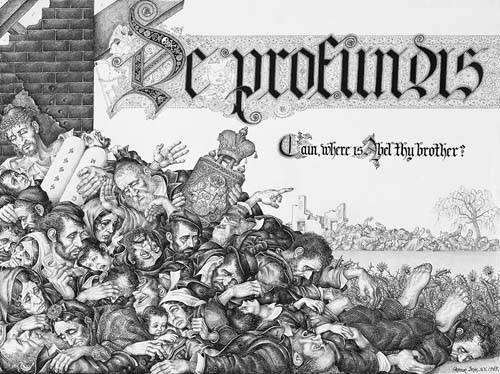
profundis-thumb

De Profundis. Cain, Where is Abel Thy Brother?
New York, 1943.
De Profundis ranks with Picasso’s Guernica and Goya’s Disasters of War as one of the greatest visual explications of the consequences of war. Men, women, and children are piled together in a mountain of dead and dying humanity, the Holocaust made visible.

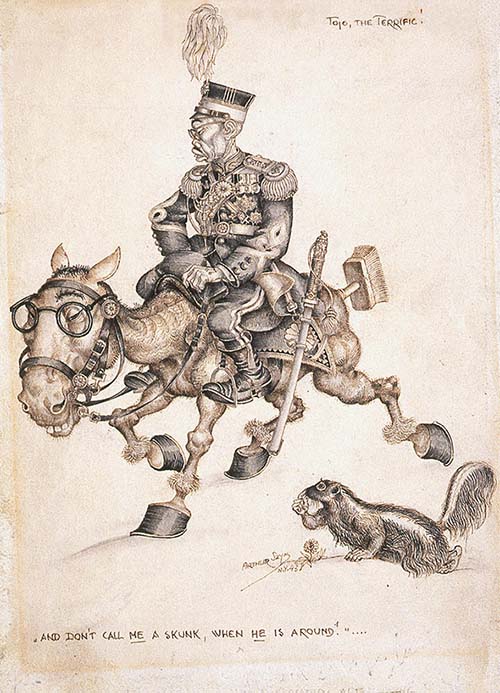
tojo-thumb

Tojo the Terrific. And Don’t Call Me a Skunk While He is Around.
New York, 1943.
Japan’s Prime Minister Hideki Tojo is drawn in pompous glory, riding a skinny nag who bears his own face. A skunk at the bottom of the drawing holds his snout, saying “And don’t call me a skunk, when he is around!”

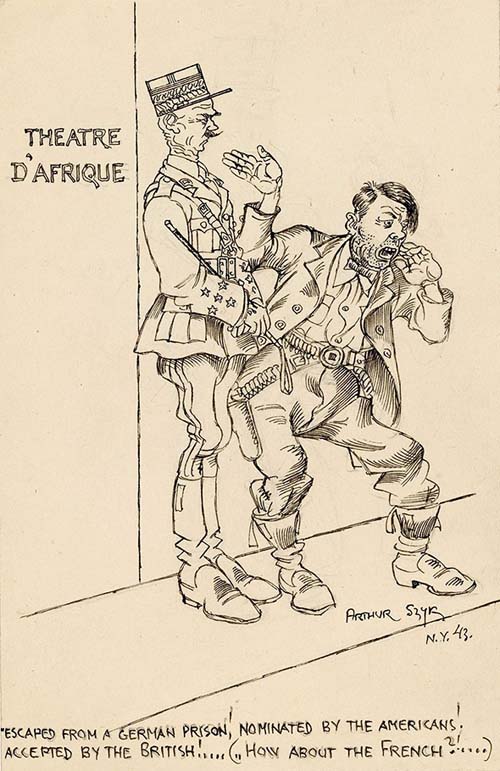
afrique-thumb

Theatre d’Afrique.
New York, 1943.
French General Henri Giraud stands (in dignified contrast) next to an unkempt roustabout. (Giraud had escaped Nazi prison and helped Allies drive Axis forces from North Africa.)

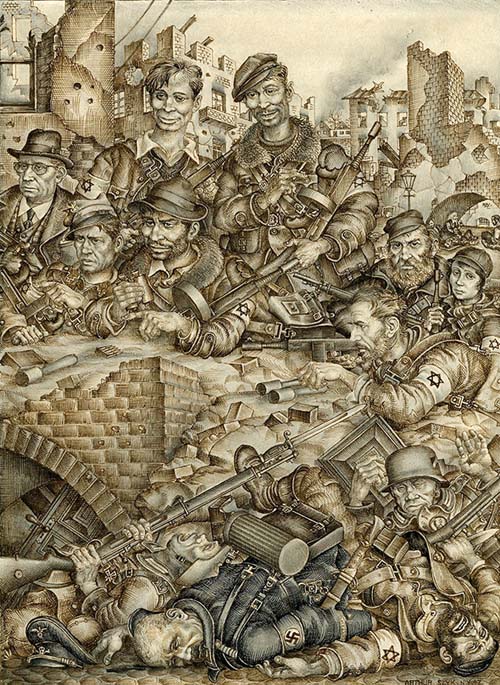
repulsed-attack-thumb

The Repulsed Attack – Battle of the Warsaw Ghetto.
New York, 1943.
Created in honor of the victims and survivors of the Warsaw Ghetto’s heroic resistance, The Repulsed Attack shows Szyk’s ideals in action: the Jewish people fight heroically for their dignity, despite being outnumbered and underarmed.

dangerous-enemies-thumb

To be Shot as Dangerous Enemies of the Third Reich.
Ink & Blood.
New York, 1943.
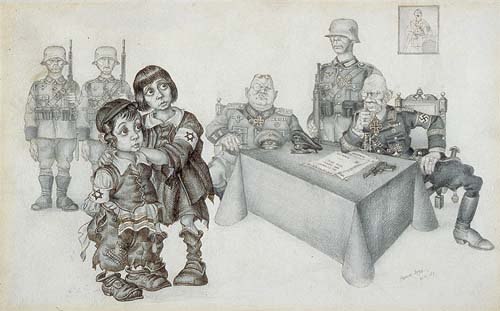
Two Jewish children stand before a Nazi tribunal in one of Szyk’s most widely circulated Holocaust images. Beside Heinrich Himmler, the head of the Gestapo, is a broadside which reads (in German): “The Eastern region must be cleansed of the Jews.”

short-of-jews-thumb

We’re Running Short of Jews.
Ink & Blood.
New York, 1943.
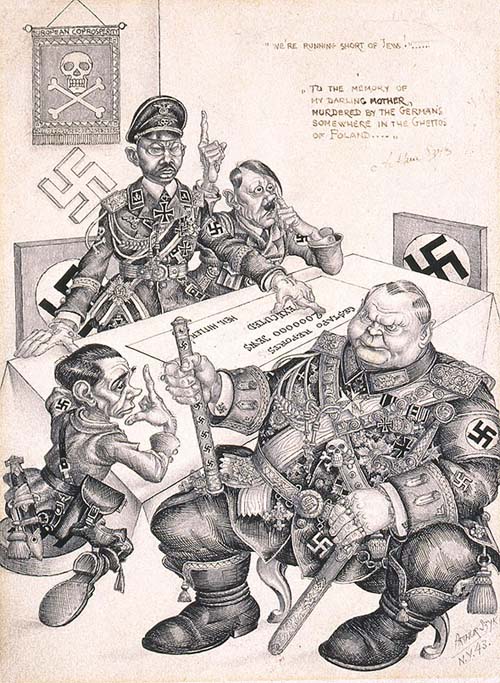
Hitler, Göring, Goebbels, and Himmler gather around a table upon which is imprinted “Gestapo reports 2,000,000 Jews executed. Heil Hitler.” This is Szyk’s most personal Holocaust work, as that staggering number includes Szyk’s own mother.

afrika-corpse-thumb

Afrika Corpse.
New York, 1943.
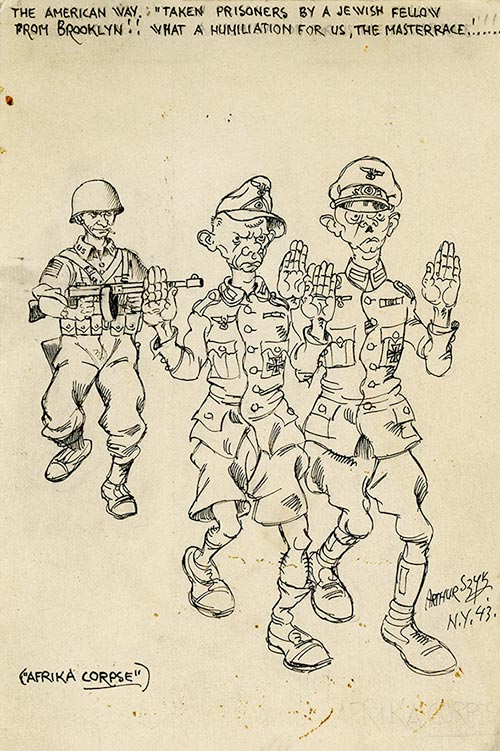
Two German soldiers of the Afrika Korps – the German expeditionary force in Africa during World War II – are captured by a Jewish American. Szyk’s deliberate choice of “Afrika Corpse” to title this illustration likely references the defeat of the Afrika Korps in May 1943.

nazi-chivalry-thumb

Nazi Chivalry.
New York, 1943.
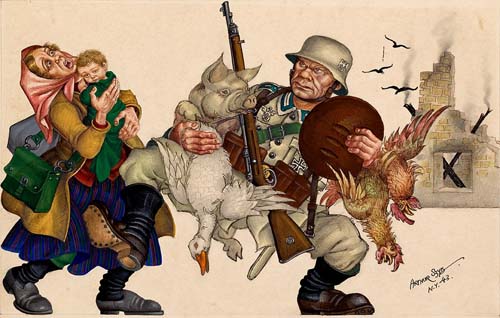
A German soldier brutally kicks a Polish peasant while he makes off with her livestock: two roosters, a pig, and a goose. He leaves the family to starve in the smoldering ruins of their homestead.

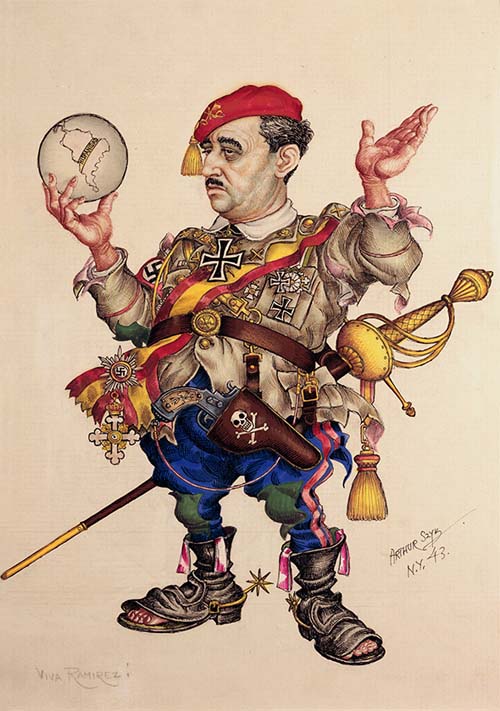
hispanidad-thumb

Hispanidad – Viva Ramirez Franco.
New York, 1943.
A provocative full-length portrait of Generalissimo Francisco Franco, who holds a globe showing South America (the region is labeled “Hispanidad”). Though plainly a satire, Szyk is rather even-handed with Franco; there are no exaggerated grotesqueries.

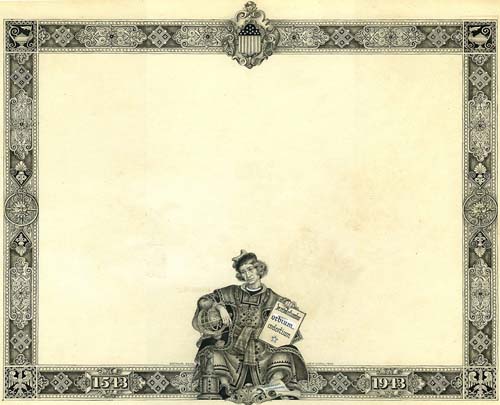
de-rev-thumb

De Revolutionibus Orbium Coelestium, 1543-1943.
New York, 1943.
This border commemorates the 400-year anniversary of the publication of Copernicus’ landmark book De Revolutionibus Orbium Coelestium. This great Polish astronomer — whose heliocentric model of the universe marked the beginning of modern astronomy — holds his famed book and a globe.

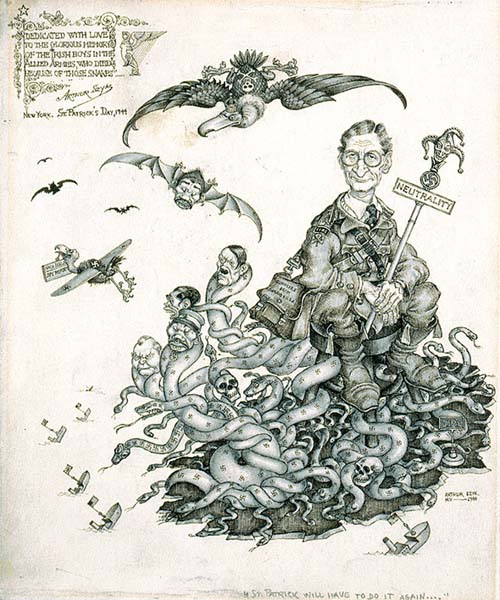
saint-patrick-thumb

Saint Patrick Will Have to Do It Again.
Ink & Blood.
New York, 1944.
Atop a writhing snake pile sits Eamon De Valera, Prime Minister of Ireland. Despite Ireland’s “neutrality” in WWII, Szyk salutes “the glorious memory of the Irish boys in the Allied armies who died because of those snakes.”

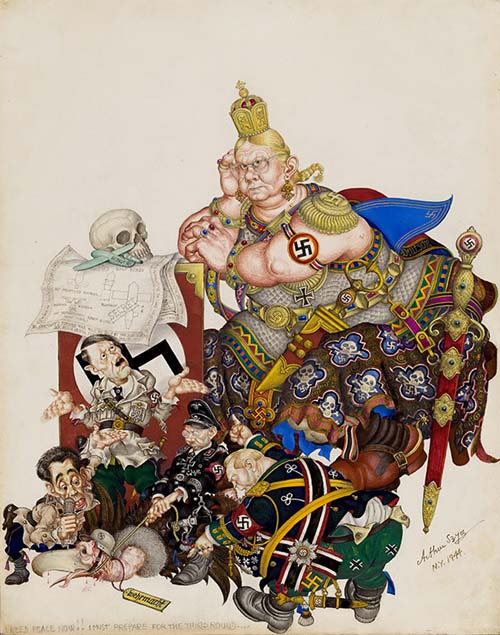
peace-now-thumb

I Need Peace Now!! I Must Prepare for the Third Round.
Ink & Blood.
New York, 1944.
Hitler frowns worriedly at the obese figure of Germania. Göring and Himmler assault the exhausted and teary-eyed vulture (the German Army) while Goebbels (the Minister of Propaganda) leans in with his microphone.

dybbuk-devil-thumb

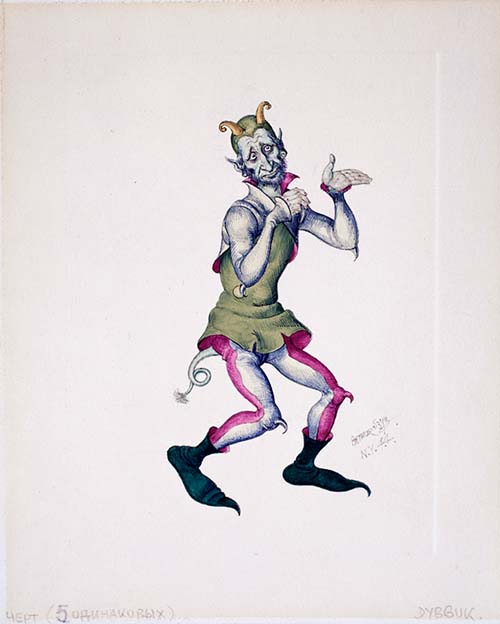
Devil.
Dybbuk series.
New York, 1944.
This image of a green devilish demon was created for a production of the Dybbuk, a play proposed by Leonard Bernstein. The demon is dressed rather like a jester.

dybbuk-angel-thumb

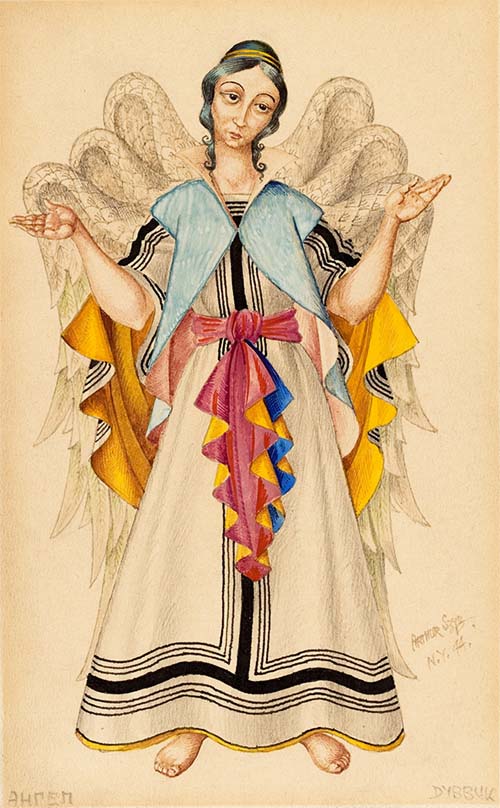
Angel.
Dybbuk series.
New York, 1944.
This contemplative image of an angelic personage — multi-layered wings, biblical robes, serene expression — was created for a production of the Dybbuk, proposed by Leonard Bernstein.

umbrella-lady-thumb

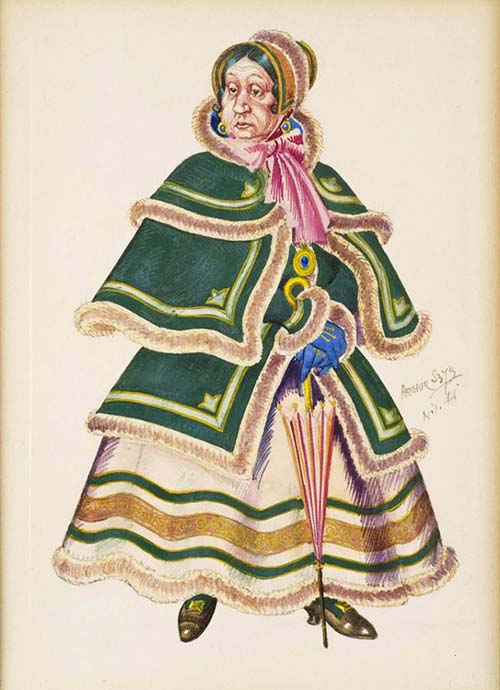
Lady with Umbrella.
Dybbuk series.
New York, 1944.
A middle-aged woman of high status conveys a somewhat haughty expression. In her color-coordinated outfit she is prepared for the winter’s chill, all the way down to a striped umbrella.

radio-commentator-thumb

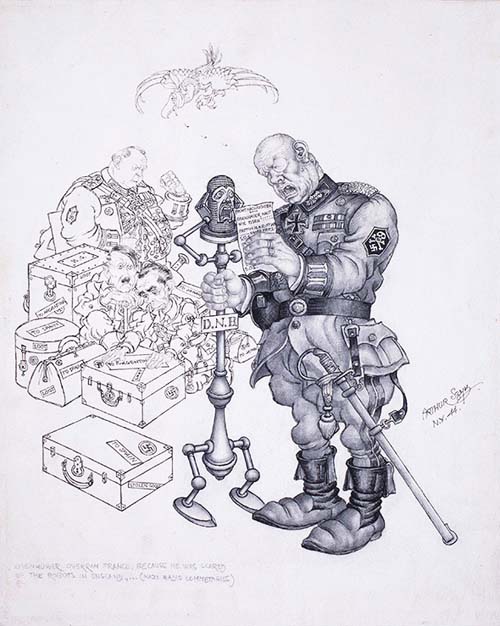
Nazi Radio Commentator. [Eisenhower Overran France.]
Ink & Blood.
New York, 1944.
Hitler, Goebbels, and Göring address packages of loot and stolen goods for shipment to Japan, Argentina, and Spain while a radio announcer brays into a microphone skewed messages of the Allies’ advances.

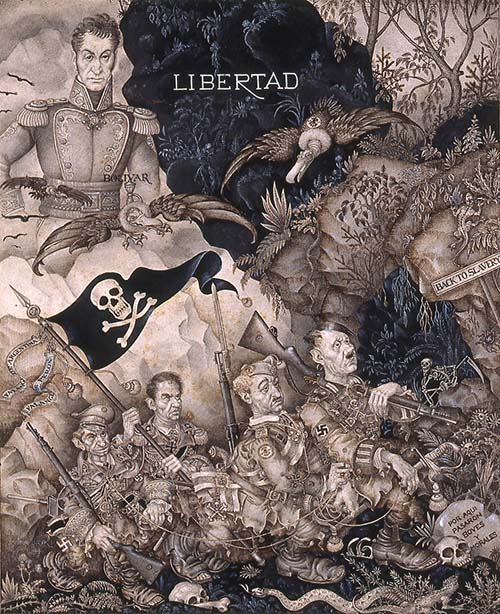
libertad-thumb

Libertad. Liberating the Oppressed, or Oppressing the Liberated?
Ink & Blood.
New York, 1944.
Hitler, Franco, and Argentinian politicians Ramírez and Perón travel a pathway toward slavery. Simón Bolívar, Liberator of South America, gazes sternly from the clouds as they cross a terrain strewn with signs of death and decrepitude.

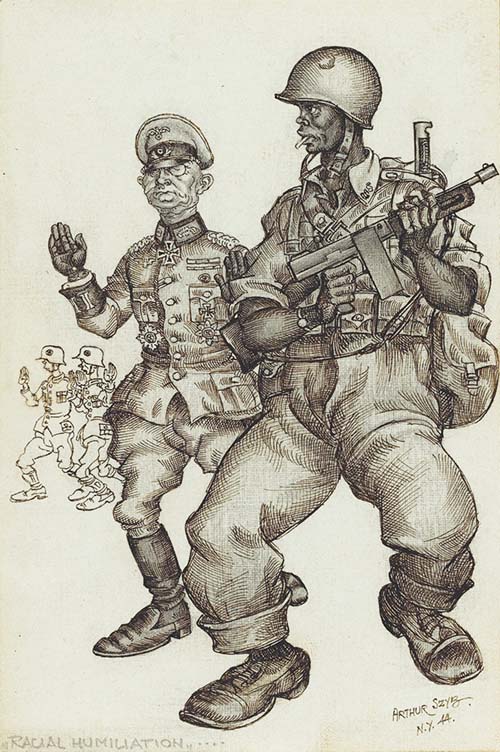
humiliation-thumb

Racial Humiliation.
Ink & Blood.
New York, 1944.
A Nazi officer’s worst nightmare is realized: being captured by a black American soldier.

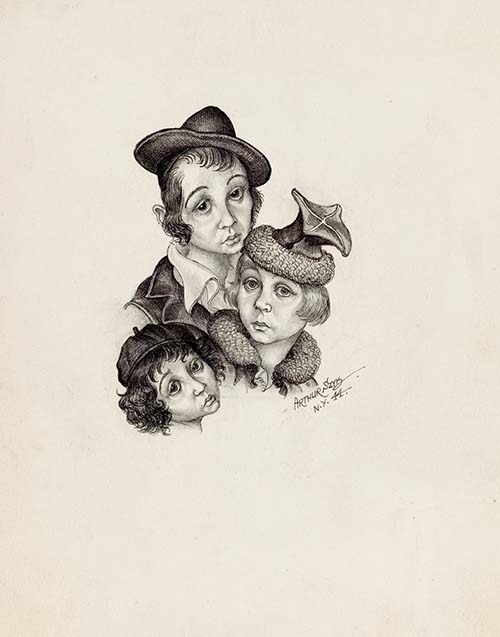
3-children-thumb

Three Jewish Children.
New York, 1944.
Soft, innocent, and fragile, these three Jewish children show a profound weariness that belies their well-to-do appearance.

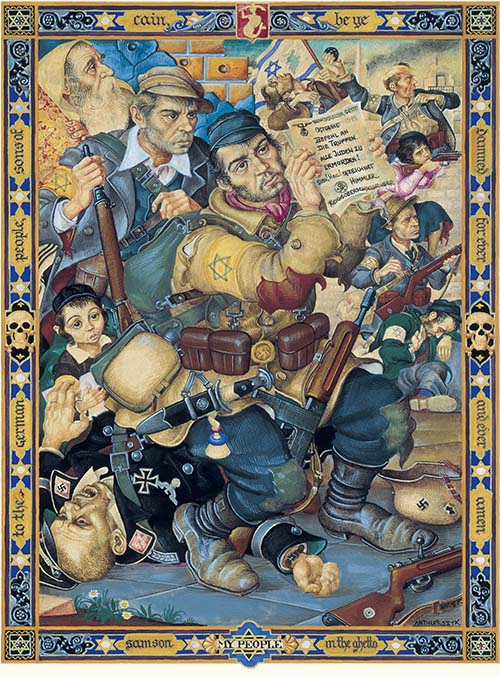
samson-ghetto-thumb

Samson in the Ghetto. The Battle of the Warsaw Ghetto.
Ink & Blood.
New York, 1945.
A Warsaw Ghetto resistance fighter holds a broadside ordering the assassination of all Jews. In the border Szyk’s sentiment toward the Nazis is unambiguous: “To the German people, sons of Cain, be ye damned forever and ever, amen.”

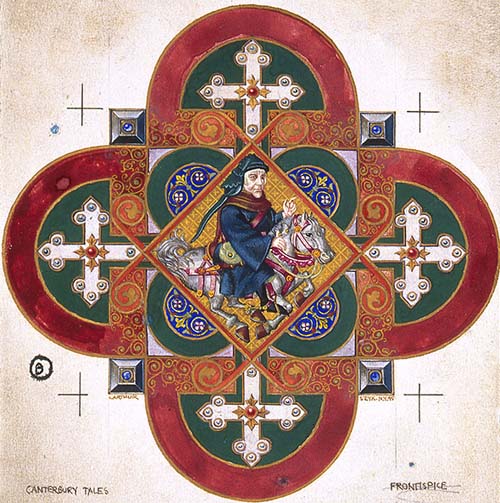
Chaucer-thumb

Chaucer.
The Canterbury Tales.
New York, 1945.
Featured on both the cover of The Canterbury Tales volume and its accompanying slipcase, this representation of Geoffrey Chaucer sits astride a gaily caparisoned white horse.

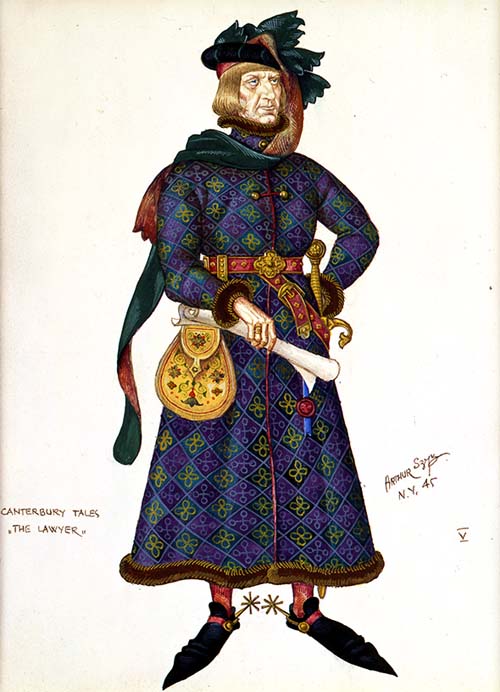
lawyer-thumb

The Lawyer.
The Canterbury Tales.
New York, 1945.
The Lawyer appears quite prosperous in a harlequin-patterned robe with a sword and decorated pouch at his sides. Evidencing he can afford a horse, he wears spurs on his shoes.

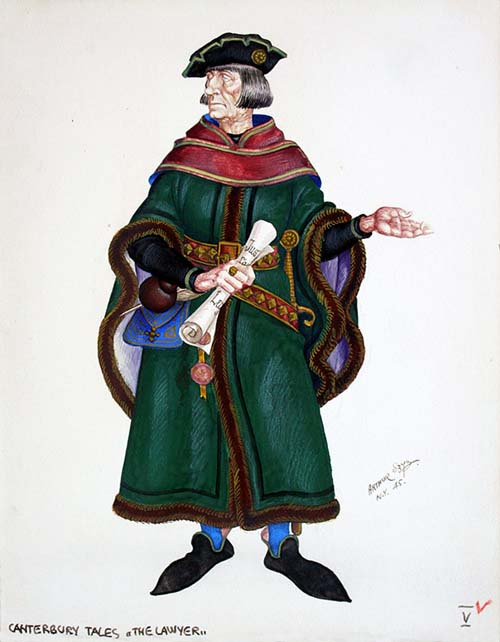
lawyer-variant-thumb

The Lawyer [variant].
The Canterbury Tales.
New York, 1945.
This version of The Lawyer wears a sumptuous fur-trimmed robe. He stands with a rolled writ in one hand and a sword on his belt.

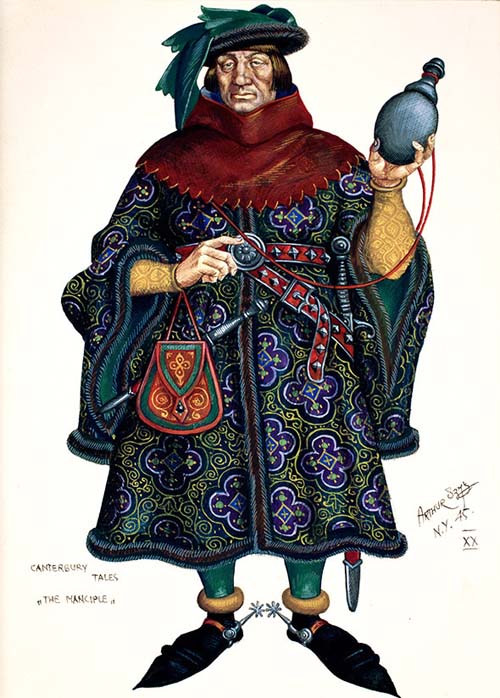
manciple-thumb

The Manciple.
The Canterbury Tales.
New York, 1945.
In charge of buying provisions for an inn, the Manciple is well-dressed in a short robe and cowl. Though he holds a flask, his stern face and the multiple weapons on his belt exude a guarded demeanor.

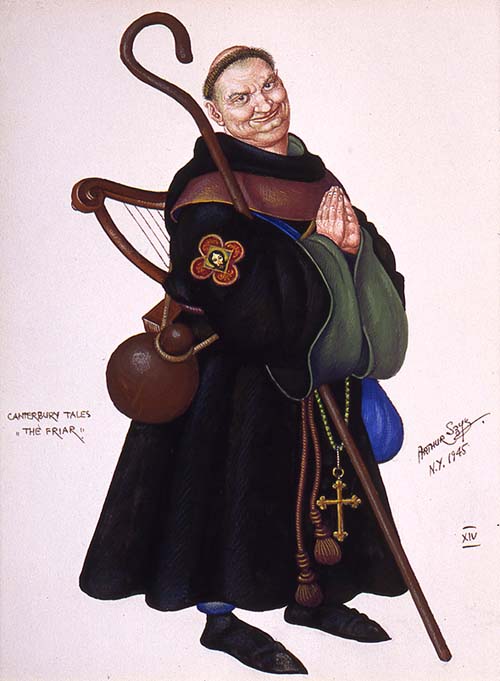
friar-thumb

The Friar.
The Canterbury Tales.
New York, 1945.
With an impish grin and a harp on his back, this is a merry Friar indeed!

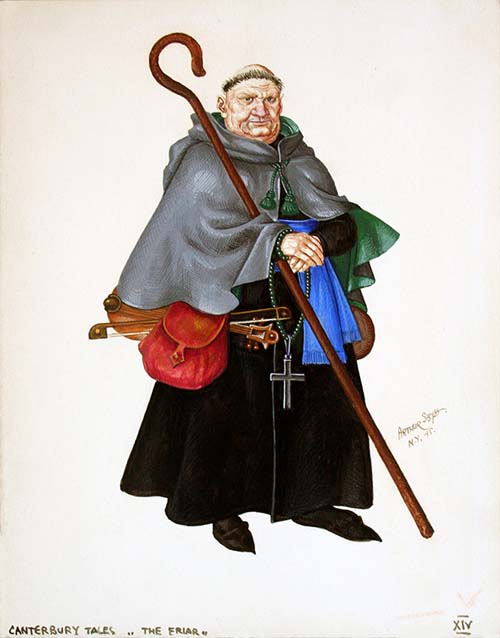
friar-variant-thumb

The Friar [Variant].
The Canterbury Tales.
New York, 1945.
The Friar’s round face wears an open expression, and together with the violin and bow peeking out from under his cape, his demeanor is one of being safe and approachable.

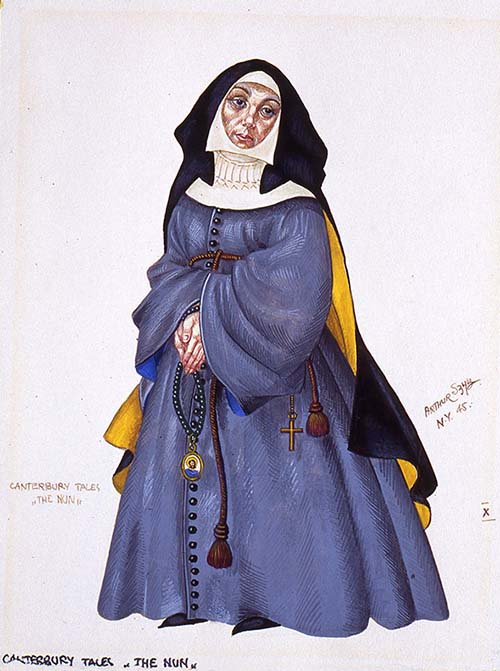
second-nun-thumb

The Second Nun.
The Canterbury Tales.
New York, 1945.
She conveys piety and contentment, her folded hands holding a rosary from which a miniature portrait of Jesus is suspended.

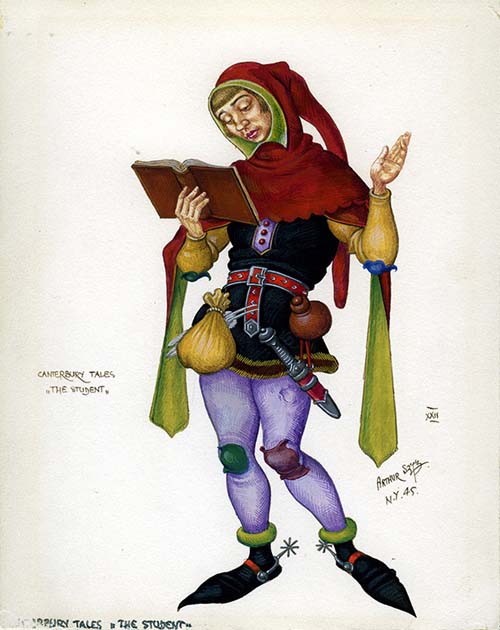
student-thumb

The Student.
The Canterbury Tales.
New York, 1945.
The Student stands in a posture of oration. The multi-colored patches on his clothes and his red and green hooded cowl lend a cheerful air to his modest appearance.

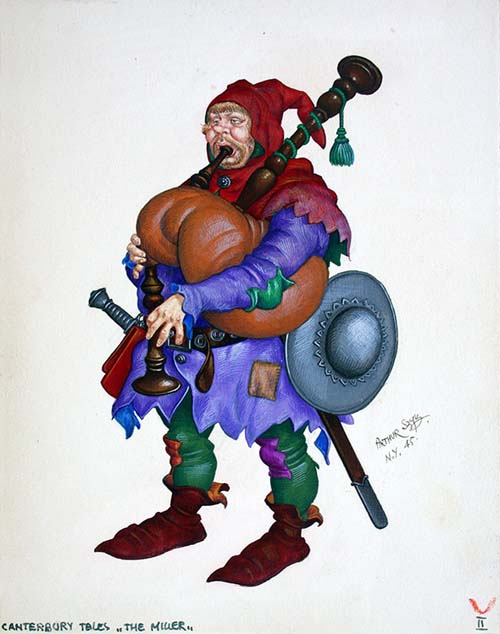
miller-thumb

The Miller.
The Canterbury Tales.
New York, 1945.
The colorfully-clothed Miller plays a great set of bagpipes, sword and buckler by his side.

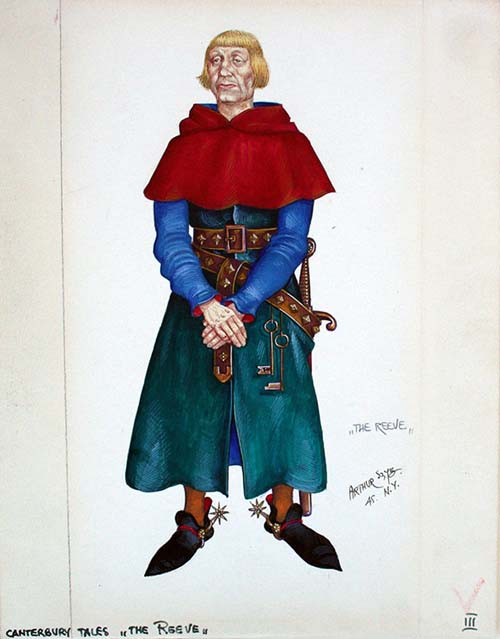
reeve-thumb

The Reeve.
The Canterbury Tales.
New York, 1945.
Somber and somewhat haughty, the keys hanging on his belt convey the Reeve’s elevated social status.

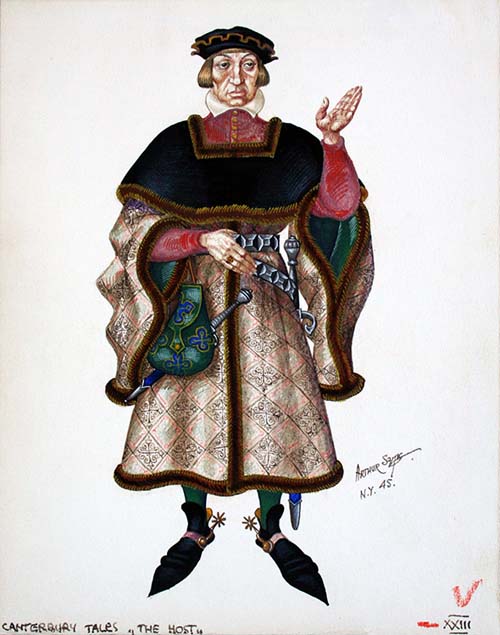
host-thumb

The Host.
The Canterbury Tales.
New York, 1945.
The richly-dressed Host stands comfortably with a thumb tucked in his belt, and a hand raised in salutation.

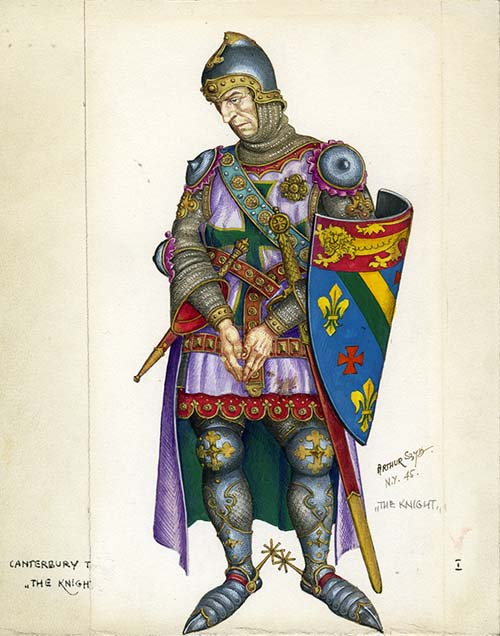
knight-thumb

The Knight.
The Canterbury Tales.
New York, 1945.
The Knight’s humble posture balances with his ornate armor and splendid multi-colored clothing to create the image of a just and prudent soldier.

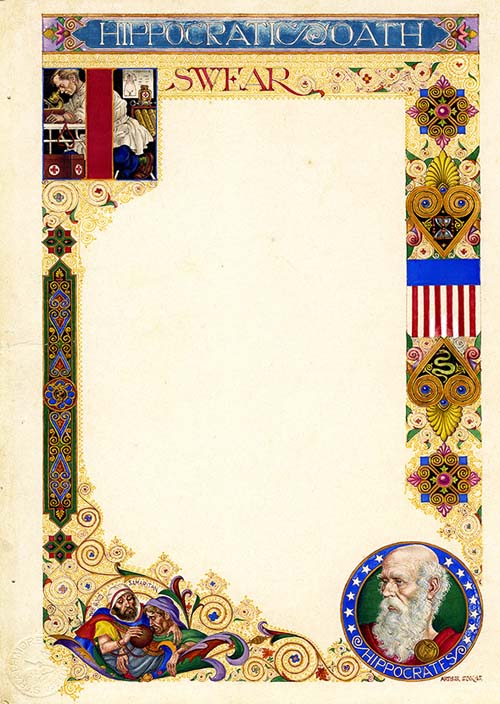
hippocratic-oath-thumb

The Hippocratic Oath.
New Canaan, 1945.
This elaborate and illuminated border features a portrait of Hippocrates, a doctor peering into a microscope, and a reference to the Good Samaritan.

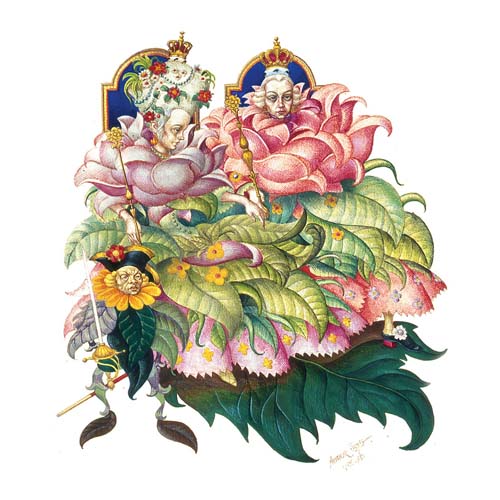
king-queen-roses-thumb

King and Queen of Roses.
Andersen’s Fairy Tales.
New York, 1945.
The resplendent king and queen are encircled by curling green leaves and an abundance of rosy-hued petals. This was the featured image for the Palace of the Legion of Honor’s 2011 Szyk exhibition.

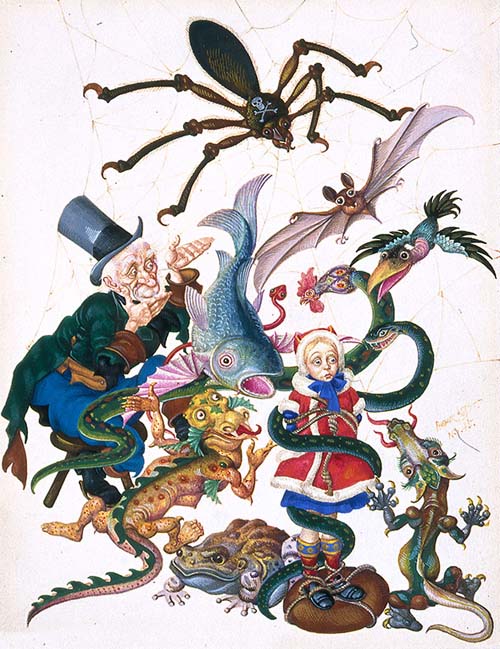
girl-who-trod-thumb

The Girl Who Trod on a Loaf.
Andersen’s Fairy Tales.
New York, 1945.
In Szyk’s hauntingly memorable image in Andersen’s Fairy Tales, a seemingly sweet girl has caught the attention of several frightening creatures.

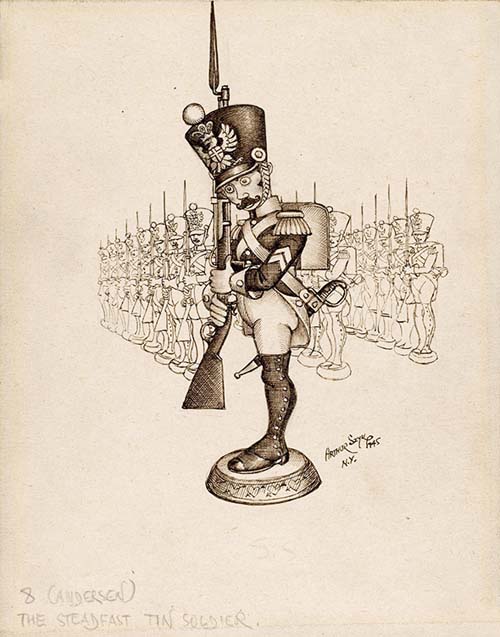
tin-soldier-thumb

The Steadfast Tin Soldier.
Andersen’s Fairy Tales.
New York, 1945.
This stalwart one-legged soldier is all heart. He stands with all the strength and pride of his companions despite his single leg. (He wears the military uniform of a Napoleonic infantryman.)

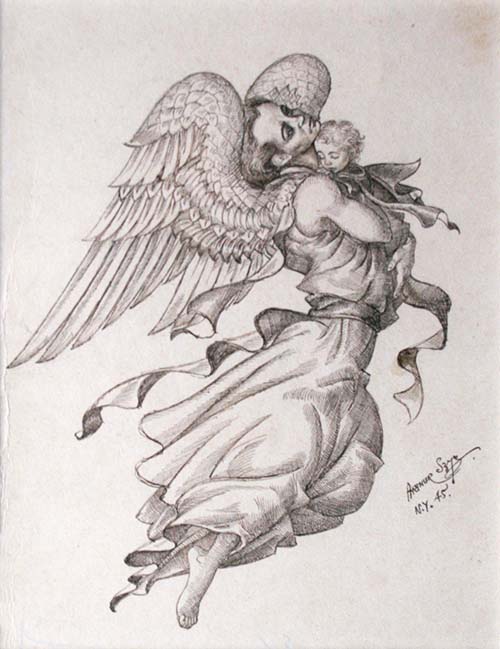
angel-andersens-thumb

The Angel.
Andersen’s Fairy Tales.
New Canaan, 1945.
On their way to heaven, a sleeping baby tucks his head into the crook of an angel’s neck.

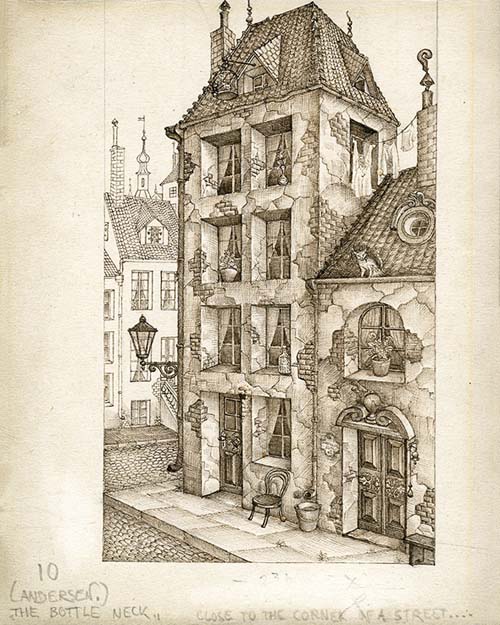
bottleneck-thumb

The Bottle Neck, Close to the Corner of a Street.
Andersen’s Fairy Tales.
New York, 1945.
The neck of a discarded bottle serves as a water vessel for a small bird living outside an attic window. A door plaque with a Star of David and “Arthur Szyk 45” show that the illustrator lives next door!

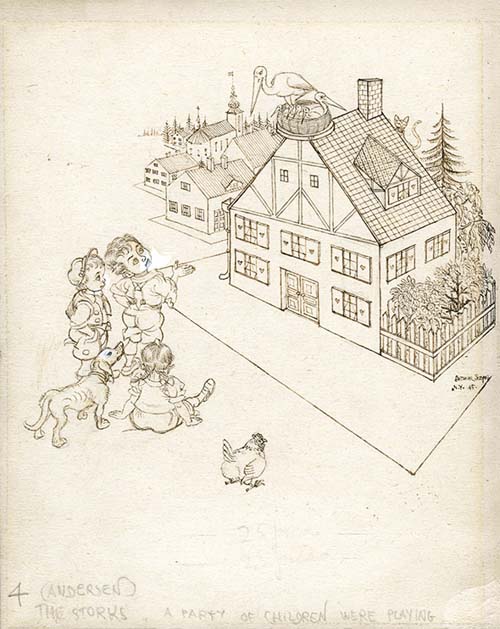
storks-thumb

The Storks, A Party of Children Were Playing.
Andersen’s Fairy Tales.
New York, 1945.
The parent storks on the roof give a stern look to the boy who gestures from the ground. His taunts will not be forgotten after the baby storks grow up!
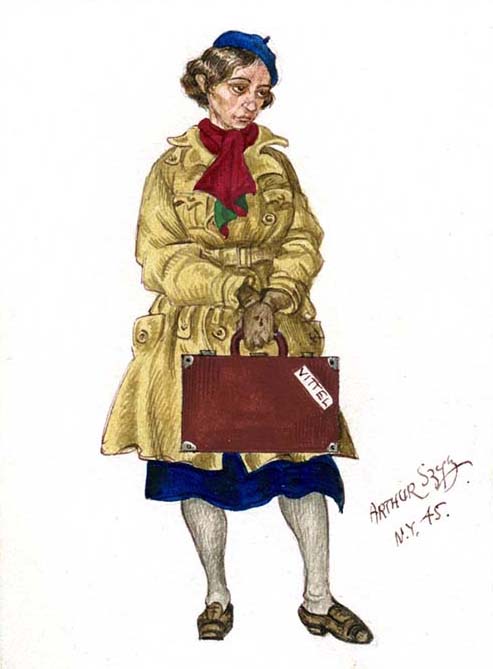
Bella Reine thumb

Bella Reine Costume Designs.
New York, 1945.
Three colorful costume designs for the celebrated Lithuanian-Russian dancer and theatrical performer Bella Reine.
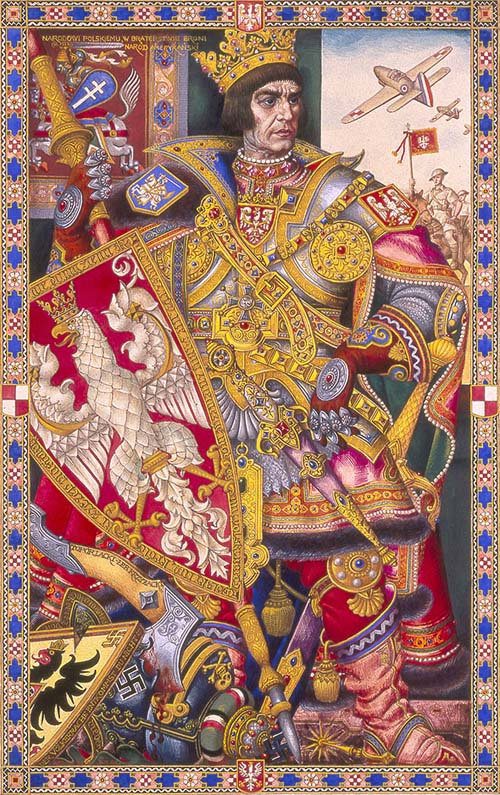
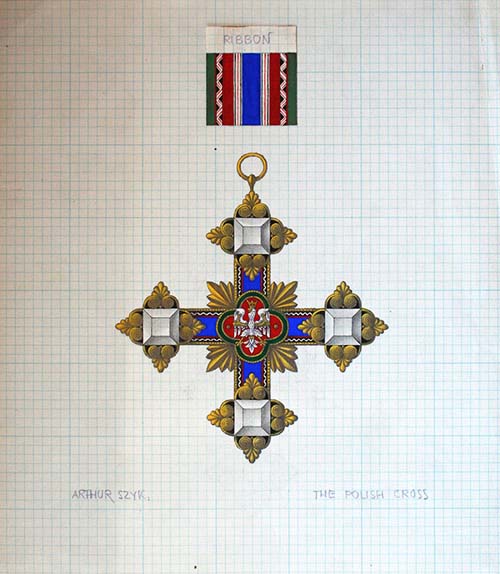
polish-cross-thumb

The Polish Cross.
New York, 1945.
A Greek-style cross with equilateral arms holds in its center the crowned Polish eagle.

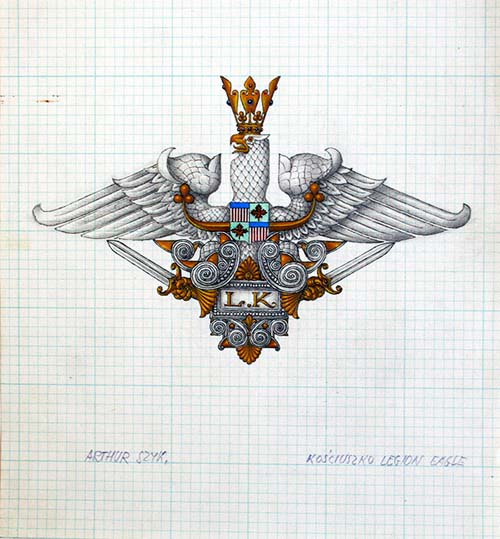
legion-eagle-thumb

The Kosciuszko Legion Eagle.
New York, 1945.
The Kosciuszko Legion began as a Polish squadron, with outposts created later in the U.S. and Canada. The eagle clutches two double-bladed swords and sports the symbols of both the U.S. and Canada on his chest.

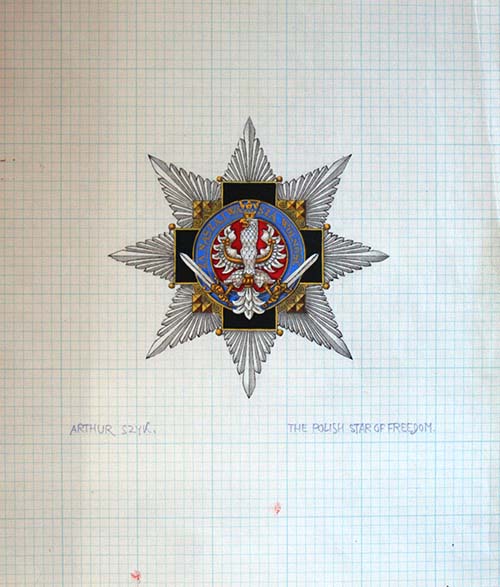
star-of-freedom-thumb

Polish Star of Freedom.
New York, 1945.
In the center of a multi-beveled eight-pointed star, a crowned Polish eagle grasps a sword in each claw. A blue circle with gold letters reads, “Za Nasza I Wasza Wolnosc” — “for your and our freedom.”

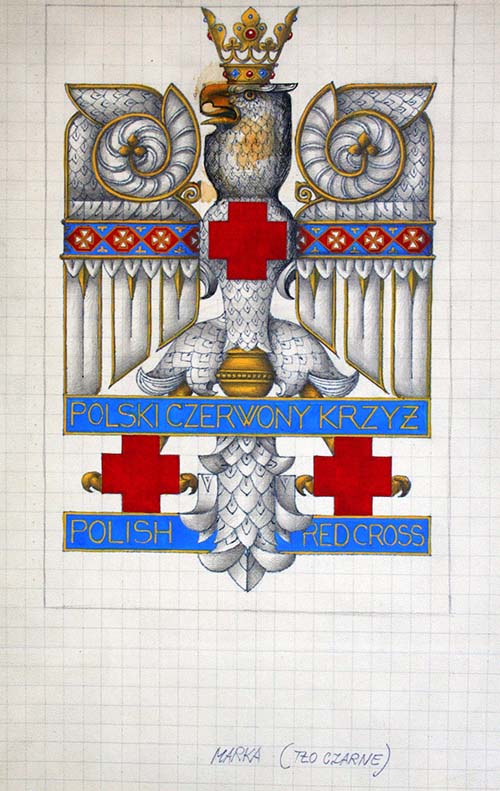
polish-red-cross-thumb

The Polish Red Cross.
New York, 1945.
A design celebrating the Polish Red Cross features a large Polish White Eagle, which for 700 years has been the coat of arms of the Polish State. The symbol of the International Red Cross is emblazoned on the Eagle’s chest.

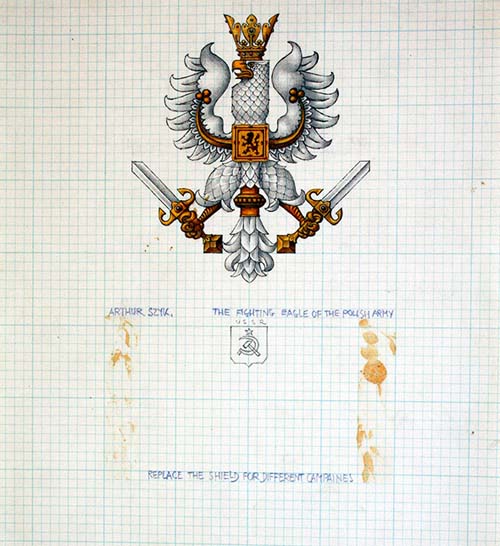
fighting-eagle-thumb

The Fighting Eagle of the Polish Army.
New York, 1945.
The eagle clutches two double-bladed swords in its talons and for this campaign sports a red and yellow heraldic lion on its chest. A jeweled crown symbolized Poland’s sovereignty.

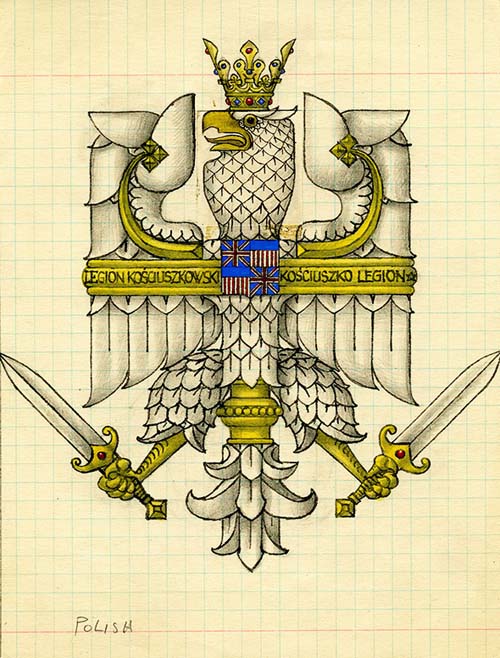
legion-kosciuszko-thumb

Legion Kosciuszkowski (Kosciuszko Legion).
New York, 1945.
This Polish eagle bears a gold band that reads “Legion Kosciuszkowski” and “Kosciuszko Legion”. At center a shield is divided into quadrants: the Union Jack occupies the upper left and lower right, the Stars and Stripes vice versa.

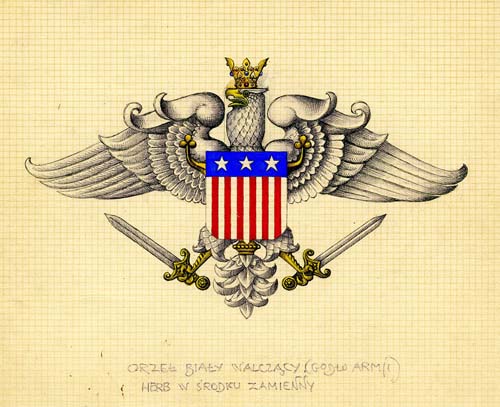
orzel-bialy-thumb

Orzel Bialy Walczacy (Godko Armji).
[White Fighting Eagle (Army Emblem)].
New York, 1945.
This white eagle seizes a sword with curved guards in each claw. On the shield in its center are America’s stars and stripes.

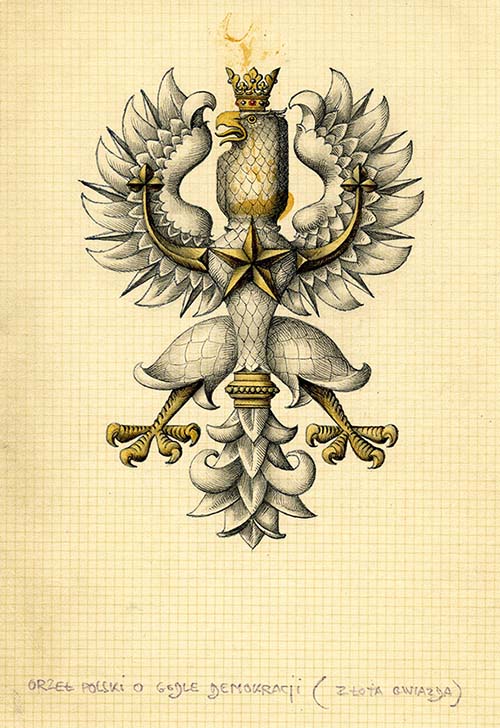
Orzel-Polski-thumb

Orzel Polski o Godle Demokracji (Zlota Gwiazda).
[White Eagle Emblem of Democracy (Gold Star)].

New York, 1945.
This white eagle with a five-pointed star (and no weapons) bears a bejeweled gold crown, and gold cloverstalks, tailband, and claws.

za-nasza-thumb

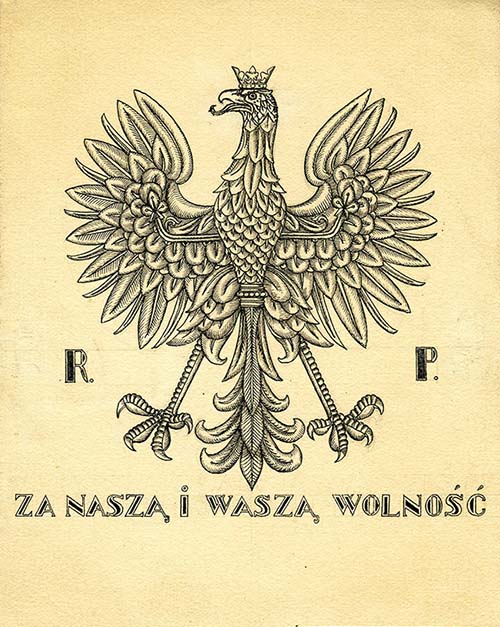
R.P. Za Nasza I Wasza Wolnosc.
[Republic of Poland: For Your and Our Freedom].

New York, 1945.
This richly detailed Polish eagle—with banded tail and cloverstalks on both wings—wears a golden crown showing Poland’s sovereignty.

Croix-Interalliee-thumb

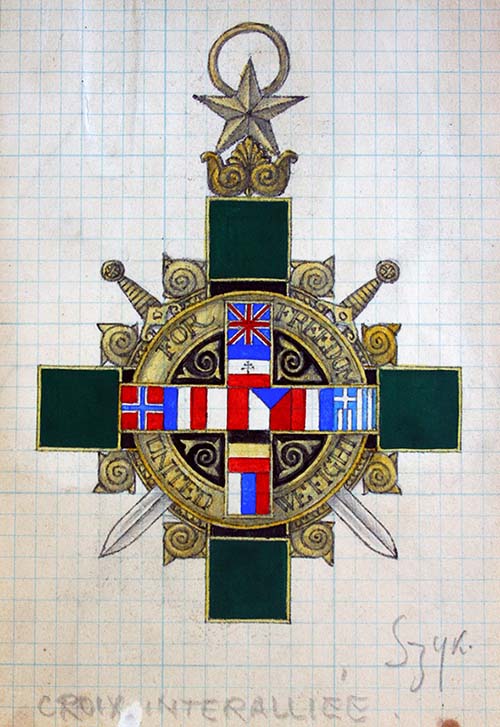
Croix Interalliée. Medallion.
New York, 1945.
The Victory Medal honors the international contributions of those who fought for freedom in World War I. It is inscribed “For Freedom United We Fight” and bears the flags of ten countries.

Christmas-and-New-Year-Wishes-thumb

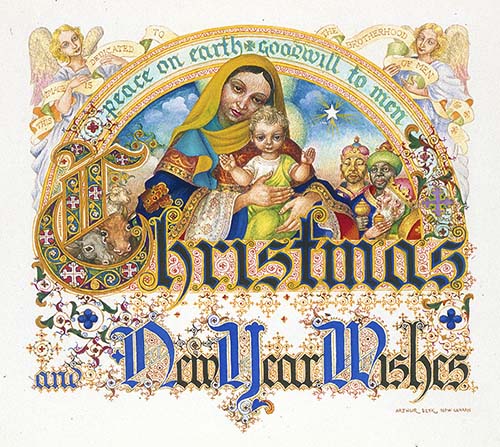
Christmas and New Year Wishes. Peace on Earth, Goodwill to Men.
New Canaan, 1946.
Szyk dedicates this Adoration of the Magi to the brotherhood of men. Mary and the baby Jesus receive three multiethnic wise men (black, white, and Asian) and their precious gifts.

Season's-Greetings-thumb

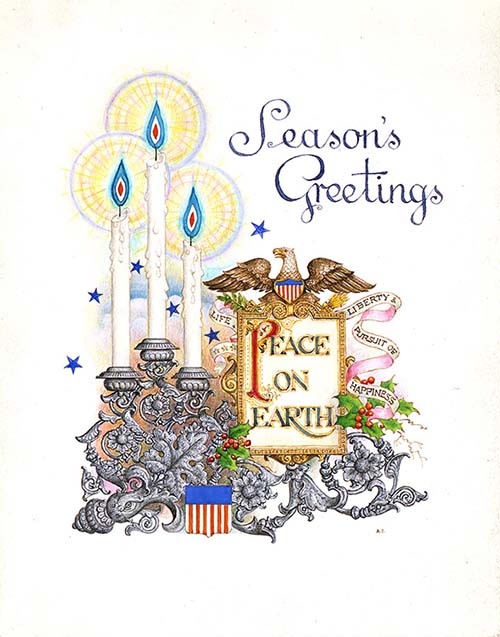
Season’s Greetings. Peace on Earth.
New Canaan, 1946.
Holiday imagery combines with American patriotism in this illuminated greeting card.

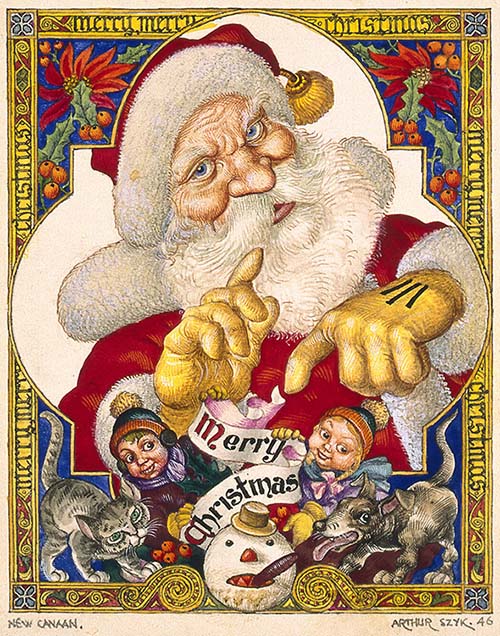
santas-watching-thumb

Santa’s Watching You.
Merry Christmas series.

New Canaan, 1946.
Santa cautions the viewer: “You better watch out.” (Because he knows if you’ve been naughty or not.) The golden border includes poinsettias and holly berries, and the words “Merry Christmas.”

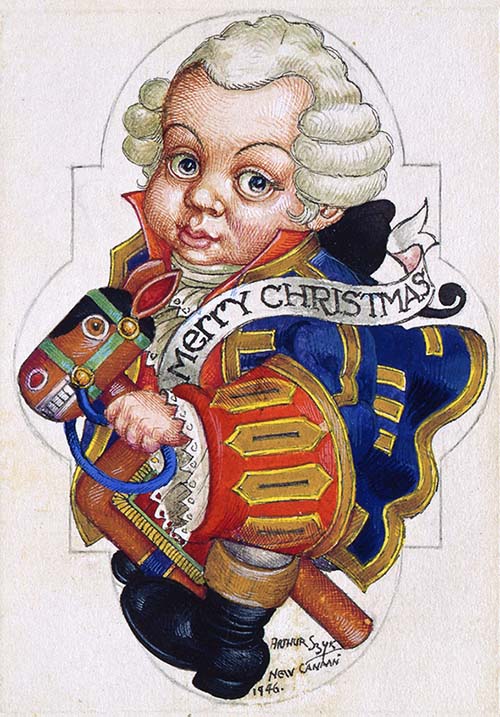
Merry-Christmas-by-George-thumb

Merry Christmas by George.
Merry Christmas series.
New Canaan, 1946.
A youngster in the image of a wee George Washington rides a hobby horse. Around him curls a banner “Merry Christmas.”

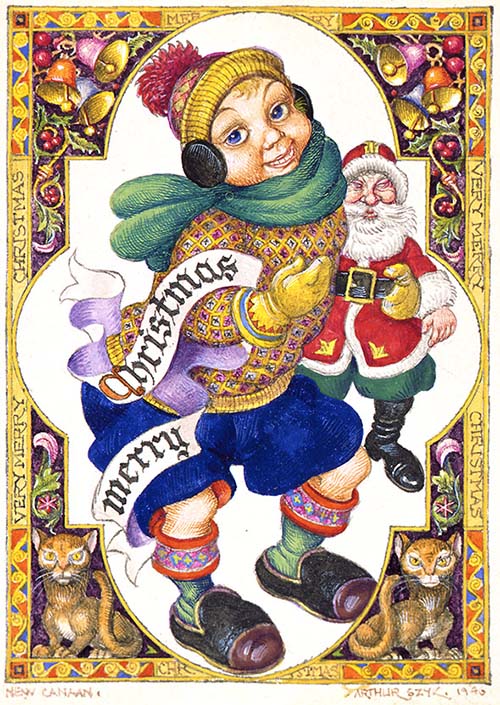
Santa-Doll-thumb

Santa Doll.
Merry Christmas series.
New Canaan, 1946.
It looks like this boy got what he wanted for Christmas: a Santa doll! This painting is one of only two in the series with a completed border.

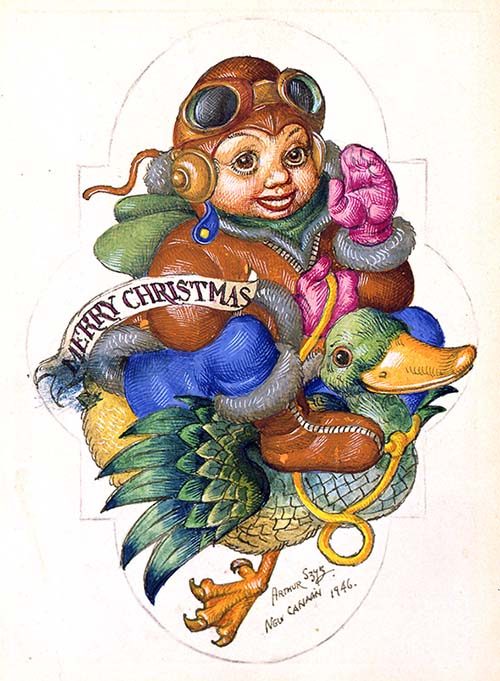
high-flying-thumb

Have a High-Flying Christmas.
Merry Christmas series.
New Canaan, 1946.
A grinning youngster in full aviator’s garb waves as he flies by on his duck.

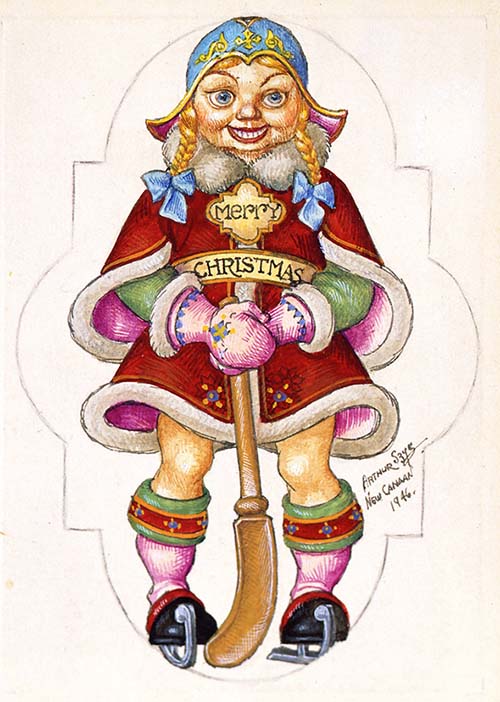
pigtails-on-ice-thumb

Pigtails on Ice.
Merry Christmas series.

New Canaan, 1946.
This girl is ready for some fun on the ice with her bright coat and cap, and hockey stick. One hopes she doesn’t skin her bare knees!

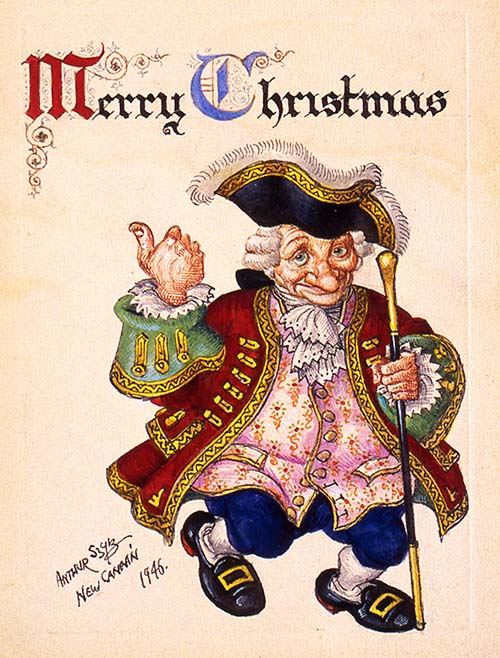
thumbs-up-thumb

Thumbs Up.
Merry Christmas series.
New Canaan, 1946.
In colorful attire reminiscent of the American colonial period, an elderly gent carries a walking stick and gestures with his thumb toward the words “Merry Christmas”.

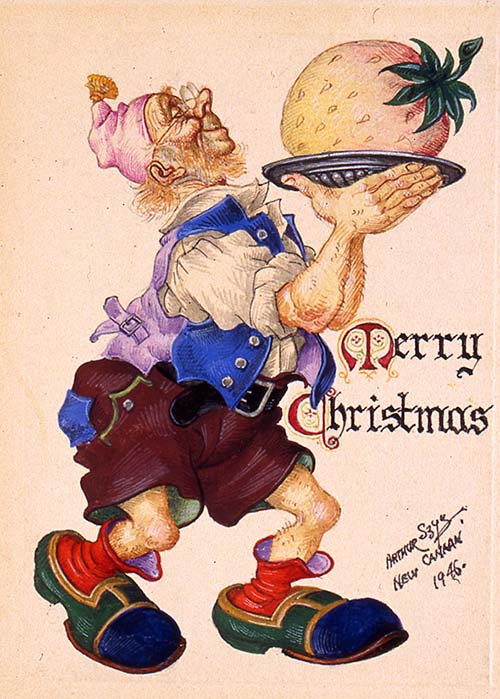
berry-christmas-thumb

Have a Berry Christmas.
Merry Christmas series.
New Canaan, 1946.
This fellow looks enormously satisfied all the way to his knobbly knees — probably thanks to the enormous strawberry he carries on a platter.

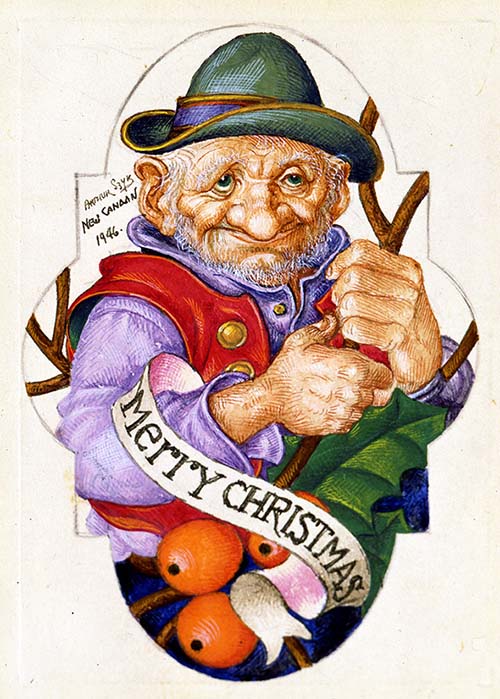
elfs-cheer-thumb

Elf’s Cheer.
Merry Christmas series.
New Canaan, 1946.
A smiling, kind-faced elderly chap wears a purple shirt, red vest, and green hat. He holds onto a holly branch, around which is curled a “Merry Christmas” banner.

hot-santa-thumb

Hot Santa.
Merry Christmas series.
New Canaan, 1946.
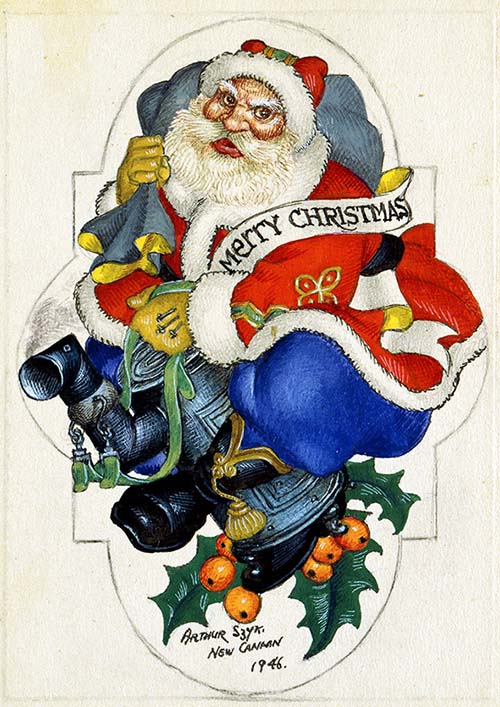
Perhaps to prove that the lack of a fireplace will not deter him, Santa makes his way via a stove.

bottoms-up-thumb

Bottoms Up.
Merry Christmas series.
New Canaan, 1946.
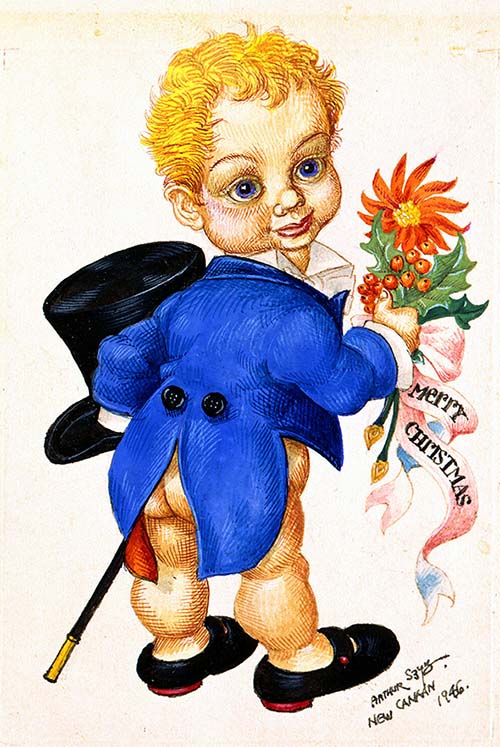
A cherubic toddler, dressed to the nines, holds a colorful bouquet tied together with a “Merry Christmas” ribbon. Though he’s got a top hat and cane, he’s missing one thing…

happy-holly-days-thumb

Happy Holly Days.
Merry Christmas series.
New Canaan, 1946.
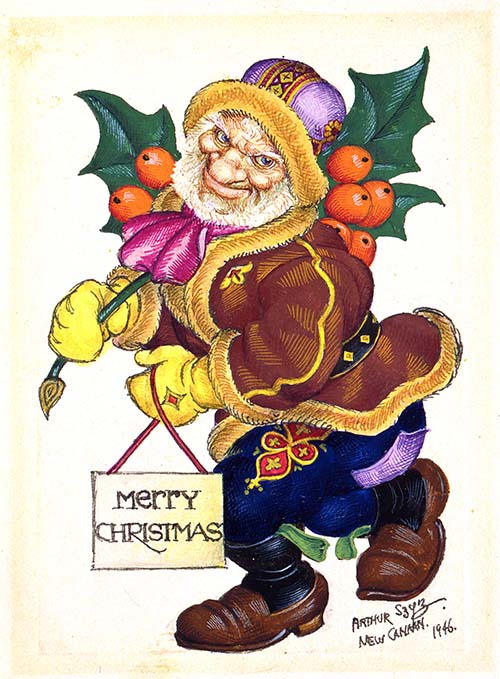
Snug in his brown coat, this character smiles out from under his white bushy eyebrows. He carries a sign “Merry Christmas” in one hand; the other holds onto a spray of holly.

no-entry-for-mars-thumb

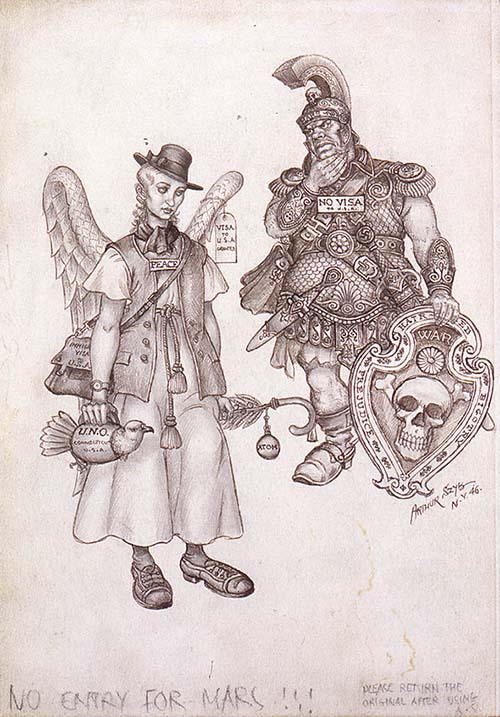
No Entry for Mars.
New York, 1946.
With World War II over, an angel of peace is tagged like a piece of luggage: “Visa to USA Granted.” She walks past a nonplussed Mars, the god of War, whose entry has been denied.

naomi-leaves-bethlehem-thumb

Naomi and Her Family Leave Bethlehem.
Book of Ruth.
New Canaan, 1946.
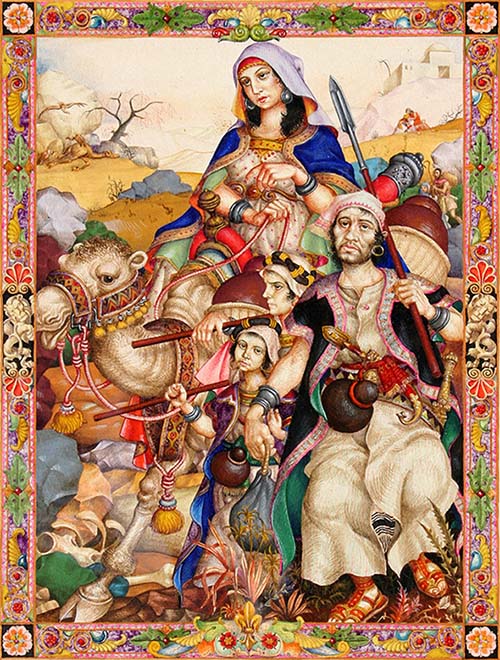
In this frontispiece for The Book of Ruth, Naomi and her family flee from the famine gripping Bethlehem. They carry all their worldly treasures, including a prayer shawl and a scroll.

naomi-ruth-arrive-bethlehem-thumb

Naomi and Ruth Arrive in Bethlehem.
Book of Ruth.
New Canaan, 1946.
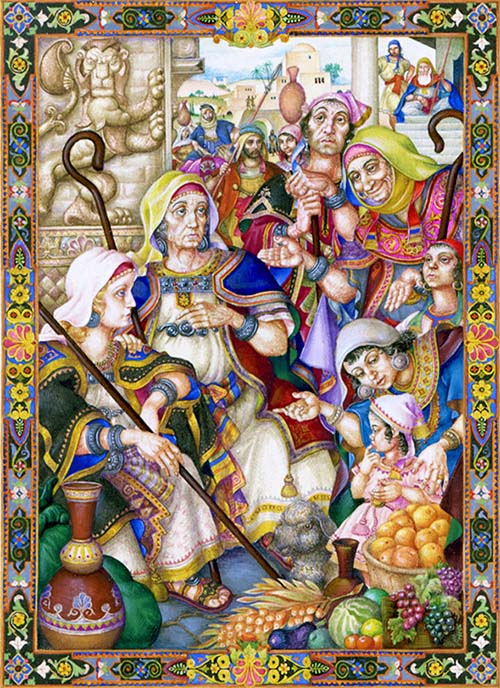
After a long sojourn to Ruth’s native Moab, Naomi and Ruth return to Bethlehem. In Naomi’s hometown, Ruth is welcomed as part of the family.

boaz-removes-shoe-thumb

Boaz Removes His Shoe.
Book of Ruth.
New Canaan, 1946.
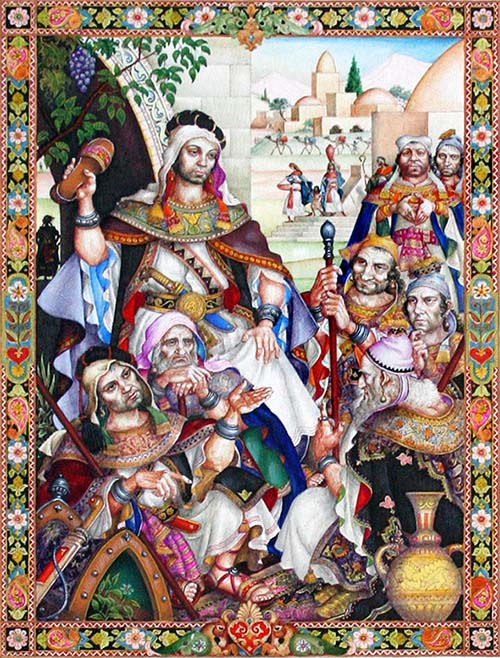
Boaz signifies his commitment to marry Ruth in this painting packed with symbols of abundance: a golden drinking vessel, grapes, a riding saddle, embroidered robes, and woven rugs.

united-states-VH-thumb

The United States of America.
Visual History of Nations series.
New York, 1945.
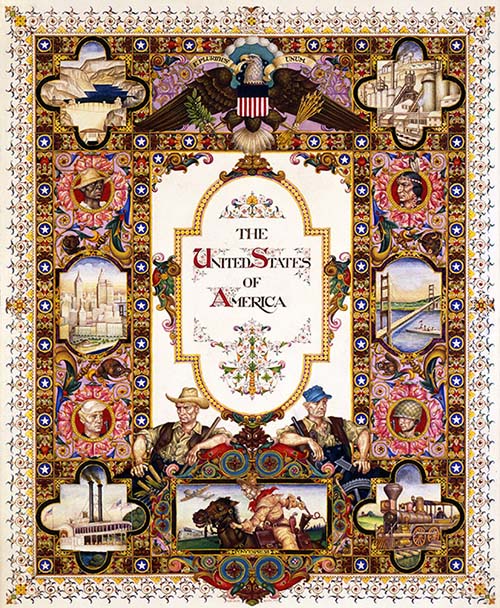
In this widely reproduced work of Americana, Szyk presents his view of his adopted country: a land rich in natural beauty and resources, inhabited by a multicultural people with perseverance, independence, and ingenuity.

canada-VH-thumb

Canada.
Visual History of Nations series.
New Canaan, 1946.
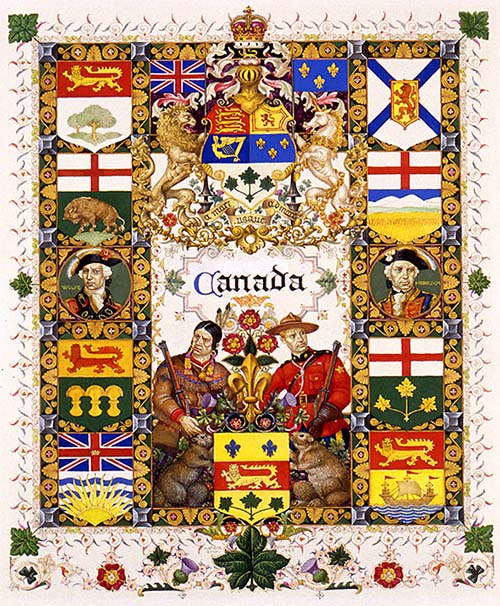
One of Szyk’s first works in the Visual History of Nations series, this piece pays tribute to Canadian Kasimir Bileski, who commissioned it. The U.K.’s Royal Seal, a Native American and a Canadian Mountie are surrounded by the seals of Canada’s (then) nine provinces.

poland-vh-thumb

Poland.
Visual History of Nations series.
New Canaan, 1946.
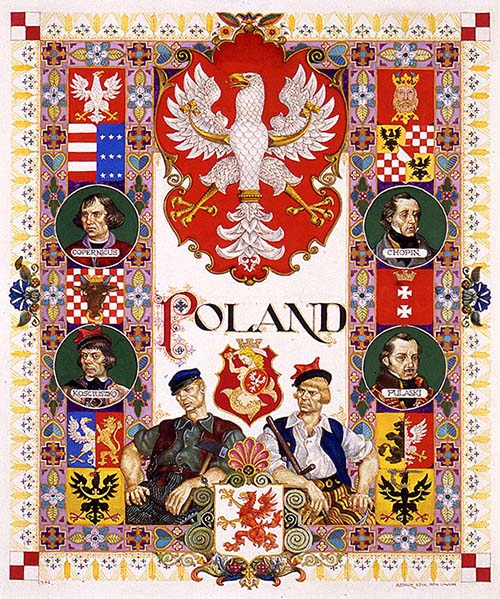
Poland’s eagle takes center stage in this illumination which also contains the coats of arms of twelve Polish regions and portraits of national heroes Copernicus, Kosciuszko, Chopin, and Pulaski.

history-of-flight-vh-thumb

There Shall Be Wings. [Da Vinci and the History of Flight.]
Visual History of Nations series.
New Canaan, 1946.
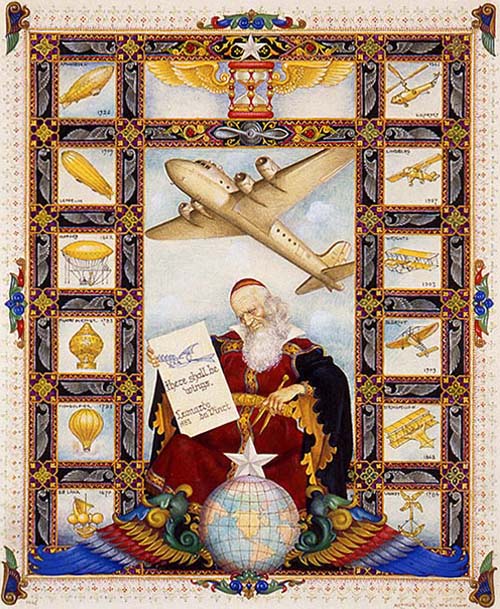
Leonardo Da Vinci considers his 1483 study of an aircraft while a modern-day airplane ascends above him. Representations of balloons, dirigibles, and other aircraft mark other important milestones in the history of flight.

ussr-vh-thumb

U.S.S.R.
Visual History of Nations series.
New York, 1947.
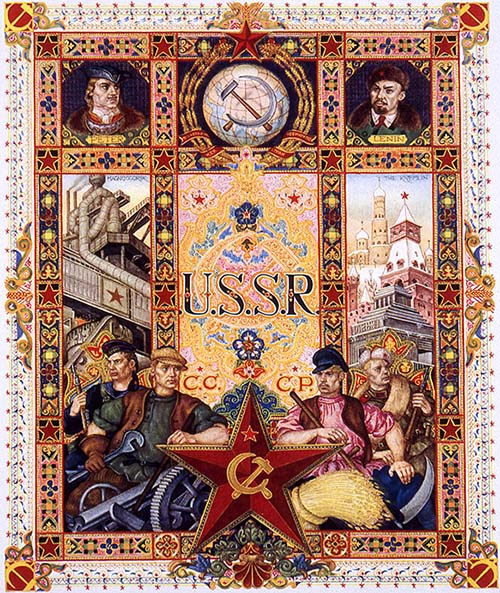
Red, the color of the Communist Party, is a key element of this visual history of the Soviet Union, which highlights Peter the Great, Vladimir Lenin, the Kremlin, and the city of Magnitogorsk.

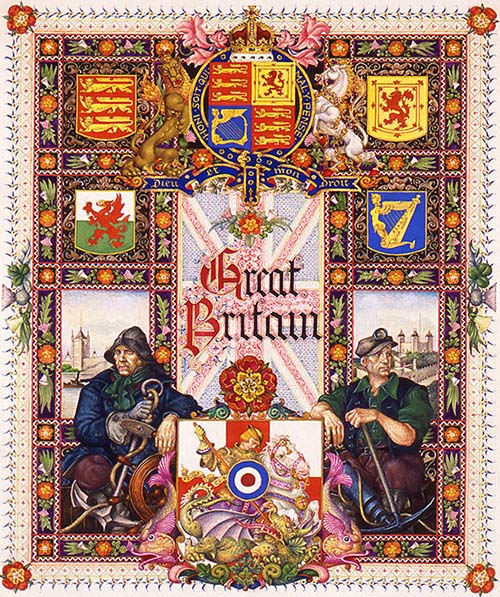
Great-Britain-vh-thumb

Great Britain.
Visual History of Nations series.
New Canaan, 1947.
Heraldry of Great Britain’s regions of England, Scotland, Ireland and Wales are prominent, their floral icons (Tudor rose, thistle, shamrock, and daffodil) appearing frequently throughout the composition.

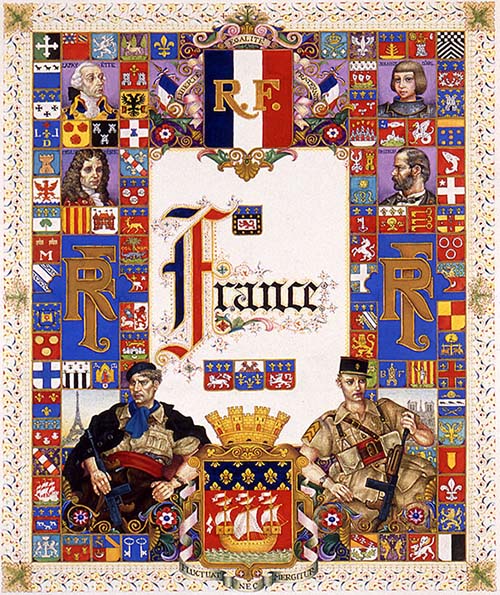
france-vh-thumb

France.
Visual History of Nations series.
New Canaan, 1947.
A veritable mosaic of bright color, each of this illumination’s 90 jewel-like squares displays the coat of arms of an individual region of France. Portraits of Joan of Arc, Lafayette, Molière, and Pasteur are featured.

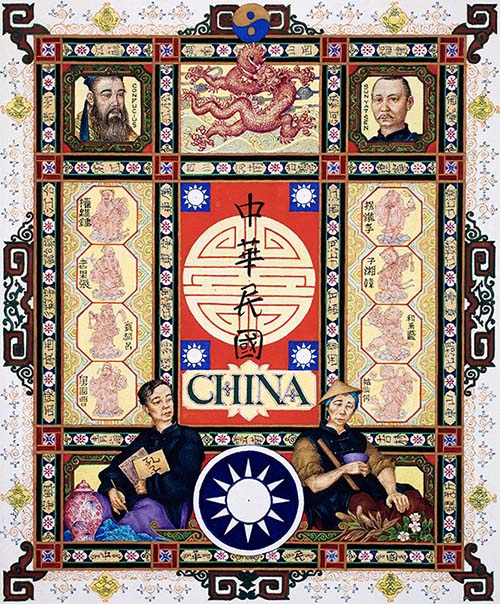
china-vh-thumb

China.
Visual History of Nations series.
New Canaan, 1947.
This visual history combines references to China’s past—Confucius and the Eight Immortals— with representations of modern people and events such as Sun Yat-Sen, the Republic of China, and the introduction of Western science.

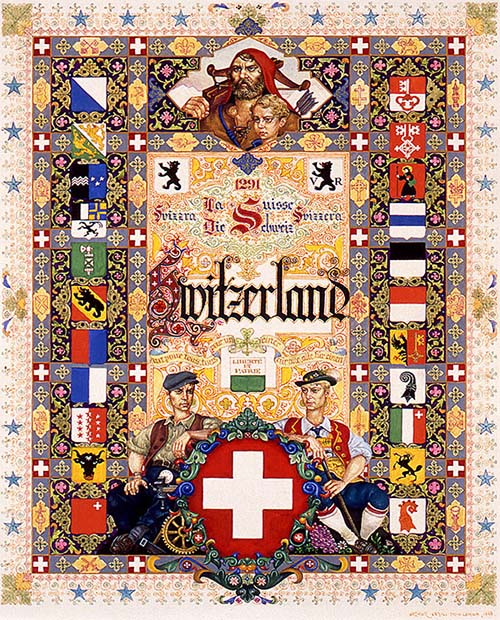
switzerland-vh-thumb

Switzerland.
Visual History of Nations series.
New York, 1948.
William Tell and son crown this composition, which is flanked by symbols of the Swiss cantons. At bottom sits a worker next to a cog (recalling Swiss watchmaking) and a man wearing the traditional attire of an Alpaufzug (Alpine cattle drive).

israel-vh-thumb

Israel.
Visual History of Nations series.
New Canaan, 1948.
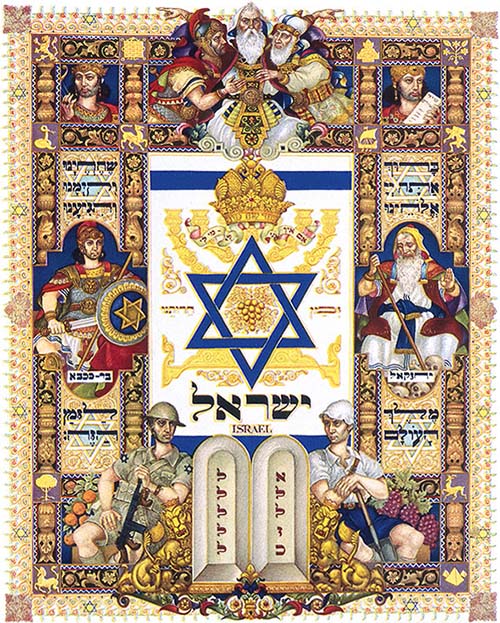
Completed in the year of Israel’s independence, this work is dominated by a blue Star of David. At the top are King David and King Solomon, as well as Hur, Moses, and Aaron; and at the sides are Bar Kochba and Ezekiel.

samuel-annointing-saul-thumb

Samuel Annointing Saul.
New Canaan, 1947.
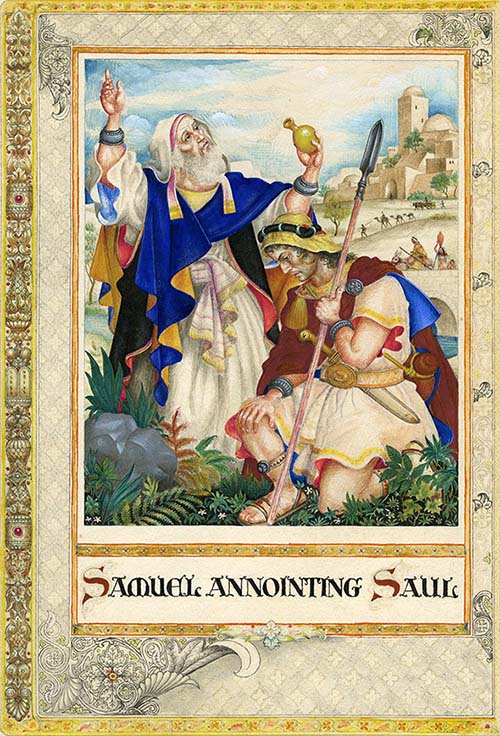
Samuel the prophet prepares to anoint Saul, marking Saul’s initiation as the first king of ancient Israel.

Arab-League-thumb

The Arab League.
Holy War series.
New Canaan, 1947.
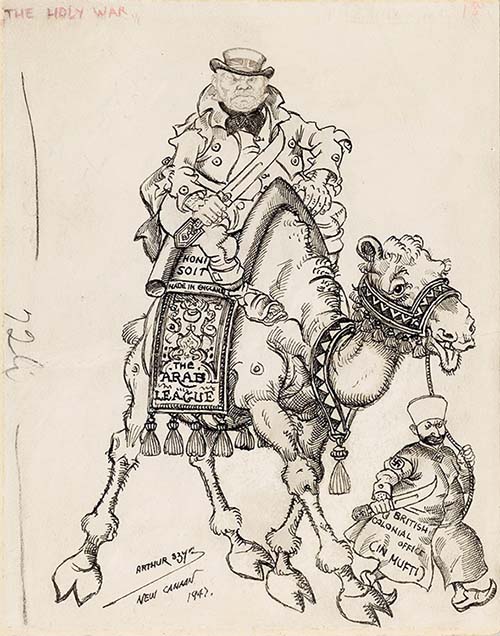
John Bull (England) rides atop a camel with an elaborate saddle labeled “Honi Soit” (from the British national motto), “Made in England” and “The Arab League”.

zachor-thumb

Zachor. Stamps of Israel.
Memorial Stamp-Europe.
New Canaan, 1948.
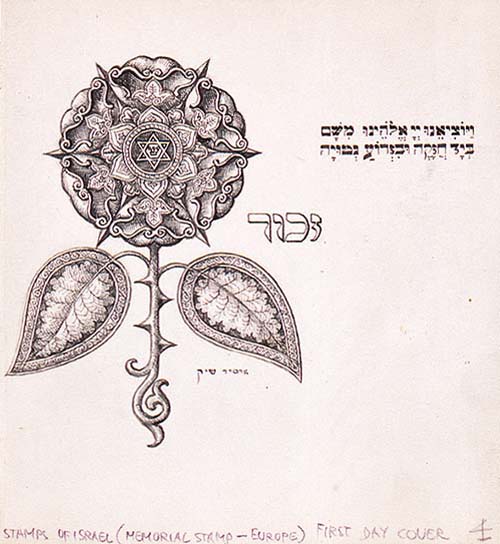
Zachor (“remember”) was designed as a Memorial Stamp for Israel, honoring those lives destroyed in the Holocaust. It features a complex rose with a Magen David, and a biblical quote: “And God brought us out from there with a strong hand and outstretched arm.”

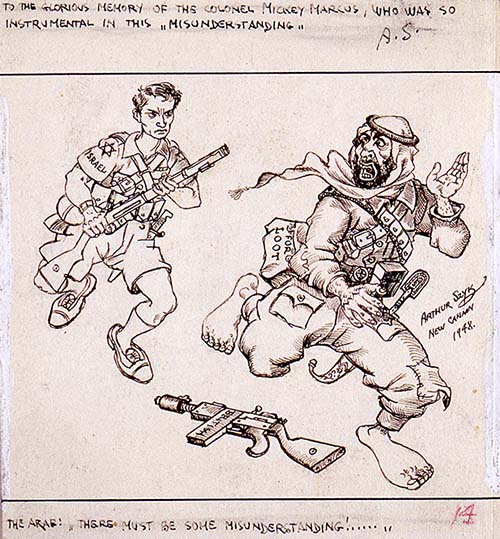
misunderstanding-thumb

There Must Be Some Misunderstanding.
New York, 1948.
The barefoot Arab in this image has been caught off-guard; he has dropped his (British) gun and cries “There must be some misunderstanding!” as he flees from an Israeli soldier giving chase with a modern carbine.

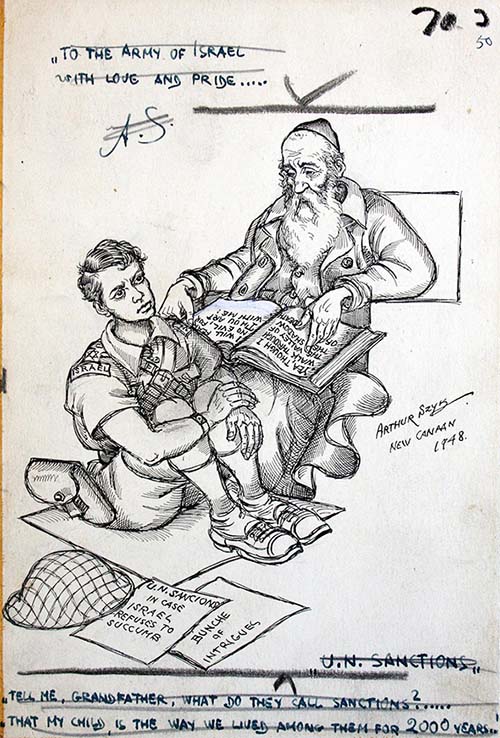
un-sanctions-thumb

U.N. Sanctions. “To the Army of Israel with Love and Pride”.
New Canaan, 1948.
A young Israeli soldier learns from his grandfather that current U.N. sanctions against Israel are nothing new: “That, my child, is the way we lived among them for 2000 years.”

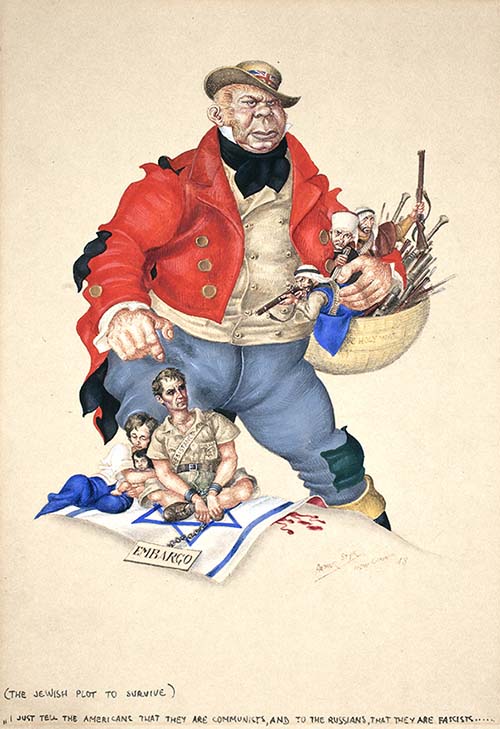
Jewish-Plot-to-Survive-thumb

The Jewish Plot to Survive.
New Canaan, 1948.
An illustration of England’s true attitude toward Israel: John Bull supports a basket of armed, angry Arabs, who aim a rifle at a Jewish mother and child. An Israeli soldier tries to shield them but his hands are chained by a U.N. embargo.

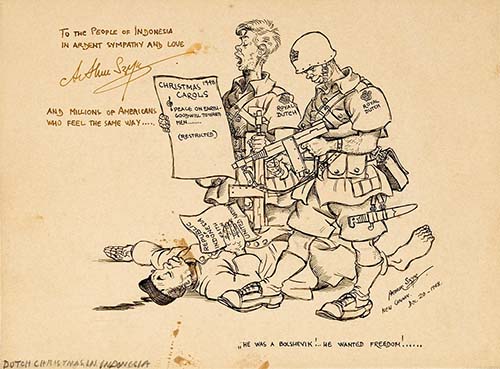
dutch-christmas-thumb

Dutch Christmas in Indonesia.
New Canaan, December 20, 1948.
A defeated Indonesian citizen — who seeks independence — is stepped on by armed Dutch soldiers singing “restricted” Christmas carols. They say of his fate: “He was a Bolshevik!…He wanted freedom!…”

Sinbad's-Seventh-Voyage-thumb

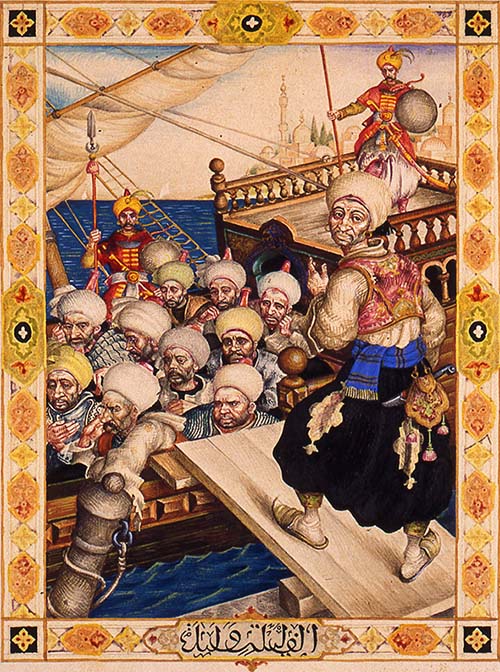
Sinbad’s Seventh Voyage.
The Arabian Nights Entertainments.
New York, 1948.
Sinbad reluctantly walks to the ship. He would retire comfortably in Baghdad, but at his Caliph’s request he will embark on one last voyage upon the treacherous sea.

Merchant-of-Baghdad-thumb

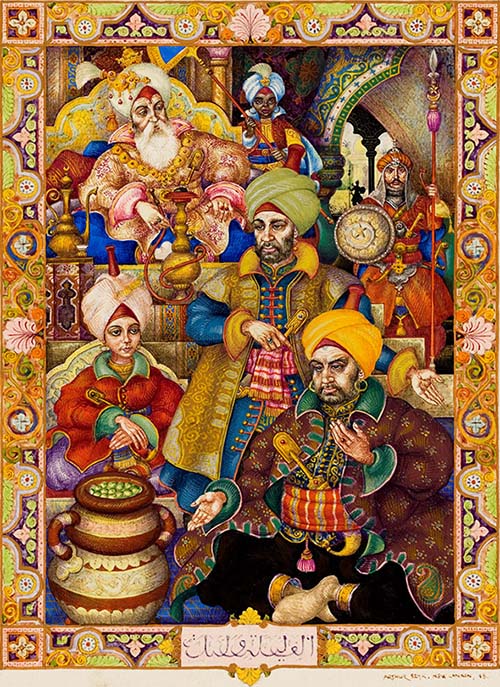
The Merchant of Baghdad.
The Arabian Nights Entertainments.
New Canaan, 1948.
Ali Khwajah and his purported friend, a Baghdad merchant, present themselves before their Caliph to argue a case. Beside them is a large jar of olives, hiding place for Ali Khwajah’s one thousand gold pieces.

Husband-and-Parrot-thumb

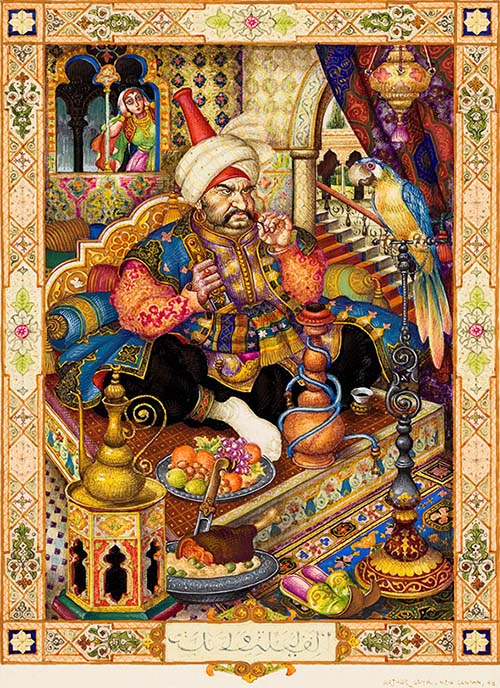
The Tale of the Husband and the Parrot.
The Arabian Nights Entertainments.
New Canaan, 1948.
A husband is seated before his blue and yellow parrot, which has spied upon the wife’s infidelity and is ready to let her secrets fly. The unfaithful wife holds her hands to her head in dismay.

Farouk-the-Royal-Crook-thumb

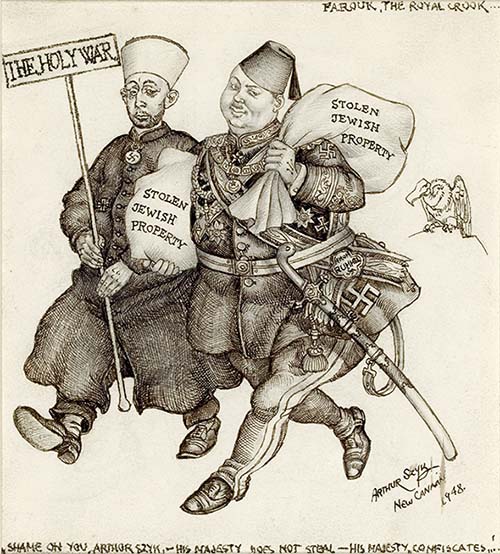
Farouk, The Royal Crook.
New Canaan, 1948.
Egypt’s King Farouk, renowned for his lavish lifestyle, carries two full gunny sacks of stolen Jewish property. He brazenly states “…His majesty does not steal. His majesty confiscates.”

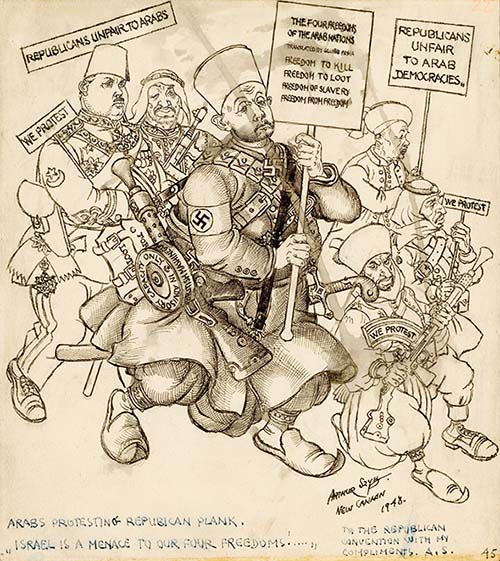
arabs-protesting-thumb

Arabs Protesting Republican Plank.
New York, 1948.
Arabs carry political placards protesting that (American) Republicans are unfair to Arab “democracies.” One wears a British machine gun marked “only in advisory capacity” and a knapsack with the words “for looting.”

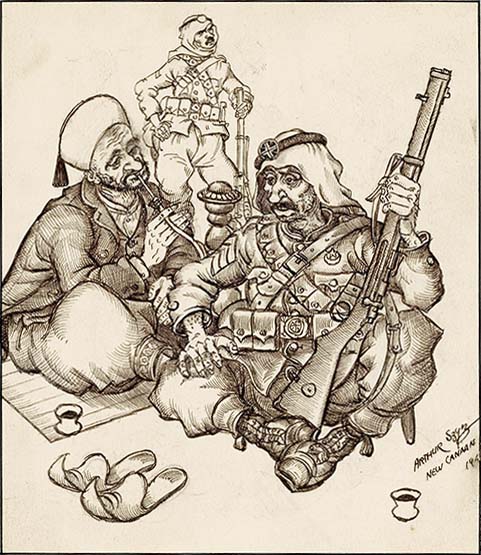
democracy-we-are-fighting-for-thumb

What Is This Democracy They Say We’re Fighting For?
New Canaan, 1948.
Over their coffee and hookah an Arab soldier and an Islamic scholar converse: “What is this Democracy they say we’re fighting for?” “That’s what they call oil in English.”

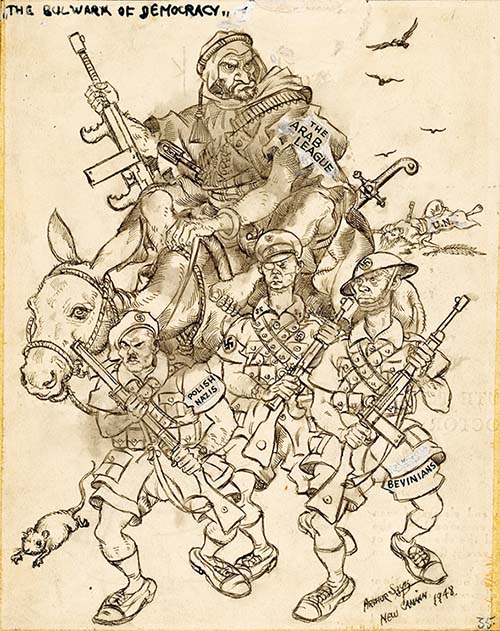
Bulwark-of-Democracy-thumb

The Bulwark of Democracy.
New Canaan, 1948.
“The Arab League” personified is accompanied by three soldiers: one representing “Polish Nazis”; one German Nazis; and one “Bevinians” (after British Foreign Secretary Ernest Bevin). Apparently this gang has attacked and left the United Nations for dead.

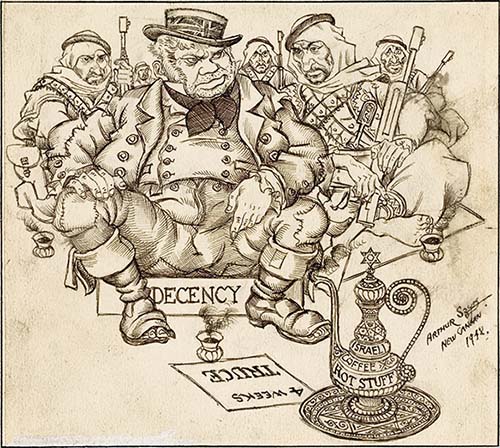
coffee-is-too-hot-thumb

That Coffee is Too Hot.
New Canaan, 1948.
John Bull (England) sits on a pillow marked “Decency” and surrounded by armed Arabs. An ornate coffee urn before them is labeled “Israeli/Coffee/Hot Stuff”. John Bull abstains from drinking saying, “That coffee is too hot! It will cool off in four weeks”. Szyk answers: “No, John Bull! It won’t!”

Honi-Soit-thumb

Honi Soit Qui Mal y Pense.
Holy War series.
New York, 1948.
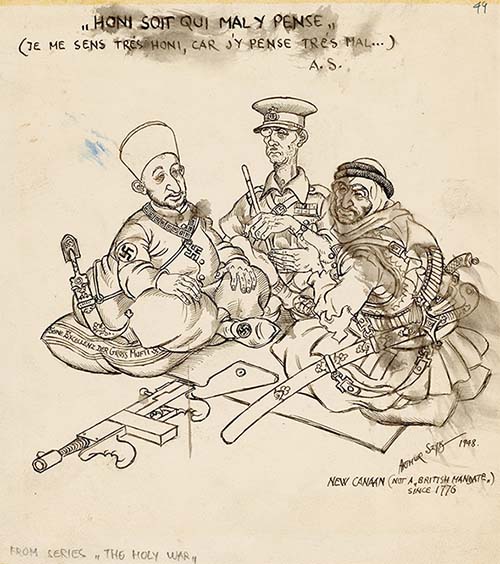
An upright British officer sits cross legged in informal negotiations with two armed Arabs. Seated upon a pillow that says “Seine Excellenz Der Gross Mufti” (His Excellency the Grand Mufti) is Amin al-Husayni, the Grand Mufti of Jerusalem.

Franco-Abdullah-Meeting-thumb

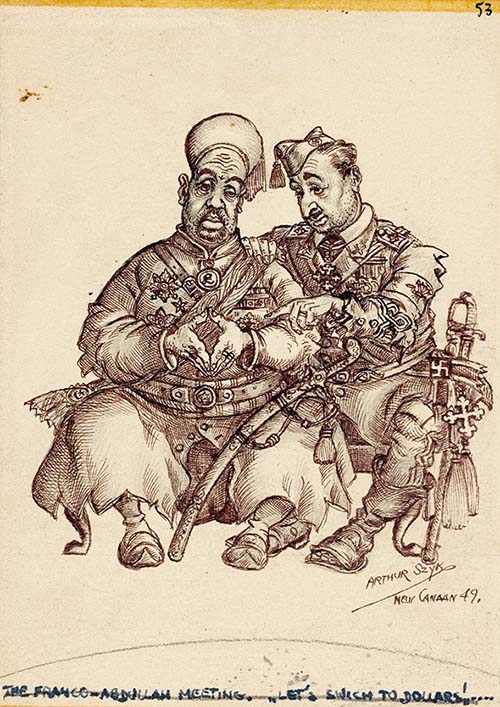
The Franco-Abdullah Meeting.
New Canaan, 1949.
Four years after the fall of Nazi Germany, Generalissimo Franco’s uniform still boasts swastikas. The Spanish dictator is in intimate discussion with an Arab leader wearing the symbol of the British Pound. “Let’s switch to dollars!”

Arab-Spokesman-thumb

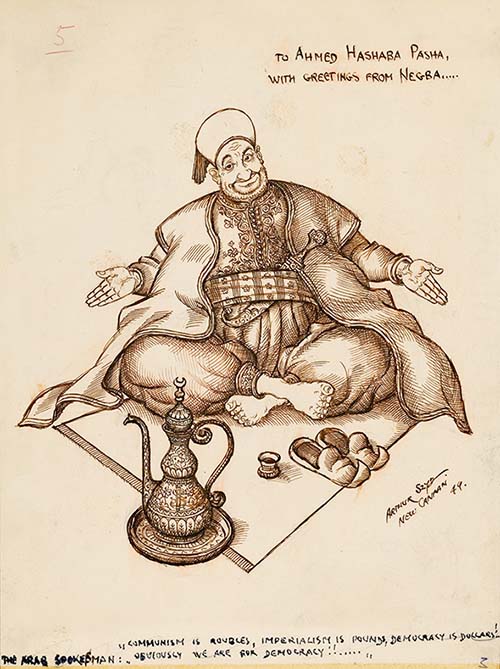
The Arab Spokesman.
New Canaan, 1949.
A genial Arab sits barefoot on a carpet, hands outstretched in a gesture of goodwill. He says, “Communism is Roubles [sic], Imperialism is Pounds, Democracy is Dollars! Obviously we are for Democracy!!”

Toys-for-the-Boys-thumb

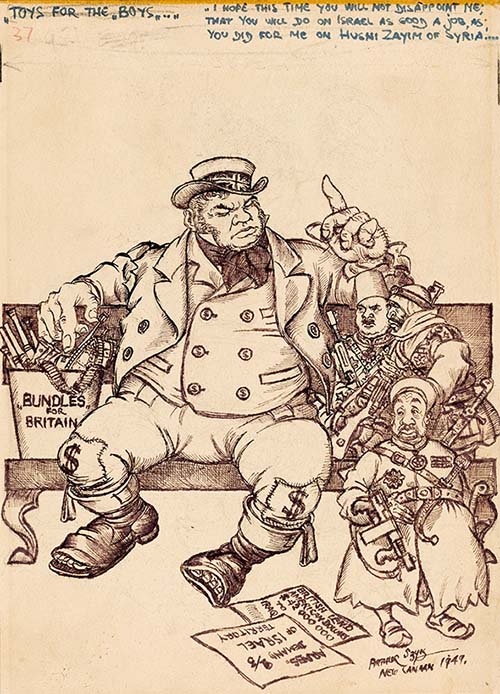
Toys for the “Boys”.
New Canaan, 1949.
John Bull (Great Britain) points at a bucket full of guns. With his other hand he remonstrates a group of Arabs: “I hope this time you will not disappoint me…”

now-youre-talking-thumb

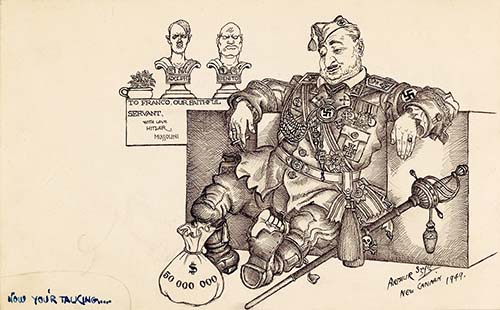
Now You’r Talking.
New York, 1949.
Francisco Franco and his battered Nazi regalia have seen better days. Yet at his feet is a bag of 50 million dollars; over his shoulder stand the busts of Hitler and Mussolini dedicated to Franco, “our faithful servant.”

Caption-Will-be-Written-By-God-thumb

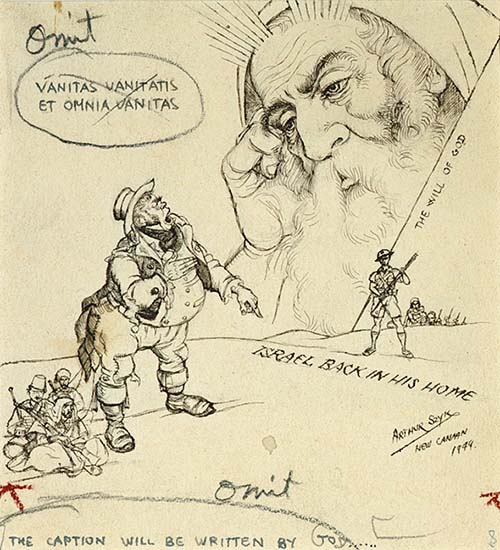
The Caption Will Be Written by God.
New Canaan, 1949.
The United Kingdom (John Bull) and an Israeli soldier are in a standoff over Israeli statehood. (The cluster of Arabs behind John Bull shows that the U.K. is especially beholden to Arab interests.)

Jerusalem World Art Museum thumb

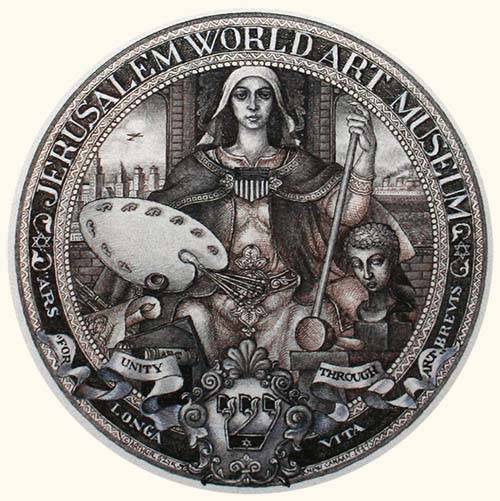
Jerusalem World Art Museum.
New Canaan, 1949.
Szyk envisioned the hoped-for Jerusalem World Art Museum would be one of the chief cultural institutions of the new nation of Israel.

do-not-forgive-them-lord-thumb

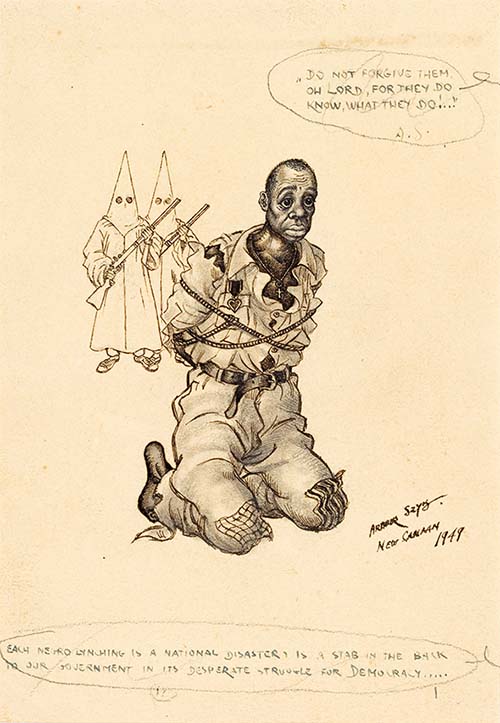
Do Not Forgive Them, Oh Lord.
New Canaan, 1949.
A black WWII veteran soldier is at the mercy of brutal Klansmen. Szyk declares, “Each negro lynching is a national disaster, is a stab in the back to our government in its desperate struggle for democracy.”

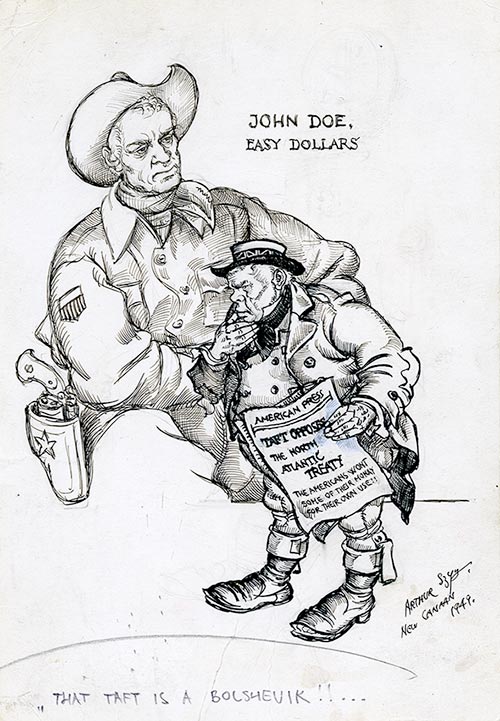
john-doe-thumb

John Doe, Easy Dollars.
New Canaan, 1949.
John Bull (England) holds a newspaper whose front page announces “Taft Opposes the North Atlantic Treaty, the Americans want some of their money for their own use!” Senator Robert A. Taft, a staunch non-interventionist during World War II, also objected to the formation of NATO.

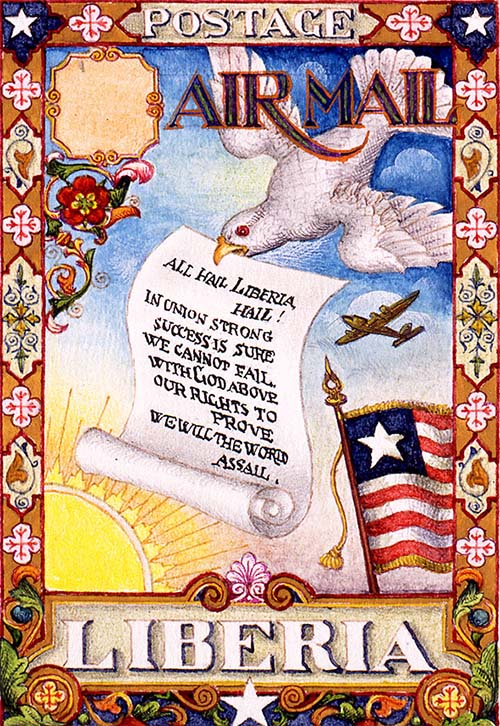
Liberia-Air-Mail-thumb

Liberia Air Mail.
New Canaan, 1949.
Szyk celebrated the first independent republic in Africa with this design for an air mail stamp, which is part of a larger project. Words from Liberia’s national anthem are on the scroll.

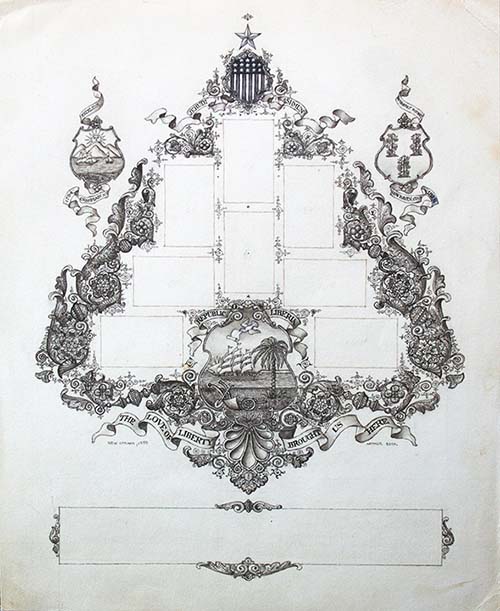
Liberian-Souvenir-Sheet-thumb

Liberia Souvenir Sheet and Proof.
New Canaan, 1950.
This souvenir sheet—the means by which a set of stamps are arranged, printed, and highlighted — is a beautiful tribute to Liberia and U.S. government agent Juhudi Ashmun (who aided the country’s founding).

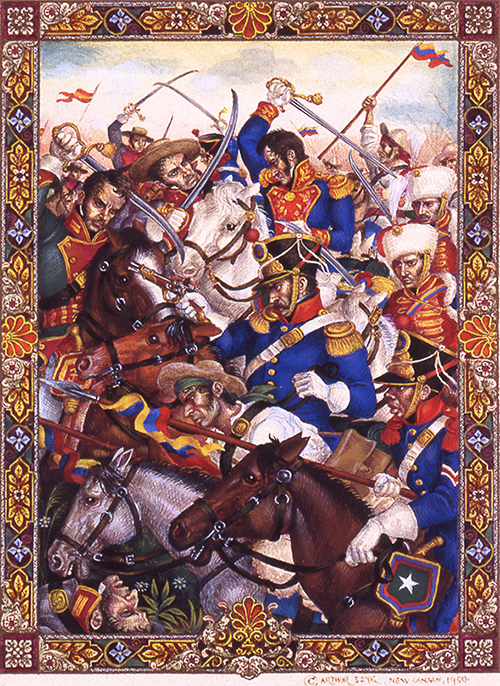
Bolivar-and-Sucre-at-Junin-thumb

Bolivar and Sucre at Junin.
Simon Bolivar and His Times series.
New Canaan, 1950.
Simón Bolivar and Antonio José de Sucre are shown at the Battle of Junin in Peru. Banners show the national colors of Venezuela and Spain. The men are armed primarily with lances and swords.

Sucre-Sitting-thumb

Sucre Sitting.
Simon Bolivar and His Times series.
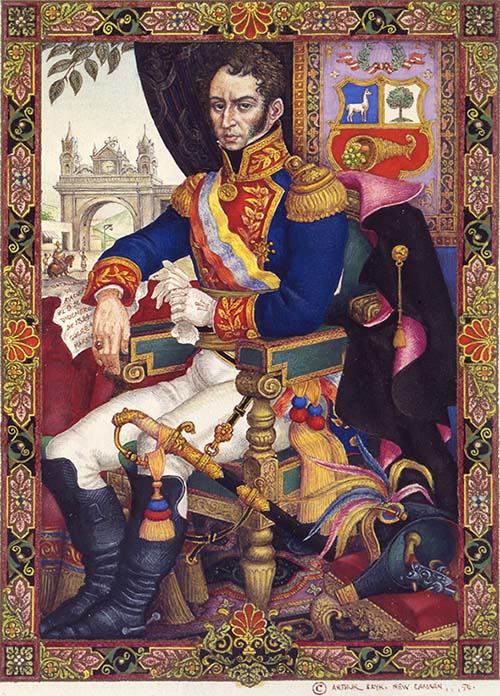
New Canaan, 1950.
Antonio José de Sucre, liberator of Peru and Ecuador and the first president of Bolivia, sits before the national shield of Peru. Sucre’s dignified bearing evidences Szyk’s admiration for his contributions to freedom and democracy.

lafayette-thumb

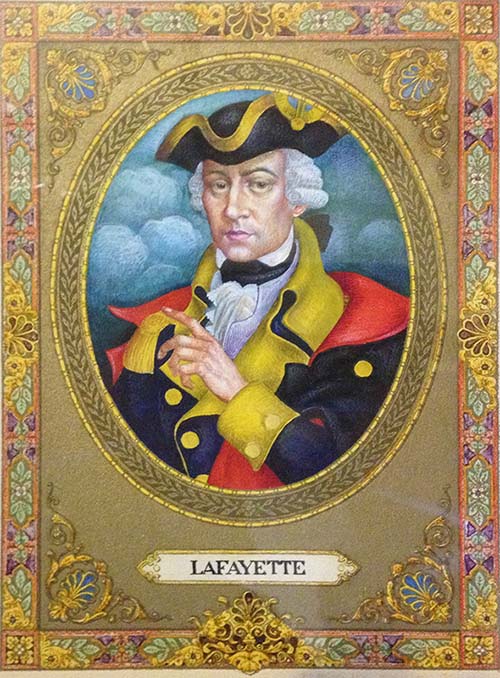
Lafayette.
New Canaan, 1950.
The revolutionary war hero wears the dress of a Continental Army officer. His calm, confident expression is a match for the overall composition of pastel colors and gold.

nova-scotia-thumb

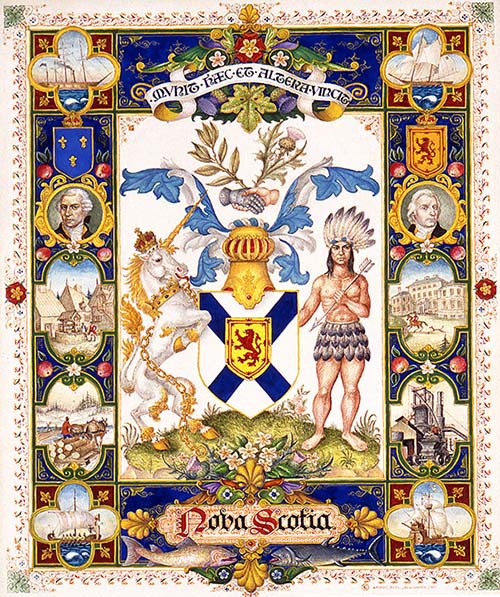
Nova Scotia.
New Canaan, 1951.
This visual history pays tribute to the region’s namesake with several Scottish symbols. These include its national flag (colors reversed), the crowned unicorn, the red lion on a gold background, and the thistle.

newfoundland-thumb

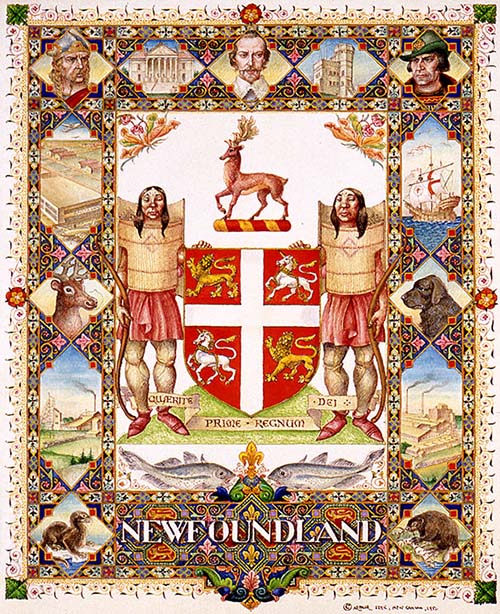
Newfoundland.
New Canaan, 1951.
Newfoundland’s visual history pairs the region’s British ancestry with its own unique development. Also featured: Leif Ericsson, Sir Humphrey Gilbert, and John Cabot; and the caribou, sea lion, and Newfoundland dog.

TB-Christmas-Seal-thumb

Tuberculosis Christmas Seal.
New Canaan, 1951.
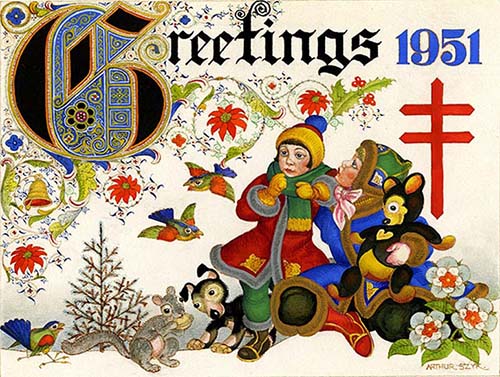
This painting, directed for the N.T.A. — the National Tuberculosis Association (later the American Lung Association) — features two girls in colorful winter attire accompanied by their dog and a teddy bear.

jeffersons-oath-thumb

Thomas Jefferson’s Oath.
“I Have Sworn Upon the Altar of God…”

New Canaan, 1951.
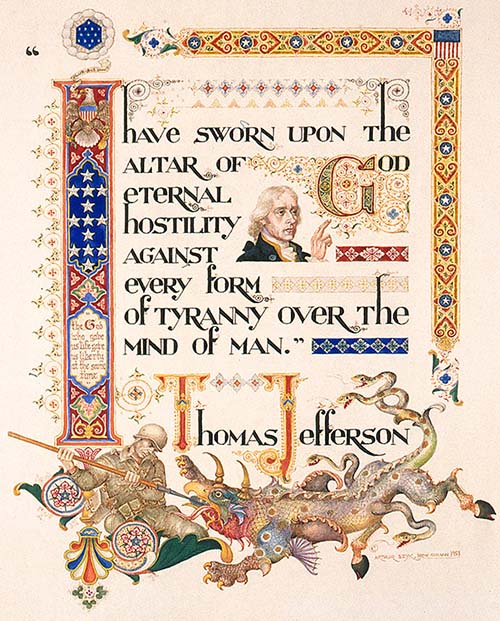
This illumination of Thomas Jefferson’s words against tyranny was one of Szyk’s final works. A brave soldier, an unequivocal force for good, battles tyranny, which takes the form of a superlatively monstrous chimera.