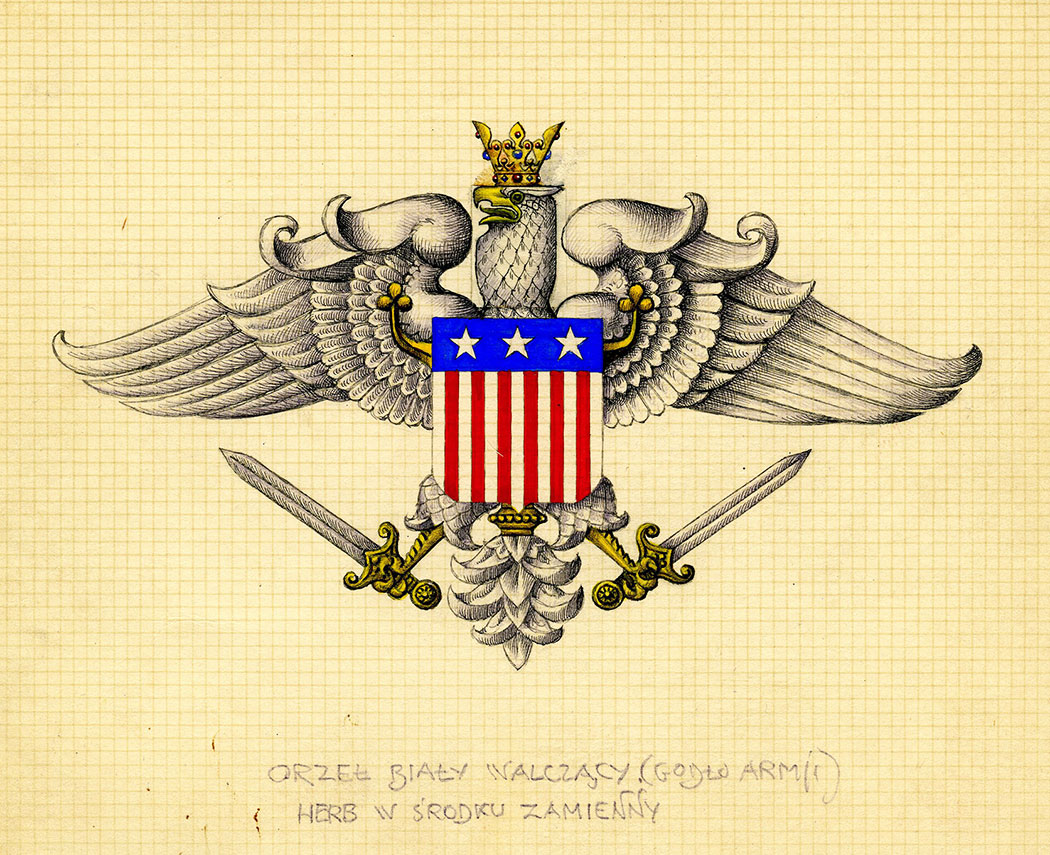
Orzel Bialy Walczacy (Godko Armji) [White Fighting Eagle (Army Emblem)]. New York, 1945.
SZYK, Arthur. Orzel Bialy Walczacy (Godko Armji). White Fighting Eagle: Army Emblem. (New York, 1945). Watercolor and gouache on paper. Sheet size: 5 3/4″ x 7″. Image size: 3 1/2″ x 5 3/4″. Very Good condition.
This white eagle, head in profile turned to the right, seizes a sword with curved guards in each claw. Its tail is banded by a gold ring, and gold cloversalks span both wings. Its crown, beak and talons likewise are gold. On the shield in its center are stars and stripes representative of the United States. The spread of the eagle’s wings in this image is somewhat luxuriously curvaceous, in contrast to the sharpened features the eagle’s wings can have elsewhere in Szyk’s work.
MODERN HISTORY OF THE WHITE EAGLE: After the defeat in 1939 and during the German and Soviet occupation of the country, the White Eagle, as Poland’s coat of arms, was strictly forbidden. Once again it became the symbol of fight for free Poland. It was used by the underground army at home and by the regular Polish army abroad. The left-oriented armed forces, however, as well as the Polish army created in the Soviet Union, adopted the White Eagle without the crown and it became the official Coat of Arms after 1945. Removing the crown from above the Eagle’s head signaled a change of the state’s political system, from now on based on the principle of “people’s democracy”. That form of the White Eagle, though officially used until the end of 1989, was not commonly accepted by the Polish nation who were extremely attached to their previous, centuries old national emblem, as clearly evidence by Szyk’s decision to use the crown in this design. In consequence of the events of 1980’s when the political system of Poland changed once again, the crown was restored to the White Eagle. In 1995, the 700th anniversary of the White Eagle’s coronation as the Coat of Arms of the Polish State was celebrated.
Provenance: Mrs. Alexandra Szyk Bracie, daughter of the artist.