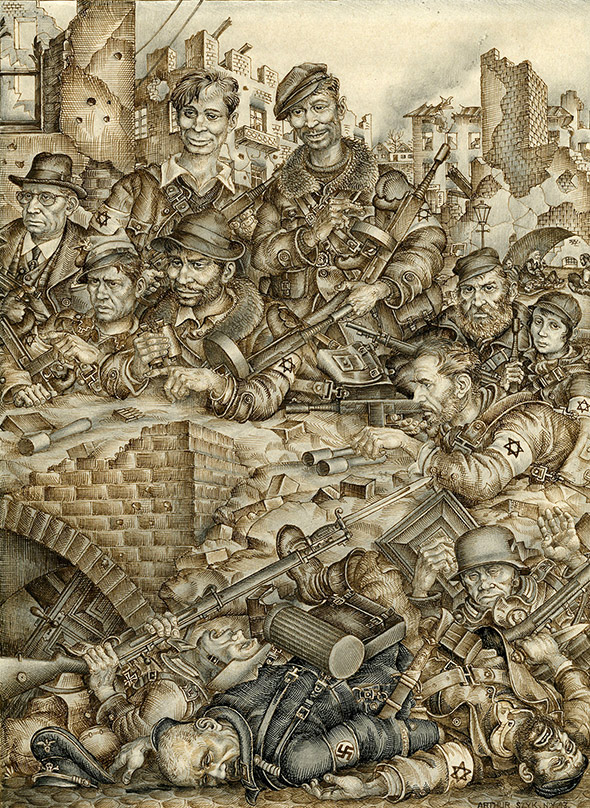
The Repulsed Attack – Battle of the Warsaw Ghetto. New York, 1943.
In Tribute to the Warsaw Ghetto Uprising
“…what really matters is that the dream of my life has become true. Jewish self defense in the Warsaw ghetto has become a fact. Jewish armed resistance and retaliation have become a reality. I have been witness to the magnificent heroic struggle of the Jewish fighters.” — Mordecai Anielewicz (1919–1943)
SZYK, Arthur. The Repulsed Attack. (From “The Songs of the Ghetto.”). [Battle of the Warsaw Ghetto]. Signed and Dated “Arthur Szyk, NY (19)43”. Ink and graphite on board. Sheet size: 10″ x 5 3/4″. Image size: 7 1/2″ x 5 1/2″. Very Good condition.
Arthur Szyk’s painfully personal rendition of “The Repulsed Attack,” created in honor of the victims and survivors of this stupendous act of resistance, is arguably one of the most important drawings of his career. To a native son of Poland, the uprising in the Warsaw Ghetto symbolized everything most noble and unspeakably tragic. For a Polish Jew who lost his mother and brother in the Holocaust, it was also a spark of hope in a hopelessly dark time. More than any other work from this period, “The Repulsed Attack” shows Szyk’s ideal in action: the Jewish people fighting back against injustice, refusing to give up their freedom — a fate the artist believed far worse than eventual death.
Massive deportations to Treblinka in 1942, as well as random executions, had left a population of some 70,000 Jews confined to the Warsaw Ghetto — down from nearly one half million when segregation was first enforced. Unsurprisingly, a year later the Jews were well aware that Treblinka was not a labor camp, but a death camp. On April 19, 1943, despite a vastly unequal and underarmed force, the Jews of Warsaw organized a last-ditch attempt to stave off the German murderers. Though the Nazis believed they could quash the rebellion in a few days, the resistance lasted nearly one month, with skirmishes continuing through June. In the end, 13,000 Warsaw Jews were killed and more than 50,000 deported to camps, yet their singular, outrageous attack against Hitler’s troops sent shockwaves throughout the world.
The brave and impetuous Polish Jews of Szyk’s meticulous image pause briefly after waging a ferocious battle that has repulsed the German soldiers charged with their annihilation. Weeks of conflict have left the Ghetto with little more than smoldering ruins. The foreground is burdened with the corpses of dead Nazis as well as that of a slain Jewish resistor; his knife still gripped in hand. The resistors who still live gather together above the chaos, ready for the next confrontation. One man holds a pair of binoculars with which to better see the fruits of their revenge. Behind him stand two young men wearing grim smiles of satisfaction. (The one at left may be Mordecai Anielewicz, the leader of the ŻOB [Jewish Fighting Organization] and the famed commander of the Warsaw uprising.) An older man and young boy with rifle in hand gaze pointedly at the viewer (far right). A middle-age man (far left) with coat, tie, glasses, and top hat may be Dr. Dawid Wdowiński, one of the leaders of the Revisionist Zionist resistance during the Warsaw Ghetto uprising.
In their heart of hearts, all the participants in Warsaw Ghetto Uprising knew with certainty that they would be killed. Their battles therefore were a desperate cry, not for individual survival, but to inspire future generations. The magnificent resistance offered by the Jews of Warsaw cost the Nazis prestige, materials and casualties. Moreover, Warsaw was the first rebellion in any occupied city in Europe. It tied down the enemy in greater numbers and for a longer period of time than did many sovereign countries overrun by the Germans during World War II.
Szyk had no forgiveness for the atrocities in Warsaw. His aim was to force the world to remember, to acknowledge what transpired here, and to prevent it from ever happening again. In his own words, “Every Jew now alive is the legatee of those who died to uphold the sanctity of the Name or dignity of his origin. Let us not profane their sacred memory by trying to hide the tragedy of our people.” [Answer magazine, April 1945, page 65].
Provenance: Julia Szyk, widow of Arthur Szyk.
Exhibition History: Messrs. Wildenstein & CO., Inc. New York, NY. Miniatures and War Satires. December 7–30, 1944; The Philadelphia Art Alliance. Philadelphia, PA. Illuminations and War Satires. February 20–March 11, 1945; The Jewish Museum. New York, NY. The Work of Arthur Szyk: A Memorial Exhibition of Original Minatures and Paintings. October 24–December 4, 1952; United States Holocaust Memorial Museum, Washington, DC. The Art and Politics of Arthur Szyk. April 20–October 14, 2002; Deutsches Historisches Museum. Berlin, Germany. Arthur Szyk: Drawing Against National Socialism and Terror. August 29, 2008–January 4, 2009; Palace of the Legion of Honor (Fine Arts Museums of San Francisco). San Francisco, CA. Arthur Szyk: Miniature Paintings and Modern Illuminations. December 4, 2010–March 27, 2011.
Publishing History: Der Morgen Zhurnal [Jewish Journal], New York, April 7, 1944; (Cover image commemorating the first anniversary of The Warsaw Ghetto Uprising) HaDoar [Weekly Newspaper], New York: Hebrew Histradut in America. 28 Nisan 1944 (April 1944); (Cover image) Our Voice. Organ published by the United Galician Jews of America. Convention Issue, 1944; (Art Section) The Forward, December 17, 1944; Moladeti. Jerusalem: Keren Kayemet L’Yisrael, 1945, p. 127; Degel Edom (Red Flag). Tel Aviv: Hashomer Hatzair, 1945, p. 107; Ink & Blood. New York: Heritage Press, 1946. Plate LXII; (Front cover of dust jacket) Seidman, Hillel. Yoman Geto Warsaw (Diary of the Warsaw Ghetto). Tel Aviv: Uma u’moledet, 1946; Drawing republished – New York: The Jewish Week, 1957; p. 245; The Art and Politics of Arthur Szyk. Washington, DC: United States Holocaust Memorial Museum, 2002, pp. 105, 107,108; Newsletter, The Arthur Szyk Society, Burlingame, CA, Spring 2005, p. 4; Sodei, Rinjiro, Arthur Szyk: Indignant Jewish Illuminator [Text in Japanese], Tokyo, Japan, 2007, p. 163; Arthur Szyk: Drawing Against National Socialism and Terror. Berlin: Deutsches Historisches Museum, 2008, pp. 246-247; Artur Szyk: Dziedzictwo polsko-zydowskiego artysty [The Legacy of Polish-Jewish Artist], Krakow, Stradomskie Centrum Dialogu, 2011, p. 94.