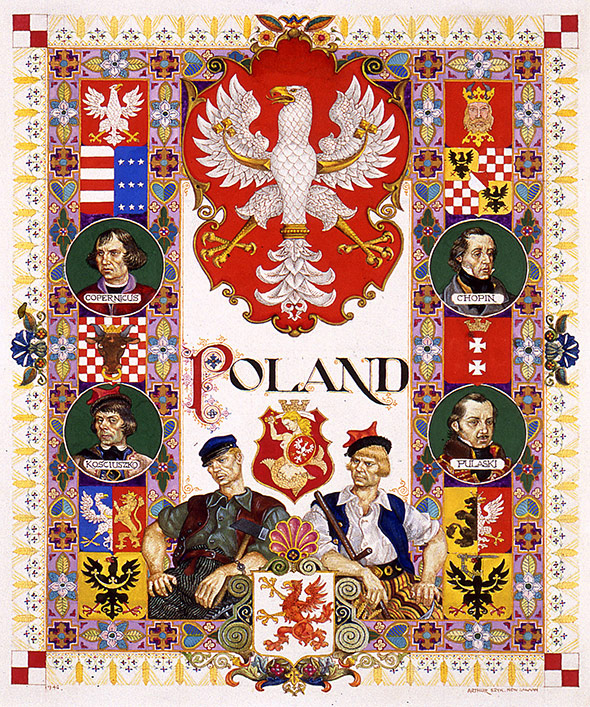
Poland. Visual History of Nations series. New Canaan, 1946.
SZYK, Arthur. Poland. Visual History of Nations series. Signed and Dated “Arthur Szyk, New Canaan, 1946”. Watercolor and gouache, graphite pencil, and ink on board. Sheet size: 11″ x 7 1/2″. Image size: 7 7/8″ x 6 9/16″. Very Good condition.
A large white eagle on a red background, the national arms of Poland, dominates the top of Arthur Szyk’s colorful Visual History. Above its head there would be a gold crown symbolizing the country’s autonomy. Since Poland was under Communist control when this illumination was created, the crown was omitted.
Twelve coats of arms adorn the sides and center of the illustration. They represent Polish voivodeships – administrative areas ranging in scale from a city to several counties, akin to a duchy or a province. Some bear testimony to Poland’s past. On the left, the white eagle designates Poznań, a region sometimes called the birthplace of Poland. Below are the stars and stripes of Sandomir, an area where human artefacts dating to Neolithic times are found. The bull on a checkered background stands for Kalisz, which contains one of Poland’s oldest cities.
The General Charter of Jewish Liberties (the Statute of Kalisz) was issued in 1264 in Kalisz. It granted Jews extensive civil and religious privileges. The region of Silesia (represented bottom left) bore witness to Auschwitz and the Gross-Rosen concentration camp (the latter housed Oskar Schindler’s Bruennlitz subcamp). The province of Brzeg (the quartered arms to the right) contained an airfield from which Nazi aircraft took off in the September 1939 invasion of Poland, ostensibly motivated by Germany’s demand to annex Gdańsk, represented on the right between Chopin and Pulaski.
Other arms signify regions that have found themselves in the crosshairs of other nations’ interests. Royal Prussia (bottom right) was an early part of the independent state of Poland, and was absorbed by Prussia during the partitions of the 18th century. For hundreds of years the people of Dobrzyń Land (top right) have stood for Polish independence against Swedes, Saxons, Russians, and Germans.
Men in portraiture are known for supporting independence as well. Casimir Pulaski (1745–1799) was a leader of the Bar Confederation, which fought for Polish-Lithuanian independence. He brought his knowledge of guerrilla warfare across the Atlantic to form the Pulaski Legion during the Revolutionary War. Thaddeus Kościuszko (1746–1817) also participated in that war, and after returning to Poland he led a national uprising against the second partition of the Polish-Lithuanian Commonwealth. (Poland’s existence as a sovereign state ceased after the third partition, and was not regained until after World War I in 1918.)
Polish influences on the arts and sciences are also featured in this illustration. Frederick Chopin (1810–1849), known for his piano compositions, grew up and composed many of his works in Warsaw (whose coat of arms — a mermaid holding a shield — is visible under the word ‘Poland’). Nicolaus Copernicus (1473–1543) hailed from Royal Prussia. His On the Revolutions of the Celestial Spheres revolutionized human understanding of the Earth’s place in the universe.
The miner (shown on the left) and the peasant in Polish national costume (on the right) represent the hardy and enduring Polish labor force.
Special thanks to David F. Phillips and Alfred Znamierowski for their invaluable assistance in identifying these coats of arms.
Historical Background: Arthur Szyk completed the visual histories of nine countries of his United Nations series (Visual History of Nations series). This series of original artworks was commissioned by Canadian stamp dealer/entrepreneur Kasimir Bileski beginning in 1945. Poland was the third work in the series (Szyk’s place of birth), after The United States of America and Canada.
Provenance: Kasimir Bileski to George Gooche, founder of The Arthur Szyk Society.
Exhibition History: Wilshire Blvd Temple, Los Angeles, CA, May 17–October 31, 1991; Spertus Museum, Chicago, August 16, 1998–February 28, 1999; Fine Arts Museums of San Francisco, Palace of the Legion of Honor, December 4, 2010–March 27, 2011.
Publishing History: Reproduced by Kasimir Bileski in 1946 as a lithographic print to serve as a frontispiece in albums for collectors of Polish stamps; Newsletter, The Arthur Szyk Society, Burlingame, CA, Spring 2005, p. 8; Sodei, Rinjiro, Arthur Szyk: Indignant Jewish Illuminator [Text in Japanese], Tokyo, Japan, 2007, p. 209; Newsletter, The Arthur Szyk Society, Burlingame, CA, Fall/Winter 2007, p. 8; Artur Szyk: Dziedzictwo polsko-zydowskiego artysty {The Legacy of Polish-Jewish Artist], Krakow, Stradomskie Centrum Dialogu, 2011, cover, p. 10, 106-107; Artur Szyk: Man of Dialogue [Polish and English editions], Centrum Dialogu, Lodz, 2011, p. 4, 94; Bulletin of the Polonus Philatelic Society, Maryville, IL, September 2012, p. 21 Newsletter, The Arthur Szyk Society, Burlingame, CA, February 2014, p.13.