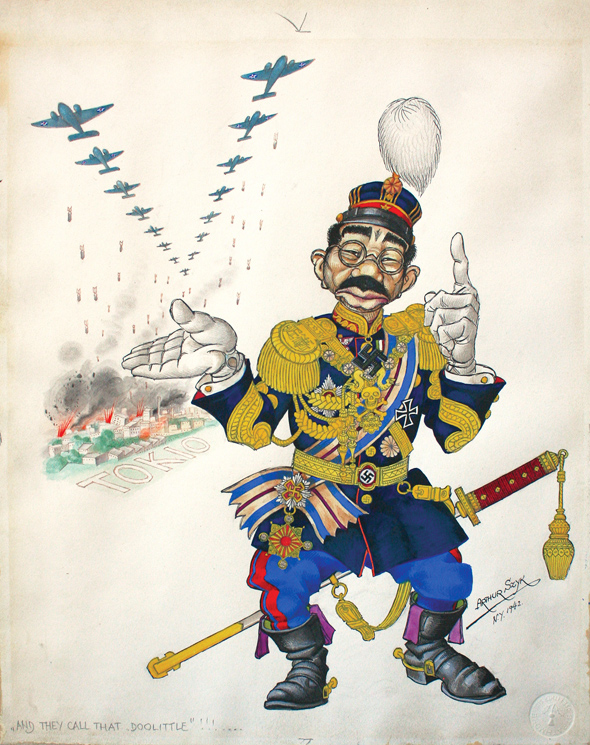
And They Call That Doolittle. New York, 1942.
America’s Surprise Attack on Tokyo
SZYK, Arthur. And they call that Doolittle! Signed and Dated “Arthur Szyk, N.Y. 1942”. Watercolor and gouache on paper. Sheet size: 13 1/4″ x 11″. Very Good condition.
In one of Szyk’s larger paintings, Japanese Emperor Hirohito gestures in dismay toward the chevron fleet of American bombers unleashed over the skies of his nation’s capital city “Tokio”. His elaborate military dress uniform is augmented with golden swastikas, iron crosses and a skull and crossbones medal commemorating Pearl Harbor. A rain of bombs has set the city afire and sent a message most plain.
In the months after the Japanese attack against Pearl Harbor on December 7, 1941, the United States watched the Japanese take over Southeast Asia and could do nothing about it. The building of a nearly unstoppable military force was begun but a boost of morale was desperately needed to demonstrate to enemies and allies alike that the United States was striking back. The way to do it was by air.
AMERICA’S FIRST VICTORY IN WORLD WAR II. Conceived by Mission Commander James H. Doolittle of the U.S. Army Air Force, the first top secret, surprise raids on Tokyo began on April 18, 1942 when 16 B-25 bombers were launched from the USS Hornet to attack targets including Yokohama and Tokyo and then fly on to airfields in China. Tokyo was stunned. People panicked. The Doolittle Raid was a complete shock to the Japanese military. The heads of the imperial Air Force and Navy accused each other of incompetence and the Air Defense commander committed suicide in the aftermath. Propagandized later as “Thirty seconds over Tokyo” the raids did no significant damage to Japan’s war capability but were a significant victory for the United States. Far from doing “little”, this raid was massive.
Emperor Hirohito (1901-1989) ascended to the Chrysanthemum Throne in 1926. Far more than just an imperial figurehead, his cabinet ministers kept him continually informed of all military actions throughout the war. His blazing iconographic place in the hearts and souls of Japanese soldiers led many to willingly give their lives for the emperor in the kamikaze raids of World War Two.
Provenance: Parke Bernet Sale, New York, Mrs. Arthur Szyk, November 24, 1961. Lot 73 (illustrated).
Publishing History : Westport Connecticut Town Crier. August 6, 1942. (The published image as one of 30 satires to be exhibited at the Y.M.C.A. Art Gallery, August 8 through August 15 under the sponsorship of the Town Crier). Also published in Liberty magazine, January 1943 (accompanying an article entitled “Behind the Jap Front.”); Sodei, Rinjiro, Arthur Szyk: Indignant Jewish Illuminator [Text in Japanese], Tokyo, Japan, p. 132.