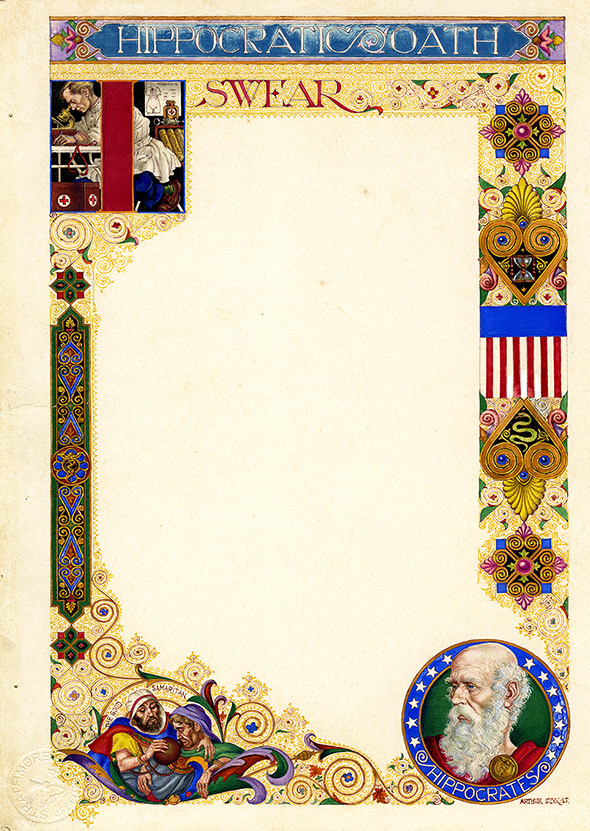
The Hippocratic Oath. New Canaan, 1945.
Original Illuminated Border Designed for Coronet Magazine
SZYK, Arthur. The Hippocratic Oath. Signed and Dated “Arthur Szyk (19)45.”(New Canaan). Watercolor and gouache on board. Sheet size: 10″ x 7 3/8″. Image size: 9 1/8″ x 6″. Very Good condition.
This group of images was created to frame the contents of The Hippocratic Oath for the May 1945 issue of Coronet Magazine, a small format, popular monthly for which the artist created 23 illuminations over the next three years. Coronet called them ‘words in pictures’ and they were part of a new look for the magazine. Each illustrated an uplifting quotation which was included as part of the design. The quote itself was added by typeset later on. Pioneers of American Medicine is the title of this month’s featured “picture story” at the end of which is a brief essay on The Gift of Hippocrates.
In the upper left hand corner of the illumination, a doctor peers into a microscope at his laboratory desk. This painting, placed beneath the large rubric letter “I”, is followed by “SWEAR”, which forms the beginning of the oath widely believed to have been written by Hippocrates, the father of medicine, in the fourth century BC. Although mostly of historical and traditional value and not obligatory, the oath is considered a rite of passage for practitioners of modern medicine. A highly detailed portrait of Hippocrates is painted at the bottom of the border with his head encircled by thirteen stars linking him to the American doctors who were the focus of the article. To the left of Hippocrates is an image of the apocryphal Good Samaritan giving aid to a stranger. The Caduceus, or Wand of Hermes, that has come to be used as a symbol for medicine, appears twice: once as a broach on Hippocrates’s tunic and again in a dazzlingly complex ribbon of design at the left center. Szyk has depicted it as a short herald’s staff entwined by two serpents in the form of a double helix and surmounted by wings.
Szyk incorporated the use of elaborately decorative borders in many of his most famous illustrated books. In some cases, remarkably the border varied even within a single book (Rubaiyat of Omar Khayyam, The Book of Ruth) whereas the border was repeated within others (Pathways Through the Bible, The Book of Esther (Megillat Esther) for reasons of visual unity, to link the images, as well as expediency. Szyk’s borders employ the use of flowers, leaves and vines, jewels, arabesques, and geometric patterns, recreating the evocative imagery of Persian carpets.
Provenance: Alexandra Szyk Bracie, daughter of Arthur Szyk.
Exhibition History: Fine Arts Museums of San Francisco, Palace of the Legion of Honor, December 4, 2010–March 27, 2011.
Publishing History: Coronet magazine, May 1945, p. 117.