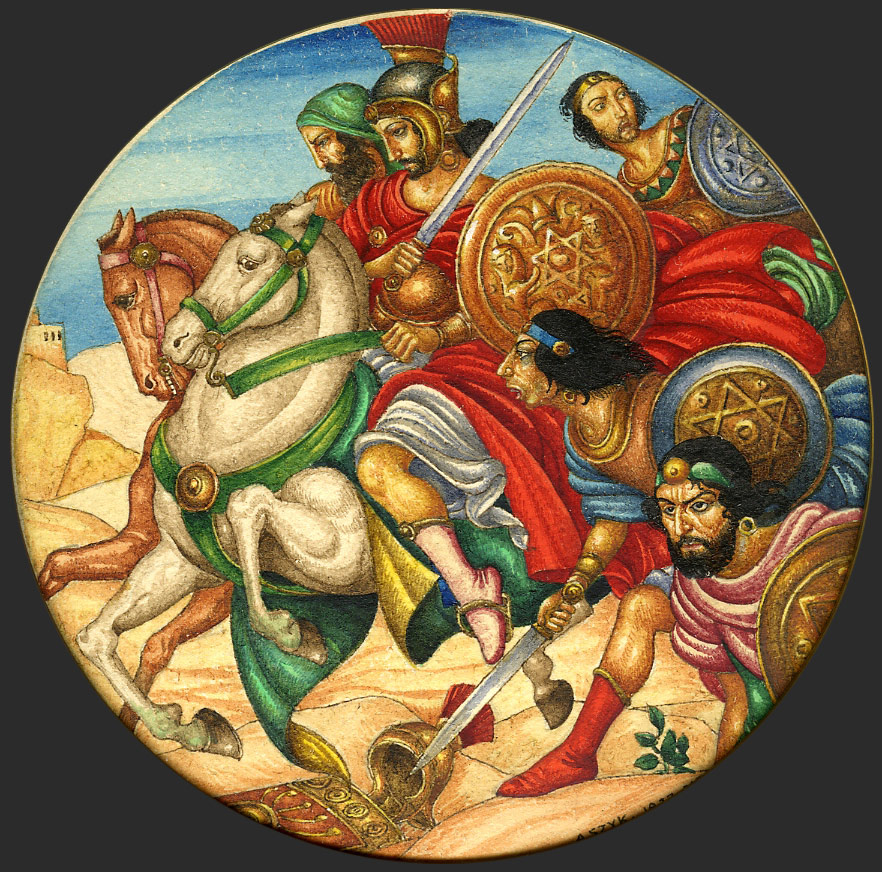
Bar Kochba. Paris, 1927.
Jewish Symbol of Valiant National Resistance
SZYK, Arthur. Bar Kochba. Signed and Dated “A. Szyk, `27.” (Paris). Watercolor and gouache on paper. Sheet size: circular illumination 3″ in diameter. In original gold frame with recent archival matting and original affixed metallic name plaque. Carved wood frame measures 8″ x 7 1/2″. Very Good condition.
This vibrant image of the Jewish General Simon Bar Kochba charging into battle to liberate Jerusalem from Roman rule is one of Szyk’s most kinetic. The hard-muscled horses are in mid stride; the soldiers are pressing forward with their swords drawn; their leader, with single minded focus, has his eye on the city before him. Dating from his early Paris years of the 1920’s, it is astonishing to see the enduring brightness of the colors in this painting. The jewel tones of sapphire blue, emerald green, and ruby red are indeed set like stones by the rich gold of the Star of David emblazoned shields carried into battle by the studly Jews.
Simon Bar Kochba [approx. 15-135 CE]. After the Emperor Hadrian’s promises to rebuild Jerusalem were broken, the Jewish sage Rabbi Akiva convinced the Sanhedrin to support an impending revolt and regarded the chosen commander Simon Bar Kochba as the Jewish Messiah. The Bar Kochba Revolt [132-135 CE] known as the Second Jewish Roman War or Second Jewish Revolt succeeded in cutting off the Roman garrison in Jerusalem and a sovereign Jewish state was restored for the two and a half years that followed. A public administration was headed by Simon Bar Kochba who took the name Nasi Israel, Prince of Israel.
Three years later the Romans regrouped and re-captured Jerusalem with the furious Hadrian intent on exterminating Judaism which he saw as a cause of continuous rebellion. After losing Jerusalem, Bar Kochba and the remnants of his army withdrew to the fortress of Betar which also came under siege and where he is presumed to have perished. The outcome of the Bar Kochba Revolt has been estimated at 580,000 Jewish dead with most of the surviving Jewish population of Judea now exiled or sold into slavery. This massive destruction and loss of life has led many scholars to date the primary start of the Jewish Diaspora from this event.
The disastrous end of the revolt also occasioned major changes in Jewish religious thought. Messianism was abstracted and spiritualized and rabbinical political thought became deeply cautious and conservative. The Talmud, for instance, refers to Bar-Kochba as “Ben-Kusiba”, a derogatory term for a false Messiah. In the post-rabbinical era, however, the Bar-Kochba Revolt has become a symbol of valiant national resistance. For Szyk, Bar Kochba, was clearly one of his heroes. He also idolized Bar Kochba in his playing card art series, painted in the 1930s, and published as part of a deck of playing cards in 2011 by Historicana. Bar Kochba also figures prominently, and most importantly, in Szyk’s Visual History of Israel illumination, 1948.
Provenance: Harry Glemby.
Publishing History : The Menorah Journal, Vol. XVI, February, 1929. Also reproduced on postcards in Paris in 1927 with printed text on verso: “Arthur Szyk / Bar Kochba / Collection Harry Glemby, New York.”; Arthur Szyk: Artist, Jew, Pole, Oxford, England, Littman Library of Jewish Civilization, 2004, plate 10; Freedom Illuminated: Understanding The Szyk Haggadah, Burlingame, CA: Historicana, 2008, p. 175; Why Some Wars Never End by Joseph Cummins, Beverly, MA: Fair Winds Press, 2010, p. 95; The Canadian Jewish News, Montreal, Canada, June 13, 2013, p. 8; Invitation cover and Program Book cover for Canadian Institute for Jewish Research 25th Anniversary Gala, Montreal, Canada, June 18, 2013.