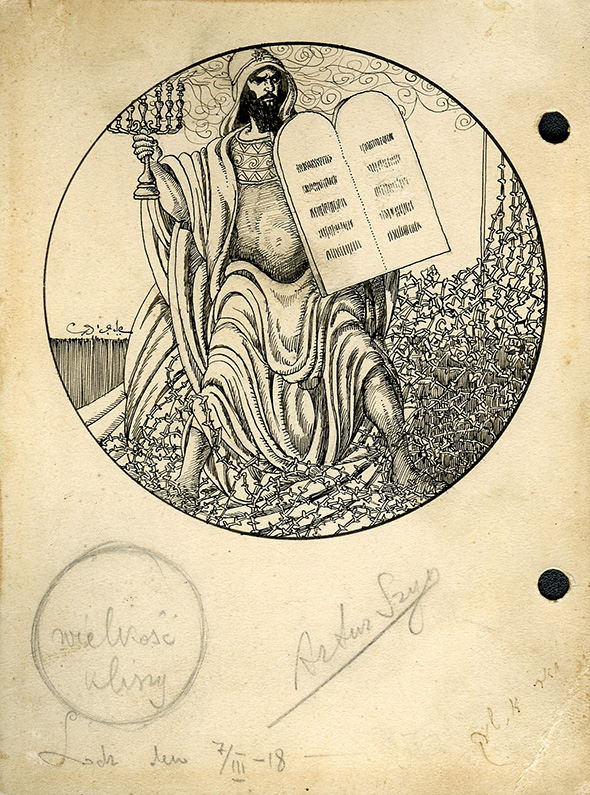
Moses the Prophet. Lódz, 1918.
Szyk’s Earliest Known Portrait of Moses
SZYK, Arthur. Moses the Prophet. Signed twice (once in Hebrew) “Artur Szyk.” Additional notations in unknown hand, with date “Lódz [illegible word] 7/III/18 [March 7, 1918].” Lódz, 1918. Original pen and ink drawing on board. Sketches and doodles on verso. Sheet size: 5 1/2″ x 4″. Circular illustration 3″ in diameter. With the exception of some soiling and two punch holes on right margin, overall Very Good condition.
This illustration of a youthful Moses, who bears a lighted menorah in his right hand and the tablets of the Ten Commandments with his left, dates from the earliest years of Arthur Szyk’s career. The sinuous lines of the candle smoke, Moses’ robe, and the thorny brambles at his feet are reminiscent of the curvilinear Art Nouveau style.
In later work, Szyk often depicted Moses as the Lawgiver (that is, with the Ten Commandments) or as a Miracle Worker (parting the Sea of Reeds). Yet this presentation of Moses with the tablets of the law as well as a lighted menorah is, to our knowledge, absolutely unique in the artist’s oeuvre. Moses is not a white-bearded elder but a youth at the height of his strength. His wide-legged stance and determined expression are that of a fighting man: he brandishes the menorah like a weapon and the Ten Commandments like a shield against adversity. (The absence of the divine “horns” of light emanating from Moses’ head, the heavy winds battering the flames of the menorah, and the tangled brambles at Moses’ feet all suggest the threat is corporeal, not spiritual.) Here, Moses is not the Lawgiver or a Miracle Worker but a Prophet doing battle for the Jewish People.
After studying at the Academy of Fine Arts in Krakow, in 1914 Szyk took an extended tour of Palestine with several other young Polish-Jewish artists and writers. While in Jerusalem he visited the relatively new Bezalel Academy of Arts and Design, which was strongly influenced by Zionist ideals. Many artists at Bezalel were determined to produce distinctively Jewish art to reaffirm their place (and the place of 20th century pioneers) in the unbroken continuum of Jewish history. Biblical scenes and figures thus were popular subject matter. The graphic black and white style of this illustration may well show the influence of Ephraim Moses Lilien (1874–1925), a founder of the Bezalel school and a one-time student at the Krakow Academy.
Historical significance: Szyk’s images of Moses (most notably in his Passover Haggadah) consistently portray the man as a fierce warrior rather than a wise old man. This earliest known drawing of Moses shows the artist embraced this interpretation of the great leader of Israel from the very beginning of his career — as the greatest prophet of ancient Israel.