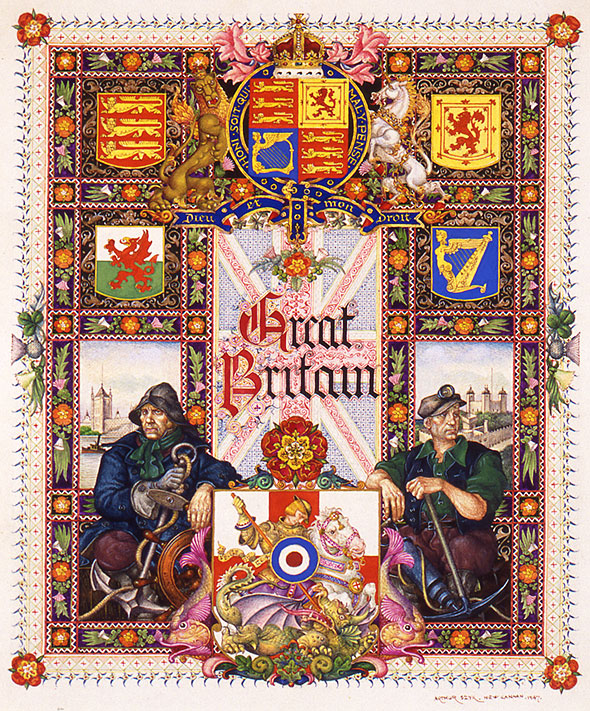
Great Britain. Visual History of Nations series. New Canaan, 1947.
SZYK, Arthur. Great Britain. Visual History of Nations series. Signed and Dated “Arthur Szyk, New Canaan, 1947”. Watercolor and gouache, graphite pencil, and ink on board. Sheet size: 11″ x 7 1/2″. Image size: 7 7/8″ x 6 9/16″. Very Good condition.
Quality and craftsmanship are apparent in Arthur Szyk’s painted history of Great Britain, which combines luminous colors with elaborate, detailed patterns and heraldic symbols.
At the top of the painting, the Imperial Crown sits above a blue garter, which surrounds Great Britain’s Royal Standard. The blue garter stands for the Order of the Garter. Created by King Edward III in 1348, the Order of the Garter is the oldest British Order of Chivalry. As the story goes, when King Edward picked up a blue garter worn by his dancing partner, the Countess of Salisbury, he quipped in French, “Honi soit qui mal y pense” (“Evil be to him who evil thinks”), which is lettered in gold around the center shield. Below, Dieu et mon Droit (My God and my right), the royal motto, is lettered in gold as well.
Supporting the central shield are the lion of England and the unicorn of Scotland. The four quadrants of the Royal Standard show tokens of Great Britain’s states: three gold lions passant, appearing twice (England), the harp (Ireland), and a red lion rampant (Scotland). These three icons are repeated in larger form at the illustration’s left and right sides, where they are joined by a fourth: Wales’ scarlet dragon segreant.
In the center and at the illustration’s corners is the Tudor rose, a longtime symbol of British royalty. A red dog rose with white interior petals and a gold center, it was adopted by the Tudor line in the late 15th century after the War of the Roses. A pattern composed of the Tudor rose, the purple thistle of Scotland, the green shamrock of Ireland, and the yellow daffodil of Wales occurs regularly throughout this piece.
At the center is the Union Flag of the United Kingdom, more commonly known as the Union Jack. Its design is a harmonious amalgam of three different symbols: a red cross on white background (the cross of St. George, patron saint of England), a diagonal white cross on blue background (the cross of St. Andrew, patron saint of Scotland), and a diagonal red cross on white background (the cross of St. Patrick, patron saint of Ireland).
The worker and sailor shown in the lower half of the painting represent the labor force of Britain on land and sea, which is the foundation of the British Empire’s economic vitality. The modern Houses of Parliament (pictured over the sailor’s right shoulder) and the Tower of London (pictured over the miner’s left shoulder) display the balance of royal and popular power that has served the British over the centuries.
At the bottom of the painting is a depiction of St. George slaying the dragon (note the cross of St. George in the background). It is overlaid with the round insignia of the Royal Air Force, linking St. George’s triumph over the monster to Britain’s victory over Nazi Germany in World War II.
Historical Background: Arthur Szyk completed the visual histories of nine countries of his United Nations series (Visual History of Nations series). This series of original artworks was commissioned by Canadian stamp dealer/entrepreneur Kasimir Bileski beginning in 1945. Great Britain was painted by Szyk in the same year as the visual histories of U.S.S.R., France, and China.
Provenance: Kasimir Bileski to George Gooche, founder of The Arthur Szyk Society.
Exhibition History: Wilshire Blvd Temple, Los Angeles, CA, May 17–October 31, 1991; Spertus Museum, Chicago, August 16, 1998–February 28, 1999; Fine Arts Museums of San Francisco, Palace of the Legion of Honor, December 4, 2010–March 27, 2011.
Publishing History: Reproduced by Kasimir Bileski in 1947 as a lithographic print to serve as a frontispiece in albums for collectors of stamps of Great Britain. The Robb Report, The Magazine for Connoisseurs, November 1990, p. 14.