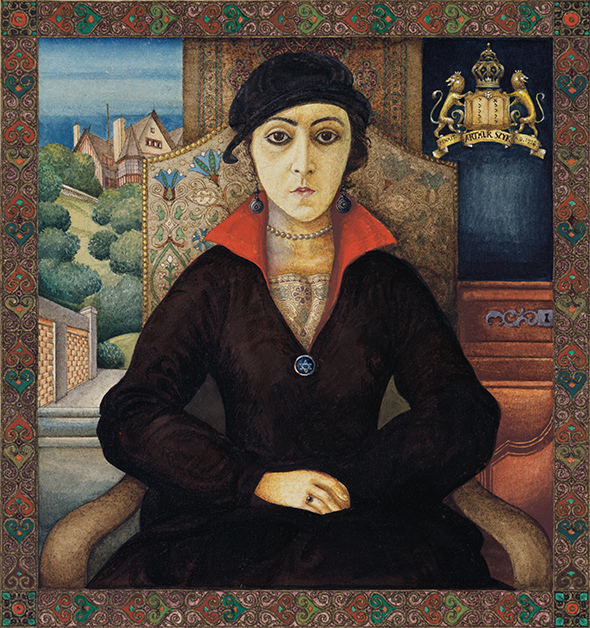
Portrait of Julia Szyk. Paris, 1926.
SZYK, Arthur. Portrait of Julia Szyk. Signed and Dated “Pinxit [Latin: he painted it] Arthur Szyk A.D. 1926”. (Paris). Original pen, ink, watercolor and gouache on paper. Image size: 6 1/2″ x 6 1/2″. Archivally matted and framed: 13 1/2″ x 13″. Very Good condition.
Portrait of Julia Szyk was painted in Szyk’s true illuminated style; the rich border pattern, the intricate design on the back of the lady’s chair, and the subtle fabric folds and printed inset of her gown. The Star of David pinned at her bodice depicts her as a Jewish woman of high esteem. In the painting’s right corner is a Jewish heraldic device composed of a Torah crown, the Ten Commandments and the Lions of Judah.
Arthur Szyk and his wife Julia moved to Paris from Poland in 1921 to be closer to the art world and further from the growing anti-Semitism in Eastern Europe. He developed a close personal and working relationship with the antiquities dealer Auguste Decour who presented three exhibitions of Szyk’s work between 1922 and 1928. These included a wide array of illuminations based on Biblical stories, folk tales, Near Eastern themes and portraits like this one.
Julia Szyk was a known beauty in her time and her husband made great use of her pulchritude as a model for many of his artworks. In this study, painted early in his career, can be seen the same dark-eyed honesty that he brought to the face of Esther in his 1925 publication Le Livre D’Esther. Over her right shoulder is a tranquil scene of what appears to be a home and gardens. This chateau-like structure was, in fact, the A. Decour estate in Rolleboise in which Arthur and Julia Szyk lived, as his guests, for two years. Arthur Szyk also designed ex libris for both Auguste Decour and his wife Lucie M. Decour; both bookplates showing scenes of Rolleboise, similar to our portrait (see Ansell, Arthur Szyk: Artist, Jew, Pole for images, p. 5)
Although Szyk certainly painted women, they were by and large superceded by the many representations of male heroes. This is a most unusual rendering of his interpretation of the essence of Jewish womanhood. Who to better exemplify it, than his own beauteous Julia?
Provenance: Harry Glemby.
Exhibition History: Deutsches Historisches Museum, Berlin, 29 August 2008–4 January 2009; Fine Arts Museums of San Francisco, Palace of the Legion of Honor, December 4, 2010–March 27, 2011.
Publishing History: Newsletter, The Arthur Szyk Society, Burlingame, CA, Summer 2002, p. 7: Drawing Against National Socialism and Terror, Deutsches Historisches Museum catalogue, Berlin, 2008, pp. 54-55; Artur Szyk: Dziedzictwo polsko-zydowskiego artysty [The Legacy of Polish-Jewish Artist], Krakow, Stradomskie Centrum Dialogu, 2011, p. 72; Artur Szyk: Man of Dialogue [Polish and English editions], Centrum Dialogu, Lodz, 2011, p. 20.
Literature: Excerpt from entry in Deutsches Historisches Museum catalogue by art historian and curator Katja Widmann: “The painting cites differing epochs of the history of art. Through his use of a renaissance ambiance Szyk refers to artistic traditions. He chose though, to paint his wife in the style of the new objectivity, which was highly modern at the time.” Excerpt from wall label at Fine Arts Museums of San Francisco Szyk exhibition by art historian and curator Karin Breuer: “In this painting Szyk depicts Julia as a sophisticated, modern woman dressed elegantly with fashionable jewelry, including a brooch that identifies her as Jewish. She is seated in a composition reminiscent of Renaissance portraiture, with a landscape scene in the background through a window or doorway.”