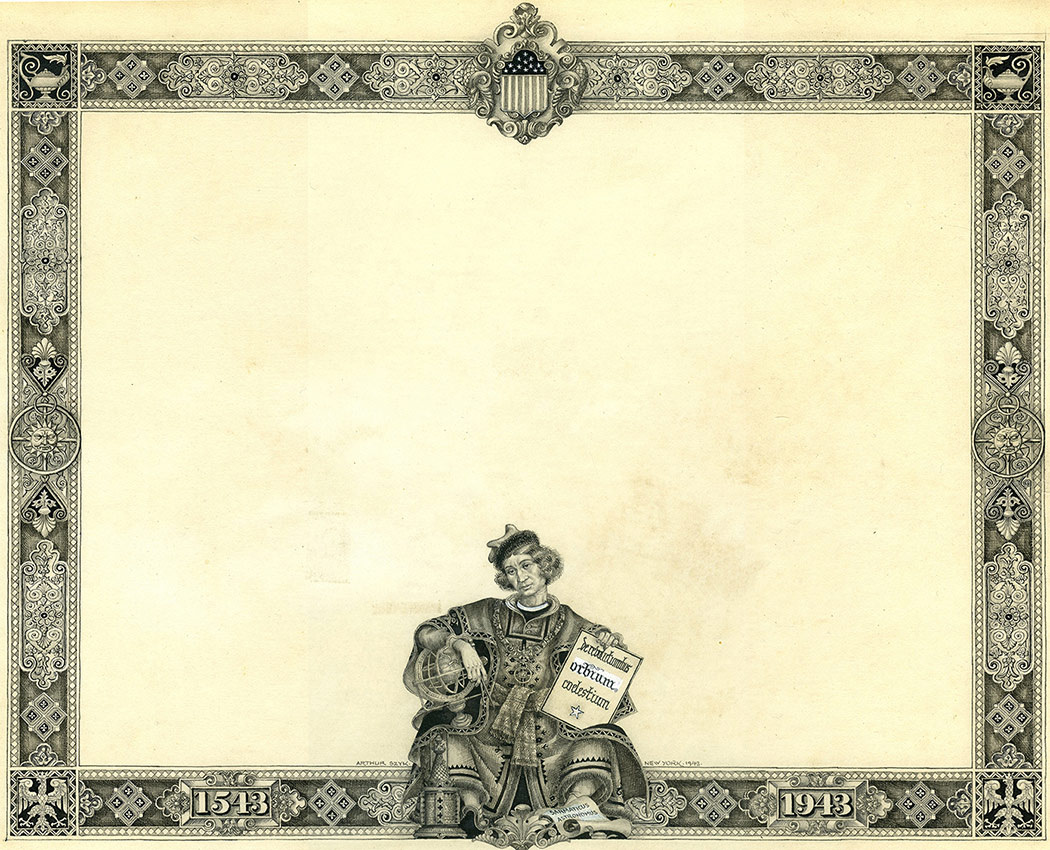
De Revolutionibus Orbium Coelestium, 1543-1943. New York, 1943.
In Honor of the 400th Birthday of Copernicus
SZYK, Arthur. De Revolutionibus Orbium Coelestium. Signed and Dated “Arthur Szyk New York 1943”. Pen and ink on board. Sheet size: 10 7/8″ x 14 1/8″. Image size: 9 1/8″ x 11 1/16″. Very Good condition.
This highly ornamented border showcases hallmarks of Szyk’s traditional style of illumination: a delight in ornate detail, symmetry, symbolism, and harmonious, balanced compositions. This particular border commemorates the 400 year anniversary of the publication of Copernicus’ landmark book De Revolutionibus Orbium Coelestium, or On the Revolutions of the Celestial Spheres. Copernicus, the great Polish astronomer whose heliocentric model of the universe marked the beginning of modern astronomy, was a man that Szyk portrayed many times throughout his career to emphasize the Polish contributions to high culture and scientific progress. In this work he depicts Copernicus seated at the bottom center of the border, holding his famed book in his left hand and a globe under his right arm. He is dressed in lavish robes befitting someone of his stature, and appears calm and thoughtful in his facial expression. Szyk peppers the border with important symbols, chief among them the Polish eagle crest in the corners, as well as solar symbols along the vertical columns of the border. It is obvious that Szyk is emphasizing Copernicus’ identity not only as a scholar, but as a Polish scholar who through his achievements lends the Polish nation dignity and importance on an international scale.
[SECOND DESCRIPTION]
In Honor of the 400th Birthday of Copernicus
SZYK, Arthur. De Revolutionibus Orbium Coelestium. Signed and Dated “Arthur Szyk New York 1943.” Pen and ink on board. Sheet size: 10 7/8″ x 14 1/8″. Image size: 9 1/8″ x 11 1/16″. Very Good condition.
This pen and ink ornamental border by Arthur Szyk commemorates Nicholas Copernicus (1473–1543) and his seminal work De Revolutionibus Orbium Coelestium, which presents the astronomer’s heliocentric understanding of the solar system. The border was an illustration for presentation certificates from the Kosciuszko Foundation that were given in 1943 (the 400th anniversary of the book’s publication and also of Copernicus’s death) to contemporary Americans who continued in the tradition of the astronomer by contributing new and challenging knowledge to society. One of the completed certificates reads:
“A Copernican Award Presented to Karlow Shapley
For effective cooperation with the Kosciuszko Foundation in the observance of the Copernican Quadricentennial.
Bestowed by the Kosciuszko Foundation
New York, May 24, 1943.”
The Award is also signed by the President and Secretary of the Kosciuszko Foundation.
The elaborate border contains a number of attractive and significant motifs. In both the upper left-hand and upper right-hand corners of the border, Szyk has drawn a lamp with a flame, representing the enlightenment that comes from knowledge. At the center-top of the border, a shield of the United States celebrates Arthur Szyk’s new homeland and the long-standing ties of affection between that nation and Poland, the land of Copernicus’s and Szyk’s birth. Moving down to the middle of the left and right sides of the border, Szyk includes stylized portraits of the sun, the center of Copernicus’s astronomical and scientific vision. At the bottom left and right corners, the eagle of the Polish coat of arms asserts the dignity of Poland in the face of the Axis onslaught during World War II.
The focal point of this intricate and beguiling border for presentation certificates is the grand figure of Nicholas Copernicus himself. On the bottom of the border to Copernicus’s right is the year “1543,” and to his left the year “1943.”The astronomer wears an academic cap and chain, the latter suspending an image of the sun surmounted by the eagle of Poland. In his left hand, Copernicus holds his book, with the title displayed on the front and the outline of a single star below. In the scientist’s right hand sits the renowned Jagiellonian golden globe, the first globe to be constructed according to Copernicus’s model of the universe. At Copernicus’s left foot, a scroll reads “Sarmaticus Astronomus” (“Sarmatian Astronomer”) to celebrate this star-gazer of eastern European heritage. Finally, at Copernicus’s right foot stands the lantern with which he viewed the night skies to make his scientific observations. Arthur Szyk also used many of these motifs in 1942, in his cover illustration for the Kosciuszko Foundation’s publication Nicholas Copernicus: 1543–1943, which provided a multifaceted introduction to the life and work of the astronomer.