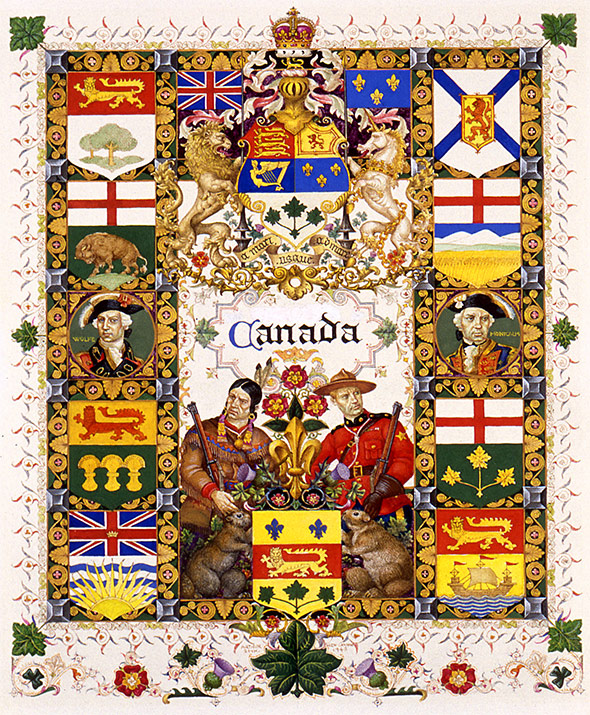
Canada. Visual History of Nations series. New Canaan, 1946.
SZYK, Arthur. Canada. Visual History of Nations series. Signed and Dated “Arthur Szyk, New Canaan, 1946”. Watercolor and gouache, graphite pencil, and ink on board. Sheet size: 11″ x 7 1/2″. Image size: 7 7/8″ x 6 9/16″. Very Good condition.
Arthur Szyk presents the heritage of Canada with a verdant illumination resplendent with deep reds, greens, browns, and gold – hues evoking its national symbol, the maple. This piece is also rich with icons of Canada’s European ancestry.
At top center, to the left of the central shield, a lion holds a lance flying the Royal Union Flag (the Union Jack). The lion and Union Jack stand for the United Kingdom. To the right, a lance bearing a blue flag with 3 gold fleurs-de-lis represents France. That lance is held by a unicorn symbolizing Scotland. The central shield itself carries four additional national symbols: three gold lions passant on a red background (England), a gold harp on blue background (Ireland), a red lion rampant on gold background (Scotland) and fleurs-de-lis (France). Beneath them three maple leaves represent Canada.
Under the shield in Latin is Canada’s motto: A Mari usque ad Mare (From Sea to Sea). It is surrounded by flora further referencing Canada’s cultural past: the red Tudor rose, the purple Scottish thistle, the green Irish shamrocks, and the French gold and white fleurs-de-lis. They also appear throughout the illustration, in the other provinces’ shields and in the borders.
Clockwise from top right are shields of arms for Canada’s (then) nine provinces: Nova Scotia, Alberta, Ontario, New Brunswick, Quebec, British Columbia, Saskatchewan, Manitoba, and Prince Edward Island. They each bear a European marker (e.g., the lion passant, seen in the shields for Prince Edward Island, Quebec, and New Brunswick). The red cross on white background is the Cross of St. George (England); the blue cross on white background is the Cross of St. Andrew (Scotland). Furthermore, the shields give testimony to the regions’ natural resources such as bison (Manitoba), agricultural fecundity (wheat in the shields of Saskatchewan and Alberta), and water (New Brunswick and British Columbia).
On the far left is a portrait of General James Wolfe; opposite him is the Marquis de Montcalm. During the final French and Indian War, both generals led forces against the other in the Battle of the Plains of Abraham (September 13, 1759). The battle removed Quebec City from French control and strengthened the pathway of British rule over Canada. It also ended Wolfe’s and Montcalm’s lives.
A member of the Royal Mounted Police (the “Mounties”) and a Native American are prominently displayed at center bottom. The beavers below them are a longtime symbol of Canadian economic and national development.
Historical Background: Arthur Szyk completed the visual histories of nine countries of his United Nations series (Visual History of Nations series). This series of original artworks was commissioned by Canadian stamp dealer/entrepreneur Kasimir Bileski beginning in 1945. Canada was the second work in the series (naturally, Bileski residing there), after The United States of America.
Provenance: Kasimir Bileski to George Gooche, founder of The Arthur Szyk Society.
Exhibition History: Wilshire Blvd Temple, Los Angeles, CA, May 17–October 31, 1991; Spertus Museum, Chicago, August 16, 1998–February 28, 1999; Fine Arts Museums of San Francisco, Palace of the Legion of Honor, December 4, 2010–March 27, 2011.
Publishing History: Reproduced by Kasimir Bileski in 1946 as a lithographic print to serve as a frontispiece in albums for collectors of Canadian stamps; Art History Publication Series No. 5, The Arthur Szyk Society, Burlingame, CA, 2010, p. 4; Artur Szyk: Dziedzictwo polsko-zydowskiego artysty [The Legacy of Polish-Jewish Artist], Krakow, Stradomskie Centrum Dialogu, 2011, p. 108-109.