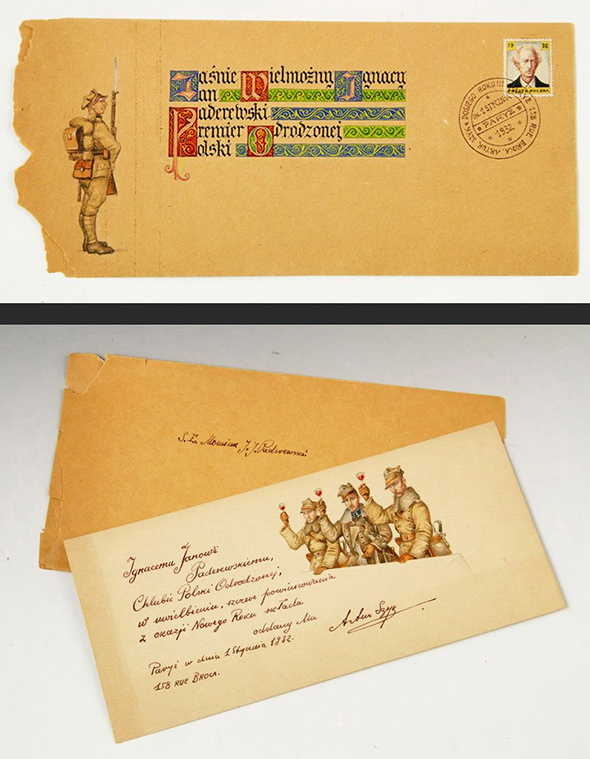
Illuminated Envelope and Greeting Card (with Letter). Paris, 1932.
New Year’s Day 1932: Linking his Washington Series with Paderewski
SZYK, Arthur. (PADEREWSKI) Autograph Letter Signed, Illuminated Greeting Card, and Illuminated Envelope to Ignacy Paderewski. Signed and dated (Letter, Greeting Card, and Illuminated Envelope) : “1 Stycznia 1932 Artur Szyk [January 1, 1932 Arthur Szyk].”(Paris). Pen, ink, watercolor, and gouache on paper and card stock. Measurements: Autograph Letter Signed, sheet 10 1/2″ x 8 1/4″; Illuminated Greeting Card, sheet 8 3/4″ x 3 15/16″; Illuminated Envelope, sheet 8 3/4″ x 4″. Accompanied by additional envelope addressed to “S.E. Monsieur I. J. Paderewski [His Eminence Mr. I. J. Paderewski.]. ” Very Good condition.
Arthur Szyk illustrated and inscribed three marvelous specimens of his vision for the former prime minister of Poland Ignacy Jan Paderewski, as New Year’s greetings dated January 1, 1932. All the pieces provide strong testimony to the artist’s unparalleled talent. Paderewski, a noted musician, served as Poland’s first premier after World War I. As Szyk biographer Joseph Ansell has observed, Szyk may have known Paderewski from the 1920s, when both men lived in Paris, and the two men maintained regular contact during the 1930s.
Over the years, Szyk illustrated a number of letters, including several in the 1920s that were addressed to the American businessman Harry Glemby, who became the first collector of the artist’s work. The illuminated envelope included in this set of items, however, is the only one known to have been illustrated by Szyk.
AUTOGRAPH LETTER SIGNED: The text of Szyk’s New Year’s letter to Paderewski is as an introduction on behalf of Arthur Jaffe, whose father’s company, Max Jaffe Verlag of Vienna, served as Szyk’s publisher and had recently produced collotype prints of the artist’s notable series of portraits entitled George Washington and His Times. In the letter, Szyk asks Paderewski to “[extend] his Valuable support to Mr. Jaffe in the event there [is] need for it.” The artist may have been seeking the former prime minister’s help in selling the original paintings of his Washington series to the government of the United States on the occasion of the bicentennial of Washington’s birth in 1932. According to the Franklin D. Roosevelt Library and Museum, Szyk eventually sold the Washington series to the Polish president Ignacy Moscicki, who in 1935 presented Szyk’s creation as a gift from the Polish nation to U.S. president Franklin D. Roosevelt. In this connection, Arthur and Julia Szyk came to the United States for an extended visit in 1933 and 1934. During their stay, an exhibition at the Library of Congress displayed a varied range of Szyk’s work, and Congress awarded Szyk the George Washington Medal in recognition of his series of illustrations commemorating the first U.S. president.
ILLUMINATED GREETING CARD: Accompanying his charming letter to Paderewski, Szyk illustrated a splendid greeting card adorned with three Polish soldiers wearing uniforms from 1919, as a tribute to Paderewski’s time as prime minister. Each raises a bright glass of red wine in a festive New Year’s toast. The handwritten note beside this picture reads (in translation): “To Ignacy Jan Paderewski, the pride of Reborn Poland, in adulation, devoted Arthur Szyk offers sincere greetings on the occasion of the New Year.”
ILLUMINATED ENVELOPE: As a token of affection and admiration for the former Polish leader, Szyk created an illuminated envelope addressed to Paderewski and containing several unforgettable graphic elements, all accompanying the illuminated greeting card. At the left of the envelope, the artist has painted a Polish infantryman in profile, again dressed in a uniform of 1919. Holding a bayonet straight up, he patriotically stands guard and faces right, suggesting attention to and respect for what lies in front of him. The center of the envelope consists of an illuminated salutation to Paderewski as follows: “Illustrious Honorable Ignacy Jan Paderewski Premier of Reborn Poland.” Szyk has adorned the salutation with several gothic initials executed in red, green, and blue, framing each initial with delicately sinuous motifs suggesting foliage. He has also elegantly staggered the text across four lines, creating more space for the display of Paderewski’s name and title by filling out individual lines with green and blue panels enclosing gently undulating patterns.
At the right end of the envelope, Arthur Szyk has hand-painted a stamp with the head of a figure (Paderewski himself) in front of a sky-blue background, with gold trim. The writing at the top and bottom of the stamp reads “1932 Poczta Polska [Polish Post].” In the course of his career, Szyk designed stamps for the nations of Israel and Liberia, for the Emergency Committee to Save the Jewish People of Europe during World War II, and for the American League for a Free Palestine in 1945. Over the lower left-hand corner of the hand-painted stamp, Szyk has hand-drawn a celebratory postal cancelation mark with the words: “DOSIEGO ROKU!!! PARYZ 158 RUE BROCA. ARTUR SZYK DN. 1 STYCZNIA 1932 PARYZ [Happy New Year!!! Paris 158 Broca Street. Arthur Szyk, January 1, 1932. Paris].” This miniature stamp and cancellation are remarkable.
Together these three original pieces offer a revealing glimpse into this remarkable artist’s personal, business, and community relationships. Moreover, they stand as supreme examples of Arthur Szyk’s artistry and imagination, and as historic documents of Szyk’s devotion to his native Poland.
RARITY: Szyk autograph letters are extremely rare on the market. Illuminated greeting cards are rarely seen, and this is the first example we have seen of an illuminated envelope. We have never seen a grouping of this nature before.
References Consulted: For an example of an illustrated letter to Harry Glemby, see Arthur Szyk: Drawing Against National Socialism and Terror. Berlin: Deutsches Historisches Museum, 2008, pp. 50-53. Szyk also illustrated holiday cards andletters to his gallery patron in Paris, Auguste Decour.
Provenance: Frank Rabbito, whose father owned a building in which Arthur Jaffe worked. Rabbito’s family is the only previous owner of this collection.