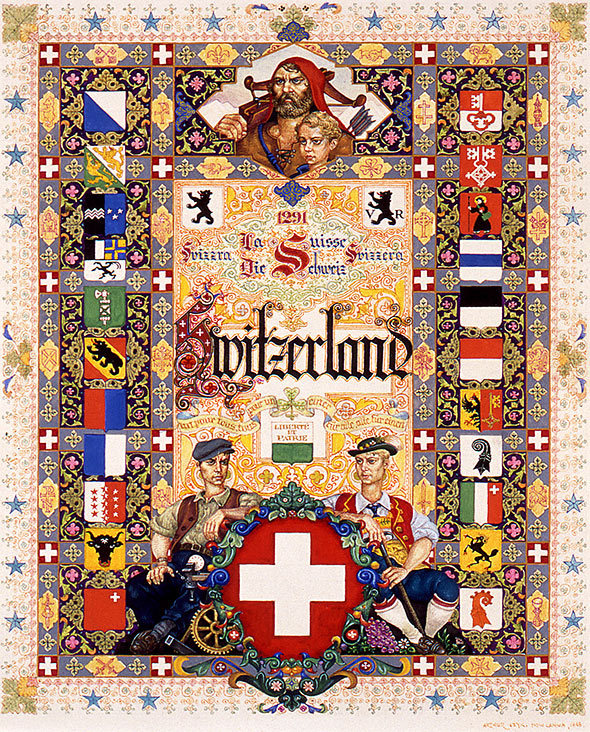
Switzerland. Visual History of Nations series. New Canaan, 1948.
SZYK, Arthur. Switzerland. Visual History of Nations series. Signed and Dated “Arthur Szyk, New Canaan, 1948”. Watercolor and gouache, graphite pencil, and ink on board. Sheet size: 11″ x 7 1/2″. Image size: 7 7/8″ x 6 9/16″. Very Good condition.
Like a timepiece of great craftsmanship, Arthur Szyk’s illustrated history of Switzerland is imbued with fine detail and gleams with jeweled colors.
Prominently placed at the top of the illumination are the 14th century farmer and famous hunter William Tell and his young son. According to legend, when forced to choose between bowing his knee to an Austrian overlord and shooting an apple off the head of his own son, Tell successfully accomplished the latter. Since then, William Tell has been an inspirational story – both within Switzerland and outside it – of an underdog’s ability to triumph.
Underneath the Tells’ image is the date 1291. This is the year that Switzerland was formed, when representatives of the three states (or cantons) of Uri, Schwyz, and Nidwalden vowed that they should forever remain free from foreign control and interference. Szyk references the main linguistic and cultural regions of Switzerland by printing the country’s name in their languages: la Suisse (French), die Schweiz (German), Svizzera (Italian), and Svizzra (Romansch). Below the country’s name in English is Switzerland’s unofficial national motto: All for one and one for all (in French on the left, and in German on the right).
Just below the motto is a shield representing the canton of Vaud. Two other cantons are also represented in this central rectangular area: Appenzell Innerhoden and Appenzell Ausserrhoden, left and right (respectively), under the image of William Tell.
Along the left and right sides of the illustration are shields of the remaining (then) 22 Swiss cantons. Clockwise from top right are: Obwalden, Nidwalden, Glarus, Zug, Fribourg, Solothurn, Geneva, Basel-Stadt, Neuchâtel, Schaffhausen, Basel-Land, Schwyz, Uri, Valais, Lucerne, Ticino, Bern, St. Gallen, Graubünden, Aargau, Thurgau, and Zürich. (The 26th canton, Jura, was created in 1978, after this Visual History was completed.)
At the bottom of the illustration is a seated worker adjacent to a cog signaling the unparalleled Swiss reputation for watchmaking. On the right, the second man’s colorful traditional attire is what one will see at an Alpaufzug – an Alpine cattle drive. In full festive parade, cows and goats are moved in the autumn from higher-altitude pastures to lower-altitude ones (and vice versa in the spring). Between the men is a large image of the Swiss flag, an equilateral white cross on a red background.
Historical Background: Arthur Szyk completed the visual histories of nine countries of his United Nations series (Visual History of Nations series). This series of original artworks was commissioned by Canadian stamp dealer/entrepreneur Kasimir Bileski beginning in 1945. Switzerland was painted the same year as Israel.
Provenance: Kasimir Bileski to George Gooche, founder of The Arthur Szyk Society.
Exhibition History: Wilshire Blvd Temple, Los Angeles, CA, May 17–October 31, 1991; Spertus Museum, Chicago, August 16, 1998–February 28, 1999; Fine Arts Museums of San Francisco, Palace of the Legion of Honor, December 4, 2010–March 27, 2011.
Publishing History: Reproduced by Kasimir Bileski in 1948 as a lithographic print to serve as a frontispiece in albums for collectors of stamps of Switzerland. Shalom, Le Magazine Juif Europeen (The European Jewish Times), Geneva, Switzerland, Pessah (April), 1999, p. 86.