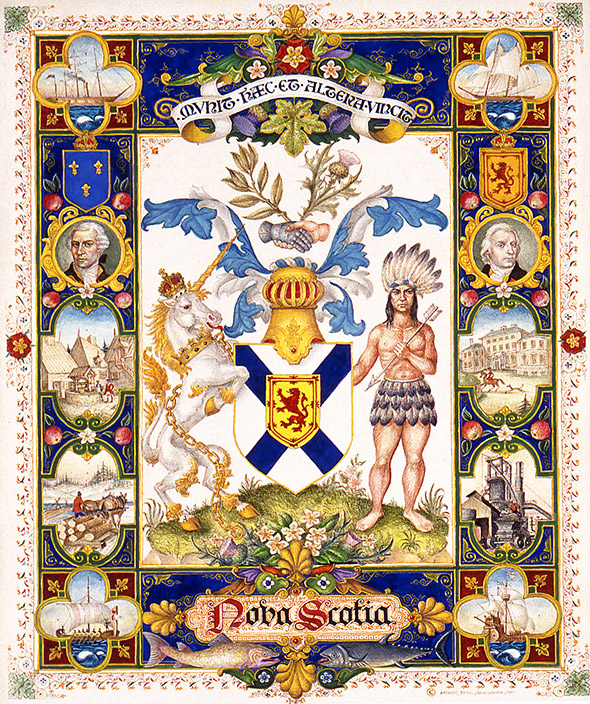
Nova Scotia. New Canaan, 1951.
SZYK, Arthur. Nova Scotia. Visual History of Nations series. Signed and Dated “©Arthur Szyk, New Canaan, 1951”. Watercolor and gouache, graphite pencil, and ink on board. Sheet size: 10″ x 7 1/2″. Image size: 8 3/8″ x 7 1/8″. Very Good condition.
Nova Scotia’s arms, dating back at least to the Stuart Dynasty, commemorate Scotland (after which the founding colony was named: New Scotland). Scotland’s national flag – a white saltire (diagonal cross) on blue is here shown on the center shield with the colors reversed. In the shield’s center appear another symbol of Scotland – a red lion on a gold background – and the crowned unicorn at the shield’s side as well. A Native American stands on the other side of the shield.
Nova Scotia’s motto (Munit Haec et Altera Vincit) roughly translates as “One defends, the other conquers” and is ostensibly represented by the two hands clasped below (one armored, the other bare). From behind the hands extend a laurel branch (representing peace) and a thistle (the plant badge for Scotland). In the border’s upper left and right are the royal arms of France (3 fleurs-de-lys on blue) and Scotland (the red lion on gold background). At the bottom of the painting are a salmon (left) and tuna (right).
Historical Background: Arthur Szyk completed the visual histories of nine countries of his United Nations series (Visual History of Nations series). This series of original artworks was commissioned by Canadian stamp dealer/entrepreneur Kasimir Bileski and was reproduced as lithographs to serve as frontispieces in stamp albums, each introducing the stamps of that particular country. The original works of art were commissioned, completed, and reproduced between 1945 and 1948 and printed in New York. An additional work of art, There Shall Be Wings [Da Vinci and The History of Flight] was also part of this series and served as a frontispiece for collectors of Air Mail stamps. In 1951, Szyk took up the series again, completing two additional visual histories: Nova Scotia and Newfoundland. It was the year he died, the lithographs were never reproduced. Why Nova Scotia and Newfoundland?—most probably because Bileski, a Canadian, felt that these lithographs would do well in his own country. With Szyk now gone, Bileski gave up on the project. Who else but an Arthur Szyk would have the knowledge, skill, talent, and unfinished passion to create such stunning historic and artistic treasures?
Provenance: Kasimir Bileski to George Gooche, founder of The Arthur Szyk Society.