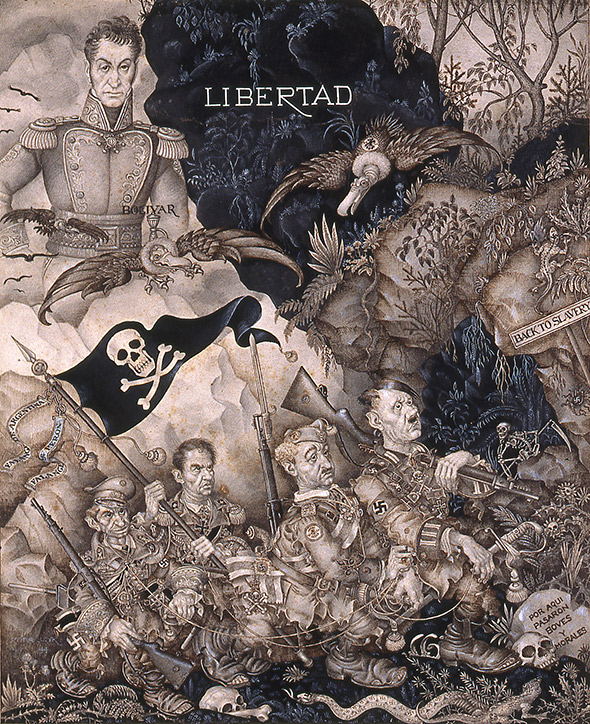
Libertad. Liberating the Oppressed, or Oppressing the Liberated? Ink & Blood. New York, 1944.
Szyk’s Detailed Understanding of South American Fascism and Liberation
SZYK, Arthur. Libertad. Liberating the Oppressed, or Oppressing the Liberated? Will there arise another Bolivar? Signed and Dated “Arthur Szyk NY (19)44”. Pen, ink and graphite on paper. Sheet size: 13 1/2″ x 10 3/4″. Image size: 12 1/2″ x 10 1/4″; hand-painted mat border measures 2″ wide; framed to 22 1/2″ x 19 1/2″. Some discoloration, overall Very Good condition.
ORIGINALLY PUBLISHED IN SOUTH AMERICA. Szyk’s powerful censoring of the Fascist regimes stomping their way across the jungle of death is magnificently portrayed in this intricately detailed pen and ink drawing. The stern, judgmental face of Simon Bolivar, Liberator of South America, gazes down upon Hitler and his obedient sycophants Franco (Spain), Peron (Argentina) and Ramirez. Vultures flying in the air, bleached bones and skulls on the ground, the Jolly Roger flag unfurled, all are graphic icons of the stenchful death that travels with this evil group.
HERE PASSED BOVES AND MORALES. As Bolivar of Venezeula fought to liberate three South American countries from the colonial dominion of Spain, early in the 19th century, he was briefly derailed by Spanish forces led by Boves and forced to flee while the land was “made safe again”. Szyk casts ironic allusions to the idea of the “Falange” — Fascist party, returning along the same road trod by Boves and Morales in their attempt to again liberate South America. A signpost ahead reads “Back to Slavery” to guide the men back to the institution abolished by the free nation of Venezuela in 1854. Spiders and lizards slither alongside a swastika covered serpent labeled “Falange Sinarquismo”.
The question is then poised… Liberating the Oppressed? Or Oppressing the Liberated? Is the world to believe Fascism is on the right road? As drawn by Arthur Szyk, this road is paved in Death.
Provenance: Parke Bernet Sale, New York, Mrs. Arthur Szyk, March 26, 1959. Lot 70 [illustrated].
Exhibition History: United States Holocaust Memorial Museum, Washington, DC, April 10–October 14, 2002.
Publishing History: PM newspaper. New York, August 20, 1944; El Nacional newspaper. Caracas, Venezuela, Dec. 5, 1944; Ink & Blood, A Book of Drawings, New York: Heritage Press, 1946, plate number LVIII. (Illustrated); Shikes, Ralph. The Indignant Eye. The Artist as Social Critic in Prints and Drawings from the Fifteenth Century to Picasso. Boston: Beacon Press, 1973, plate 346; Sodei, Rinjiro, Arthur Szyk: Indignant Jewish Illuminator [Text in Japanese], Tokyo, Japan, 2007, p. 198.
Rarity. Hand-painted mat accompanies Szyk’s illustration: This green and orange watercolor border with black ink and gold, is painted in a repetitive geometric pattern on a mat, separate from the painting (but intended to be part of it). This is the only hand-painted border known to accompany a Szyk painting and we have no doubt it is by Szyk himself!
Literature: From Shikes The Indignant Eye, 1973, p. 349: “Not until the forties and fifties were American artists—interestingly, most of them foreign-born—able to go beyond the “violently obvious” and effectively transmit that fascism was a betrayal of mankind. With infinite detail and lines drawn with a jeweler’s precision, Polish-born Arthur Szyk assailed the dictators in a series of exquisitely delineated satires, treating the men like figures in a folk tale. In Libertad, Simon Bolivar, the Latin American liberator, looks down on Hitler, Franco and two South American fascist allies who betrayed their heritage. The dictators parade through a Gothic landscape.”
[SECOND DESCRIPTION]
ORIGINALLY PUBLISHED IN SOUTH AMERICA. Arthur Szyk strongly condemns fascism in this intricately detailed pen and ink drawing. Simón Bolivar (1783-1830), Liberator of South America, gazes sternly from the clouds while Hitler, Francisco Franco, Pedro Ramirez, and Juan Perón march by below. In his right hand Hitler holds a line which ends in a noose around Franco’s neck. Franco, in turn, holds two lines in his hand; they extend back to encircle Ramirez’s and Perón’s necks. Symbols of death and decrepitude surround the men: carrion birds in the sky, bleached bones on the ground, an unfurled Jolly Roger. Blossoming flowers reveal skulls in their centers, and possibly Death himself with his scythe sits thoughtfully on a rock to the right of Hitler.
Sorting who holds a noose around whom’s neck discloses Szyk’s political savvy. Franco rode on the coattails of Hitler and Nazism for his own political gain; Latin American Falangists looked to the fascism of Franco’s Spain and sought to apply its principles to other Spanish communities—thus Ramirez’s and Perón’s unhealthy connection directly with Franco, while Franco is connected directly to Hitler. Colonel Perón led a military coup in Argentina on June 4, 1943 which installed Ramirez as president. Here Szyk depicts Ramirez as Perón’s spokesperson of sorts: he holds a lance to which are attached the banners “Falange de Argentina” and “Falange Peron”. At their feed a swastika-covered serpent is labeled “Falange Sinarquismo,” referring to the 1930s Mexican synarchist political movement, similar to fascism.
At the bottom right a stone (or gravestone?) shows the words “Por Aqui Pasaron Boves y Morales” (This way Boves and Morales passed). Francisco Morales rose to the rank of field Marshal in the Spanish army during the Venezuelan War of Independence, and in 1813-1814 he led Venezuelan campaigns under José Boves, a man remembered for the atrocities he committed against those who supported Venezuelan independence. (Those campaigns temporarily drove Bolivar out of Venezuela.) Szyk warns that the Falangists will take their countries down the deadly pathway (to slavery, their signpost reads) that Boves and Morales created over a century before.
The question is then poised: Liberating the oppressed? Or oppressing the liberated? Is fascism on the right road? As drawn by Arthur Szyk, this road is paved in death.
Provenance: Parke Bernet Sale, New York, Mrs. Arthur Szyk, March 26, 1959. Lot 70 [illustrated].
Exhibition History: United States Holocaust Memorial Museum, Washington, DC, April 10–October 14, 2002.
Publishing History: PM newspaper. New York, August 20, 1944; El Nacional newspaper. Caracas, Venezuela, Dec. 5, 1944; Ink & Blood, A Book of Drawings, New York: Heritage Press, 1946, plate number LVIII. (Illustrated); Shikes, Ralph. The Indignant Eye. The Artist as Social Critic in Prints and Drawings from the Fifteenth Century to Picasso. Boston: Beacon Press, 1973, Entry 346; Sodei, Rinjiro, Arthur Szyk: Indignant Jewish Illuminator [Text in Japanese], Tokyo, Japan, 2007, p. 198.
Rarity. Hand-painted mat accompanies Szyk’s illustration: This green and orange watercolor border with black ink and gold, is painted in a repetitive geometric pattern on a mat, separate from the painting (but intended to be part of it). This is the only hand-painted border known to accompany a Szyk painting and we have no doubt it is by Szyk himself! The mat seems only fitting to compliment the intensity of the artwork itself.
Text accompanying Szyk drawing “Libertad” featured in El Nacional —
Caracas, Venezuela December 4, 1944
TRANSLATED FROM THE SPANISH:
Expressly sent by the artist for El Nacional, we are pleased to reproduce the present piece from a notable drawing that recently appeared in the New York newspaper “PM” by the magnificent Polish painter Arthur Szyk— relative to the political situation of the Latin American front concerning the Fascist threat that currently exists with Franco in Spain. Bolivar looks on seriously as Hitler, Franco, Peron and Ramirez travel the same road passed earlier by Boves and Morales.
Szyk is a notable miniaturist and illuminator who studied in Pairs. He was a soldier in the last war of 1914 but acts alone now since being recognized for his political drawings which are featured daily in North American newspapers and magazines. He is admirably aware of our history and has spent some years in Geneva on an exposition of paintings concerning our War of Independence, none of which lamentably have come to Venezuela but have been acquired by other Latin American collections. He is a prominent figure among the progressive, Polish democratic circles in the United States headed by Orlemansky and have supported Roosevelt in his recent candidacy. Arthur Szyk has promised to send us more drawings for El Nacional.