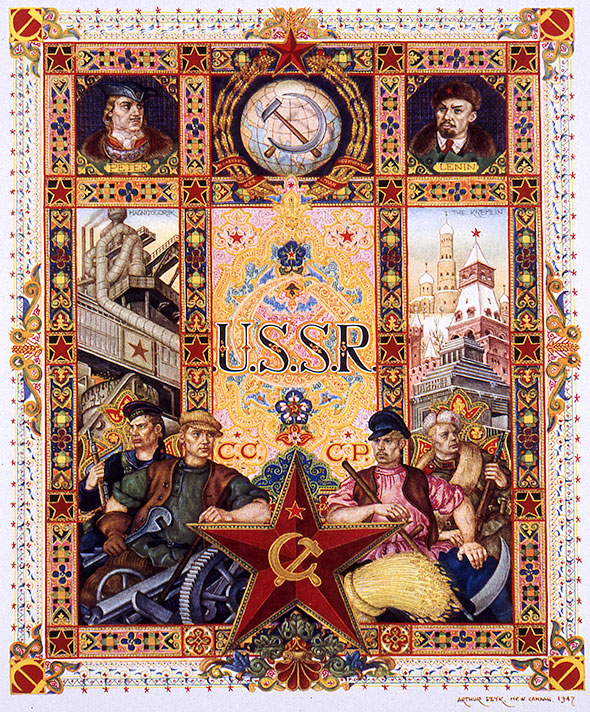
U.S.S.R. Visual History of Nations series. New Canaan, 1947.
SZYK, Arthur. U.S.S.R. Visual History of Nations series. Signed and Dated “Arthur Szyk, New Canaan, 1947”. Watercolor and gouache, graphite pencil, and ink on board. Sheet size: 11″ x 7 1/2″. Image size: 7 7/8″ x 6 9/16″. Very Good condition.
Arthur Szyk’s masterful illumination of the Union of Soviet Socialist Republics emphasizes the red end of the color spectrum. This is apropos, both because red is the color of the Communist Party, and because the word ‘red’ in the Russian language (krasny) has the same root as the Russian word for ‘beautiful’ (krasivy).
At the top and center is the Soviet Union’s state emblem. A hammer and sickle are superimposed on a world globe. This is topped by a red star and surrounded by grain bundled by a scroll displaying the popular rallying cry from Karl Marx and Friedrich Engels’ Communist Manifesto: “Workers of the world, unite!” Several of these elements are repeated throughout Szyk’s Visual History. The hammer stands for industrialized workers and the sickle for peasants. Their unified action to create the Soviet state is captured by the graphical union of the two symbols. The red star at the top stands for the Communist Party. The Soviet Union’s state motto, shown in Russian in Szyk’s illustration, has appeared as many as 16 times in the emblem’s full presentation, each iteration in a distinct language of the different Soviet republics. The stalks of wheat celebrate the U.S.S.R.’s agricultural richness, and the labor of Russia’s peasants throughout history to sustain its inhabitants.
The initials ‘U.S.S.R.’ (Union of Soviet Socialist Republics; ‘C.C.C.P.’ is the acronym for the nation’s name in Cyrillic) is juxtaposed with an ornamental background of traditional Russian and Byzantine decoration, often seen in lacquered art. With portraiture Szyk honors two men who left lasting impressions on Russia’s development: Vladimir Lenin (1870–1924) and Peter the Great (1672–1725). Peter the Great reigned over Russia from 1682 to 1725 and ushered in widespread changes to modernize and westernize Russia domestically, militarily, and governmentally. Lenin famously led the way to sweeping changes in Russia as well: after the Russian Revolution of 1917, his Bolshevik party (later renamed the Communists) took control of the country in 1922.
The Kremlin in Moscow, traditional center of political and cultural life in Russia, is depicted at right center. The city of Magnitogorsk is opposite at left center, representing the Soviet Union’s modern industrial development.
The bottom panel of the illustration offers the viewer a characterization of essential military and economic elements of the Soviet Union. A sailor and a soldier flank a worker and a farmer, all of whom support and protect the nation’s lives.
Historical Background: Arthur Szyk completed the visual histories of nine countries of his United Nations series (Visual History of Nations series). This series of original artworks was commissioned by Canadian stamp dealer/entrepreneur Kasimir Bileski beginning in 1945. U.S.S.R. was the fourth country in the series to be completed by Szyk.
Provenance: Kasimir Bileski to George Gooche, founder of The Arthur Szyk Society.
Exhibition History: Wilshire Blvd Temple, Los Angeles, CA, May 17–October 31, 1991; Spertus Museum, Chicago, August 16, 1998–February 28, 1999; Fine Arts Museums of San Francisco, Palace of the Legion of Honor, December 4, 2010–March 27, 2011.
Publishing History: Reproduced by Kasimir Bileski in 1947 as a lithographic print to serve as a frontispiece in albums for collectors of stamps of the Soviet Union.