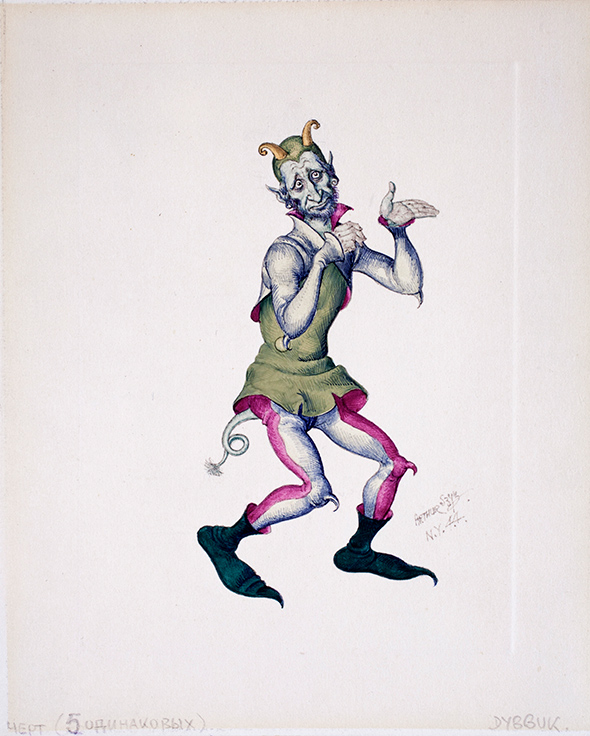
Devil. Dybbuk series. New York, 1944.
Original Costume Design for the Dybbuk
SZYK, Arthur. Devil . Dybbuk series. Signed and Dated “Arthur Szyk, NY 1944” with additional Cyrillic lettering. Watercolor and gouache on paper. Sheet size: 5 1/2″ x 4 1/2″. Image size: 3 1/2″ x 2″. On verso, printed invitation to British American Ambulance Corps exhibition by Szyk.
Arthur Szyk was truly a renaissance man within the art world. Besides his political caricatures and medieval illuminations for books, magazines and newspapers he was known to have designed costumes for theatrical productions such as those for Esterke [Yiddish Art Theatre, NYC] in 1940-41. This image of a green devilish demon was created for a production of the Dybbuk that was never realized. The demon is whimsically portrayed; dressed rather like a jester. Szyk’s prodigious knowledge of history and folkloric customs would have been a tremendous asset within the theatre.
The Dybbuk, in Jewish folklore, is a disembodied spirit that inhabits a living person for a period of time causing great confusion and sorrow. The legend of an evil spirit is found in Talmudic and kabalistic literature but the term dybbuk only came into use during the 1700’s. The folklorist S. Ansky depicted such a spirit in his classic Yiddish drama the Dybbuk, circa 1916.
According to Alexandra Bracie, Szyk’s daughter, in the early 1940’s the composer Leonard Bernstein and choreographer Jerome Robbins having just completed their first collaboration Fancy Free, first spoke about creating a ballet based on Ansky’s Dybbuk. The idea of a Jewish Homeland was on everyone’s mind at this time and Bernstein was intrigued with the idea of a project that might encompass so much of Jewish culture and legend. To this end, he met briefly with Arthur Szyk who among his many skills included that of costume designer. Szyk set to work immediately. Armed with his astounding knowledge of Jewish folklore and Eastern European culture he executed approximately 35 theatrical figures using his traditional watercolor and gouache technique.. Unfortunately, the Bernstein/Robbins idea, though not abandoned, was superseded by other projects (one being West Side Story). By the time they returned to the Dybbuk and saw its premiere in 1974, Szyk was long dead and one can only speculate on how his magnificent, colorful designs accompanied by a prodigious knowledge of history and folkloric customs might have translated to the Broadway stage.
Provenance: Parke Bernet Sale, New York, Mrs. Arthur Szyk, November 24, 1961, lot 5B.
Exhibition History: Untitled Exhibition, The Jewish Museum, New York: July, 1948.