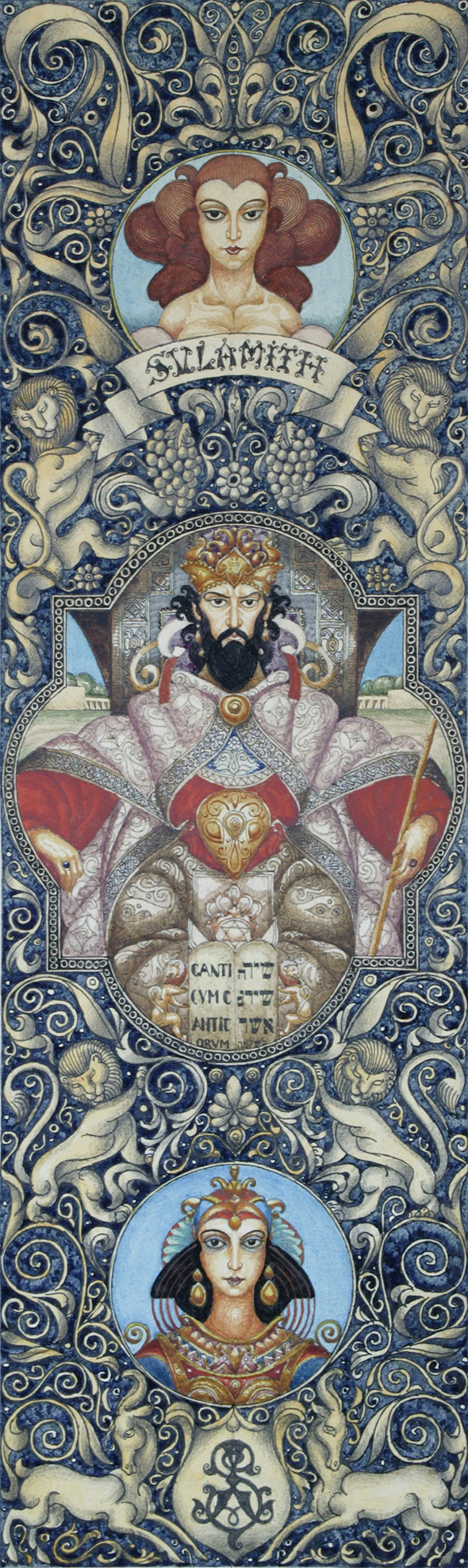
Shulamith and King Solomon. Song of Songs. Paris, 1925.
SZYK, Arthur. Shulamith and King Solomon [The Song of Songs]. Signed “A.S.” in decorative motif. (Paris, 1925). Original watercolor and gouache on paper. Image size: 9 1/4″ x 2 3/4″. Archivally matted and framed: 17 1/2″ x 10 1/2″. Fine condition.
The elaborate visual density of this painting could accommodate a full book of text, so deeply does its legend reach. The central figure is the stern and powerful King Solomon, bedecked in his finest robes and holding tablets with the words “Song of Songs” in both Latin and Hebrew. He sits between two portraits of his Sulamith (variant of Shulamit), the woman of The Song of Songs.
The Song of Songs has long puzzled Biblical scholars because its themes seem to have nothing to do with the religious concerns of the rest of the Bible. If it is among the sacred texts, doesn’t that make its meaning sacred? And yet these beautiful verses are love songs, erotic poetry, the most sensuous of language to be found in the Bible. King Solomon (the son of King David and Bathsheba) is long credited with authorship. As he had three hundred wives and seven hundred concubines, he must have been a magnificent lover and uniquely qualified to speak on the subject. Szyk evidently concurred with tradition, choosing to paint Solomon and Sulamith rather than an anonymous “lover” and his “beloved.”
Sulamith is mentioned by name in the Song of Songs, in chapter 7, verse 1: “Return, return, O Shulamit; return, return, and let us gaze upon you…” She is a rural woman who once worked her family’s vineyard, a fact emphasized by the grape clusters just beneath her nameplate. The upper portrait of Sulamith – barely clothed, her hair loose – perhaps reflects the simplicity of her life before her lover – the grand King Solomon – brought her into his chambers (Song of Songs 1:4). By contrast, the lower portrait appears to show her dressed as a queen, “lovely with ornaments” (Song of Songs 1:10) as her new station requires.
The verses in The Song of Songs are redolent in fertile imagery. The lovers speak of the sweetness of grapes, strength of a lion, and beauty of the gazelle, symbols that Szyk deftly weaves into the intricate background of the painting. It is extremely rare to find a Szyk illumination unsigned, especially one of such refinement. In this instance, he has instead sealed the work with an ornate monogram – “A.S.” – within a shield at the bottom center of the design.
Arthur Szyk readily acknowledged the importance and influence that the stories and heroes of the Bible provided for him. These legendary figures fueled the prodigious imagination and creativity that lasted the length of his lifetime. The watercolor technique seen here is among the earliest known examples of the style Szyk would make world famous. This is a rare and decidedly precious gem from the master illuminator.
Provenance: Collection of Harry Glemby, Szyk’s first patron in Paris in the 1920’s.