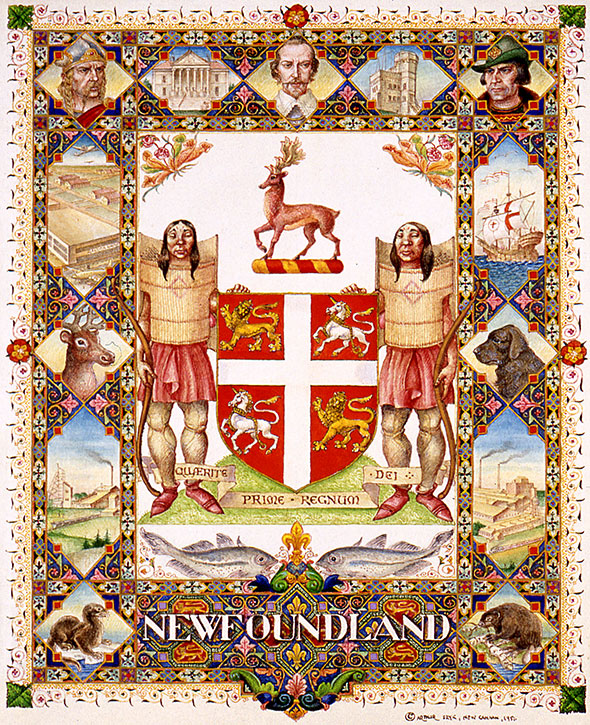
Newfoundland. New Canaan, 1951.
SZYK, Arthur. Newfoundland. Visual History of Nations series. Signed and Dated “©Arthur Szyk, New Canaan, 1951”. Watercolor and gouache, graphite pencil, and ink on board. Sheet size: 10″ x 7 1/2″. Image size: 8 3/4″ x 7 1/8″. Very Good condition.
A self-governing dominion from 1907 to 1949, Newfoundland’s arms were granted in 1638 shortly after various English settlements were unified under a single government. The basis is St. George’s cross; the unicorns and crowned lions are taken from the British royal arms and above the shield is a stag. To the shield’s left and right are 17th century Native Americans with wicker armor. The Latin text at their feet translates “Seek first the Kingdom of God.” Beneath the banner are codfish, which have long served the area as its economic base.
The men pictured across the top are Leif Ericsson, the first European explorer to land in Newfoundland (around 1001), Sir Humphrey Gilbert, who claimed it for England in 1583, and John Cabot, who re-discovered it on St. George’s Day 1497. Below Cabot is his ship Matthew with the cross of England on its sails. Opposite that is the Gander Airport, a necessary refueling stop in Szyk’s time for flights between New York and London. Other local animals shown include the caribou, sea lion, and Newfoundland dog. Meaningful flora include the pitcher plant (an emblem of Newfoundland) in the center panel. In the border are Tudor roses and fleurs-de-lys.
Historical Background: Arthur Szyk completed the visual histories of nine countries of his United Nations series (Visual History of Nations series). This series of original artworks was commissioned by Canadian stamp dealer/entrepreneur Kasimir Bileski and was reproduced as lithographs to serve as frontispieces in stamp albums, each introducing the stamps of that particular country. The original works of art were commissioned, completed, and reproduced between 1945 and 1948 and printed in New York. An additional work of art, There Shall Be Wings [Da Vinci and The History of Flight] was also part of this series and served as a frontispiece for collectors of Air Mail stamps. In 1951, Szyk took up the series again, completing two additional visual histories: Newfoundland and Nova Scotia. It was the year he died, the lithographs were never reproduced. Why Newfoundland and Nova Scotia?—most probably because Bileski, a Canadian, felt that these lithographs would do well in his own country. With Szyk now gone, Bileski gave up on the project. Who else but an Arthur Szyk would have the knowledge, skill, talent, and unfinished passion to create such stunning historic and artistic treasures?
Provenance: Kasimir Bileski to George Gooche, founder of The Arthur Szyk Society.