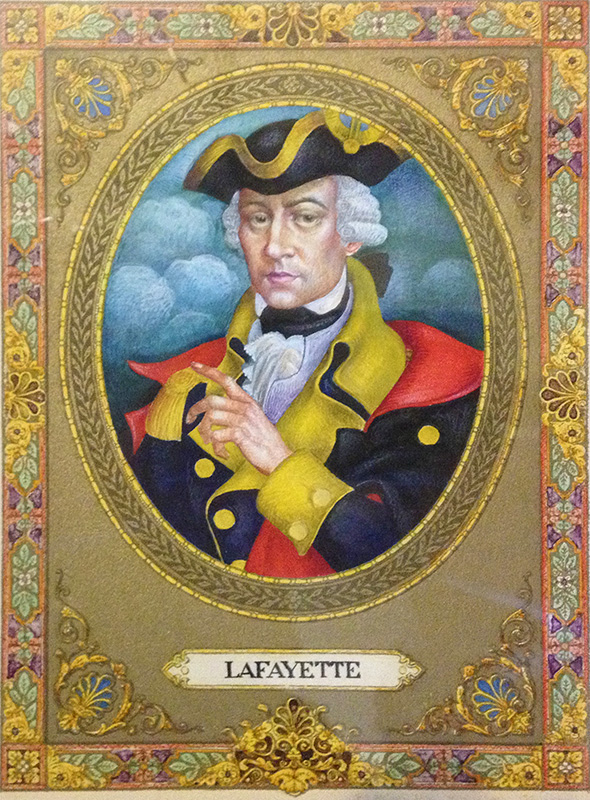
Lafayette. New Canaan, 1950.
SZYK, Arthur. Lafayette. Signed and Dated “©Arthur Szyk, New Canaan, 1950”. Accompanied by additional presentation inscription, formerly on verso of frame. Watercolor and gouache on paper. Sheet size: 10″ x 7 1/2″. Image size: 5 3/4″ x 4 1/4″. Signature faded, otherwise Very Good condition.
Late in his career, Arthur Szyk returned to a notable subject of his earlier miniature painting, the Marquis de Lafayette. The Polish-Jewish artist who fought tirelessly for freedom had always admired the American defense of liberty during the Revolutionary War, and he also recognized the courageous contributions of America’s allies during the Revolution. In the 1930s, Szyk had painted a portrait of the Revolutionary hero Lafayette as part of his series George Washington and His Times. The artist placed each portrait of that series within a double framework of an inner oval border in gold, set within an outer rectangular border decorated not only with gold and green but with red, white, and blue. In his later portrait of the Marquis de Lafayette, Szyk once again used the device of an oval border within a rectangular border, but he decisively altered his choice of colors in the new picture. Instead of the energetically patriotic red, white, and blue of George Washington and His Times, Szyk turned to a more subtle, meditative use of pastels (including pink, green, purple, and yellow) that contrast with prominent patterns of gold, black, and aquamarine.
The outer border of the portrait of Lafayette is executed in pastels, with a reddish-pink outline. A yellow flower that contains a tiny white flower at its center is found within each of the four corners of the border. Between these corners, each side of the border consists of two settings of a pink and green flower painted against a purple background. Each pink and green flower is flanked by a pair of clusters of green leaves, one of which contains a tiny white flower. The pattern of these two floral settings on each side of the border is bifurcated by a scallop outlined in yellow and filled in with black. Each of these four scallops, located at the center of each side of the border, is itself placed within a yellowish-gold setting of tendrils and leaves, with the scallop on the bottom of the border lodged within an even more elaborate setting of the same coloring and pattern. Directly above this especially ornate yellow-and –black scallop at the bottom is a nameplate reading “LAFAYETTE”.
In each of the four corners between the outer, rectangular border of the painting and the inner, oval border (wreath) of gold leaves immediately surrounding the portrait of Lafayette, Szyk has added a scallop outlined in gold but filled in with an aquamarine color instead of black. Each of these scallops is set within yellow filigree containing a touch of orange.
For the portrait of Lafayette himself, Szyk shows the head and shoulders of the Revolutionary War hero, who is dressed as an officer of the Continental Army. Lafayette’s uniform of black, red, and gold is adorned with gold buttons, while under his black tricorne hat trimmed with gold he wears the periwig that was traditional in his time. Gently rolling clouds are visible in the sky behind Lafayette’s shoulders. The marquis wears a calm expression on his face, looks straight ahead at the viewer, and points with the forefinger of his left hand, as if making a point in conversation. Together with the quiet pastels that adorn the portrait, Lafayette’s peaceful demeanor suggests the strength and assurance of a man who has achieved victory and is determined to build on that victory to make a better future. This masterful depiction of a Revolutionary hero with global appeal shows Arthur Szyk to be an unmatched virtuoso of his craft, while demonstrating the artist’s decades-long fascination and appreciation of America and the freedoms it represents.
Provenance: Dr. Ida Davidoff. Inscription in Arthur Szyk’s hand formerly on the verso of the frame: “To Helen and Donald Wallach / with lots of best wishes for a happy ‘foreverafter’ / Julia and Arthur Szyk / New Canaan 1951”. Helen was daughter of Drs. Leo and Ida Davidoff of New Canaan, CT. Leo Davidoff was Arthur Szyk’s best friend. Helen remarried Dr. Jules Hirsch, from whom this painting was purchased, after her death.