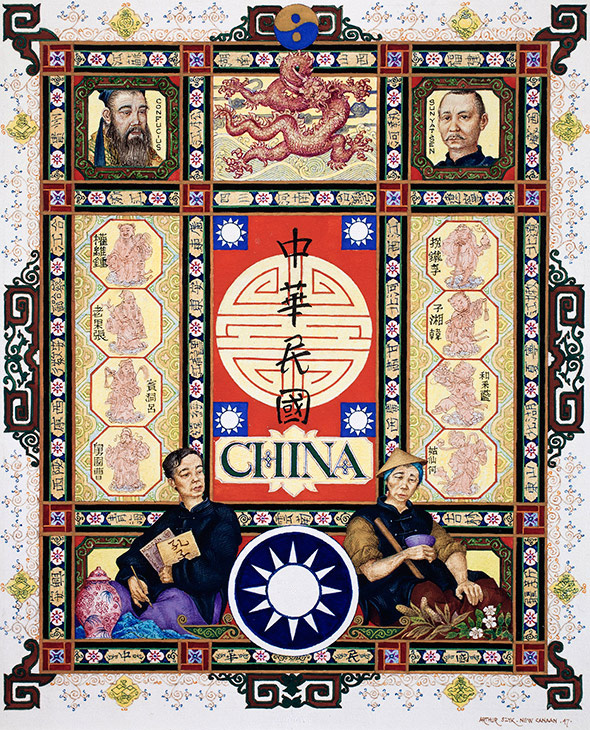
China. Visual History of Nations series. New Canaan, 1947.
SZYK, Arthur. China. Visual History of Nations series. Signed and Dated “Arthur Szyk, New Canaan, (19)47”. Watercolor and gouache, graphite pencil, and ink on board. Sheet size: 11″ x 7 1/2″. Image size: 7 7/8″ x 6 9/16″. Very Good condition.
A master of detail, Arthur Szyk evokes the delicacy and richness of fine embroidered silk in his presentation of China’s long and illustrious history.
The dragon (top center) plays a prominent part in Chinese art and folklore and is frequently portrayed with a ball or sphere nearby or in its grasp. The sphere has been interpreted as indicating something precious: a jewel or pearl (possibly of wisdom) that the dragon values and pursues. That orb’s role might be taken here by the yin-yang symbol which floats over the dragon’s head. The representation of yin and yang betokens the ubiquitous interdependence of opposites and the cyclic nature of creation and destruction.
Adjacent to the dragon are portraits of men who have had formative influences on China’s development. To the left is Confucius (551–479 B.C.E.), whose teachings on individual and social values set the foundation for how Chinese individuals lived their lives for centuries. To the right is Sun Yat-sen (1867–1925), a major force who spearheaded the end of dynastic rule in China in 1911 and replaced it with a republic.
The central section of the illumination is marked by strong saturated colors and a bold graphic style. Against a red background, black characters spelling “Republic of China” overlay a yellow Chinese symbol for long life. This is surrounded by four white stars on blue backgrounds, symbols of the Republic’s Nationalist government, which was founded after the overthrow of the Qing dynasty in the early 20th century.
In contrast, the panels left and right of center are soft with pastel hues and supple lines. Here are represented the Eight Immortals. Typically associated with Taoism, these figures have had widespread presence in Chinese literature and art. These characters are said to have achieved immortality through their studies of nature’s secrets. Each epitomizes particular conditions in life, such as poverty, wisdom, strength, and femininity.
The Nationalist China logo anchors the bottom of the picture. To its left a man, possibly a scholar, holds two texts: one with “Confucius” inscribed in Chinese characters, the other with “Modern Science” in English, possibly referring to the 1940s cultural division between maintaining traditional values and embracing those of contemporary western society. The urn and fabric at bottom left remind the viewer of China’s many contributions to the fine arts. To the right, a peasant woman holds a bowl of tea. In the right corner are plum tree blossoms, the national flower of the Republic of China. The plum tree blossom motif repeats throughout the illustration’s borders, which also contain the names of Chinese provinces.
Historical Background: Arthur Szyk completed the visual histories of nine countries of his United Nations series (Visual History of Nations series). This series of original artworks was commissioned by Canadian stamp dealer/entrepreneur Kasimir Bileski beginning in 1945. China was painted by Szyk in the same year as the visual histories of U.S.S.R., Great Britain, and France.
Provenance: Kasimir Bileski to George Gooche, founder of The Arthur Szyk Society.
Exhibition History: Wilshire Blvd Temple, Los Angeles, CA, May 17–October 31, 1991; Spertus Museum, Chicago, August 16, 1998–February 28, 1999; Fine Arts Museums of San Francisco, Palace of the Legion of Honor, December 4, 2010–March 27, 2011.
Publishing History: Reproduced by Kasimir Bileski in 1947 as a lithographic print to serve as a frontispiece in albums for collectors of stamps of China; Justice Illuminated: The Art of Arthur Szyk, Spertus Museum, Chicago, 1998, plate34; Sodei, Rinjiro, Arthur Szyk: Indignant Jewish Illuminator [Text in Japanese], Tokyo, Japan, 2007, p. 209.