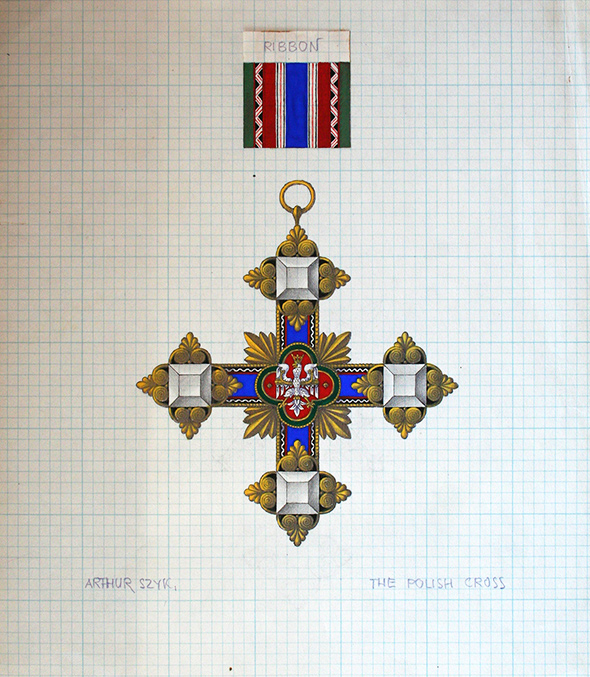
The Polish Cross. New York, 1945.
SZYK, Arthur. The Polish Cross. Signed “Arthur Szyk”. (New York, 1945). Watercolor and gouache on paper. Image size: 5 5/8″ x 3 3/4″. Very Good condition.
There is a powerful poignancy visible in this exquisitely rendered design created for an imaginary medal to be pinned on the chest of a deserving hero. Szyk has painted an elaborate Greek style cross, the ancient cruciform with arms of equal length. At the center of the cross is the glorious white Polish eagle. The eagle wears a jeweled crown to show the nation’s sovereignty. During Szyk’s lifetime, he had seen his native country both independent (when the eagle wears a crown) and under the dominion of foreign powers when the eagle remained uncrowned. A section of official military ribbon accompanies the cross.
This Polish Cross was designed to have been cast in gold and silver with the center decoration reproduced in blue, red, and green enamel. Traditionally the symbolic use of the Cross for a military medal was awarded for the most conspicuous bravery, or pre-eminent act of valor in the presence of the enemy.
Szyk was most likely basing this military award on The Order of the White Eagle which had been one of Poland’s highest honors since its inception in 1705. Redesigned many times over the centuries, an act of Parliament in 1921, created a medal used until 1948 when the People’s Republic of Poland came into existence. The Order of the White Eagle was no longer awarded but it was never officially abolished and it was used by the Polish Government in Exile. Following the collapse of communism, the Order was once again reinstated in 1992.
MODERN HISTORY OF THE WHITE EAGLE: After the defeat in 1939 and during the German and Soviet occupation of the country, the White Eagle, as Poland’s coat of arms, was strictly forbidden. Once again it became the symbol of fight for free Poland. It was used by the underground army at home and by the regular Polish army abroad. The left-oriented armed forces, however, as well as the Polish army created in the Soviet Union, adopted the White Eagle without the crown and it became the official Coat of Arms after 1945. Removing the crown from above the Eagle’s head signaled a change of the state’s political system, from now on based on the principle of “people’s democracy”. That form of the White Eagle, though officially used until the end of 1989, was not commonly accepted by the Polish nation who was extremely attached to their previous, centuries-old national emblem, as clearly evidence by Szyk’s decision to use the crown in this design. In consequence of the events of 1980’s when the political system of Poland changed once again, the crown was restored to the White Eagle. In 1995, the 700th anniversary of the White Eagle’s coronation as the Coat of Arms of the Polish State was celebrated.
Provenance: Mrs. Alexandra Szyk Bracie, daughter of the artist.