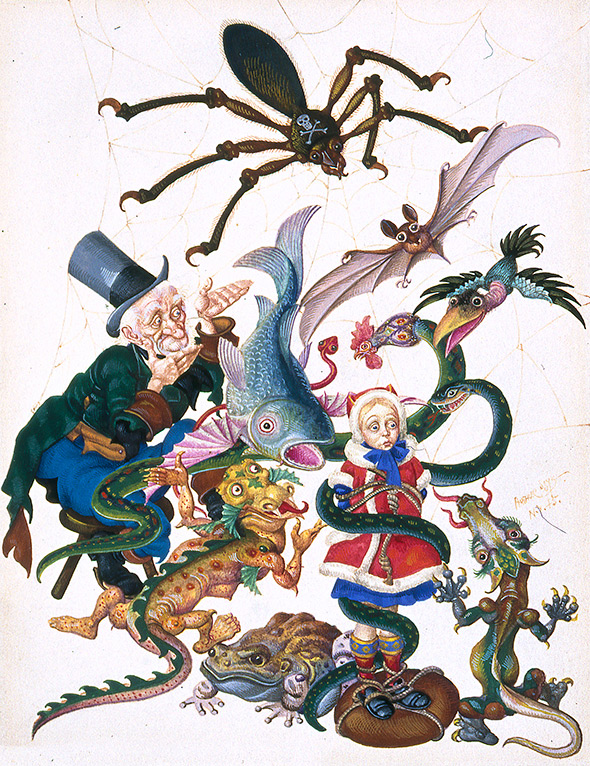
The Girl Who Trod on a Loaf. Andersen’s Fairy Tales. New York, 1945.
SZYK, Arthur. The Girl Who Trod on a Loaf. Signed and Dated “Arthur Szyk N.Y. (19)45.” Illustration for the chapter titled “The Girl Who Trod on a Loaf” in Andersen’s Fairy Tales. Watercolor and gouache on paper. Sheet size 7″ x 5 1/2″. Image size: 6 1/2″ x 5 1/2″. Signature faded, otherwise Very Good condition.
This illustration contains many creepy creatures: a bat, a spider, a toad, snakes (one of which has a rooster’s head), a gigantic fish, and dragons (one with human hands and feet). They all hone in toward Inge, the sweet-faced little girl in the center. Outfitted in colorful stockings and a bright blue dress, her blonde hair is tucked beneath a red hat with white fur trim. Her red coat is similarly trimmed. Puzzlingly, her arms and torso are bound by a rope, as are her ankles and feet, and she is attached to round loaf of bread beneath her shiny black shoes. Her blue eyes are wide open, but is she afraid, or merely repulsed.
Raised in poverty by a hard-working single mother, young Inge enjoyed performing cruel acts for which, because she was pretty, she was excused rather than being reproved. In time Inge was taken in to service a wealthy family who dressed her finely, which increased her pride. Inge avoided visiting her hometown because she was ashamed of her mother’s poverty, but when her mistress gave Inge a loaf of bread and insisted she see her family, Inge agreed. On the way home she came upon a puddle in the road and, rather than risk getting her shoes dirty, she threw the bread intended for her mother into the mud so that she might walk on it. When she stepped upon it she became affixed to the bread, and descended far underground to the home of the Marsh Woman, and in her cesspool of a brewery Inge remained for generations, frozen in place and attended by every sort of noxious creature, until at last she learned the meaning of grief, humility, and gratitude.
The life work of Arthur Szyk can be seen as a unique trinity of styles comprised of miniature illumination, political caricatures, and fantasy or children’s work. This latter category reveals a winsome, fey, innocent side of Arthur Szyk that is so antipodal to his political drawings. The snakes, dragons, sea serpents and spiders of this painting are distinguishable from the monsters of Szyk’s political work by their eyes: they are round and bright, childlike still.
Andersen’s Fairy Tales was not the only book Szyk produced for children (his Pathways Though the Bible has been read by millions). It is however, the only full volume displaying this big-eyed, rosy-cheeked style.
Historical significance: Adults today agree in recalling “The Girl Who Trod on a Loaf” as the most memorable and haunting of Szyk’s images in Andersen’s Fairy Tales.
Provenance: Parke Bernet Sale, New York, Mrs. Arthur Szyk, November 27, 1963. Lot 35.
Publishing History: Andersen’s Fairy Tales, New York: Grosset & Dunlap, 1945.