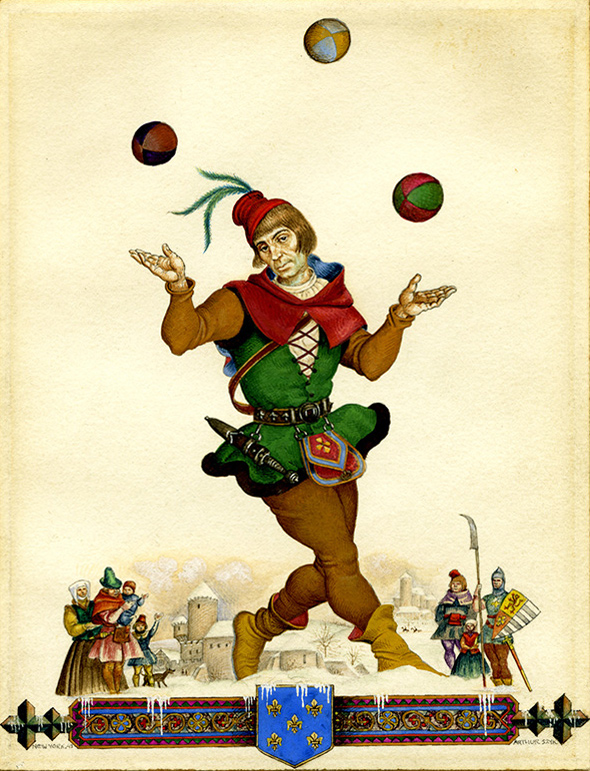
The Juggler. New York, 1943.
SZYK, Arthur. The Juggler. Signed and Dated “Arthur Szyk New York (19)43”. Watercolor and gouache on paper. Sheet size: 5 15/16″ x 4 7/16″. Image size: 5 9/16″ x 4 7/16″. Very Good condition.
In the foreground of this medieval scene, a juggler in garb of red, green, and brown lofts three parti-color balls in the air. Snow-clad castles, peasants, and a soldier stand in the background. In medieval Europe, jugglers were often associated with troubadours as resilient tricksters and jesters who stood somewhat apart from the mores of the rest of society.1 In the center of the lower decorative border of the painting, Szyk has painted a coat of arms that contains five fleurs-de-lis. As heraldist David Phillips has observed, the use of fleurs-de-lis on a blue field gives the scene a French flavor without necessarily indicating the French monarchy. In this painting, this heraldic pattern may also suggest the performer’s role in medieval French society as a jongleur, one who made his living as an itinerant singer, poet, and all-around entertainer.
In his painting, Arthur Szyk has skillfully represented the separateness of the jongleur from the norms of society through the enlarged figure of the juggler, whom the artist has placed clearly in front of (and thus apart from) the other people depicted in the scene. These other characters contrast sharply with the main figure of the painting.
In the lower left-hand corner, the grouping of a man, woman, and two children (together with a pet dog) suggests the stability and practicality of family life that the juggler or jester eschews. Even so, the family members seem fascinated with the novelty and outsider persona of the juggler, as their waving salutations of him imply. In contrast, the three individuals in the lower right-hand corner appear more subdued and perhaps skeptical of the freewheeling demeanor of this performer who has come into their midst. The soldier, in particular, may represent a segment of society that tolerates less play and demands more purposefulness than the juggler.
By placing all these figures within the setting of a severe winter, Arthur Szyk may be arguing that the juggler (or his modern equivalent) provides badly needed relief from the dreariness of existence through his dazzling performances and antic exuberance. The festive lower border of Szyk’s scene, with its vibrant colors shining out from behind a series of icicles, reinforces this idea that human experience can often be so harsh that it must be enlivened with spectacle, charm, and wit. As a forceful painter and a caricaturist with a keen sense of humor, Szyk himself certainly contributed to making the difficult moments of the human journey bearable. This gorgeous, engaging painting serves as powerful testimony to that record of artistic achievement.
1 Arthur Chandler, “On the Symbolism of Juggling: The Moral and Aesthetic Implications of the Mastery of Falling Objects,” Journal of Popular Culture. Winter 1991, Vol. 25, no. 3. Accessed online.↩