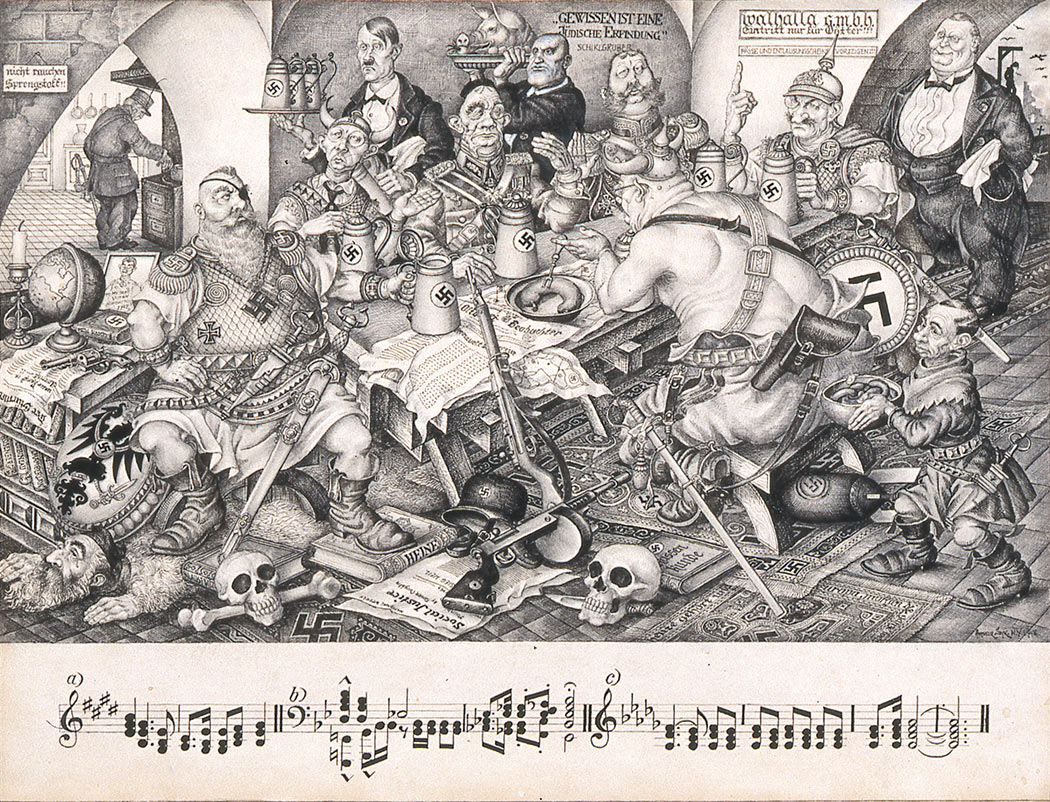
Valhalla. The Niebelungen series. Ink & Blood. New York, 1942.
SZYK, Arthur. Valhalla. The Niebelungen series. Signed and Dated “Arthur Szyk, N.Y., 1942”. Black ink and graphite on board. Sheet size: 10 1/2″ x 14″. Image measures 9″ x 11 7/8″. Very Good condition.
The German fascination with northern Scandinavian and Viking war myths has long dominated their artistic and musical tradition. Richard Wagner’s fist rousing operas perennially feature the superiority of the Fatherland in every aspect of physical and moral life and Szyk has illustrated actual music from the Ring Cycle to give sound to his vision of the heaven of the beast — Valhalla.
ARTHUR SZYK REVEALS THE MODERN VALHALLA: This Nazi heaven is portrayed as a private party at a rowdy German beer hall, the host of which is Wotan himself (the King of the Gods in Germanic mythology) whose palace was called Valhalla. He has gathered figures in German Imperial history to hoist their steins and gorge on franks including Kaiser Wilhelm and Otto Von Bismarck. Interestingly, he has cast the major Axis leaders as waiters: Hitler carries beer, Mussolini hoists a pig head on a platter, Göring has a napkin under his arm and Goebbels is a downcast dwarf serving sausages. General Pétain, of the Vichy government, can be seen in the kitchen to the rear “French cooking” for the guests.
A major strength of this caricature is drawn from how intricately crowded it is. The eye of the viewer darts from left to right, top to bottom absorbing the kinetic visuals. Though we are primarily witnessing a noisy “boys night out”, a closer examination shows at what price the party has been purchased. Wotan’s beefy right leg rests not on a bear rug, but a Jew rug, while his left crushes a volume by 19th century German Jewish poet Heinrich Heine. On the far right, a man is strung up on the gallows in a cemetery. Human skulls are tossed casually about the floor. On the wall is a quote attributed to Schiklgruber [Hitler], “Conscience is a Jewish invention.” Everywhere are small visual references to ongoing World War II: a copy of Mein Kampf, a signed photo of Hirohito to Wotan, German slogans woven into the rug borders, guns and knives and bombs, oh my! The saturation of swastikas in this image is the deepest ever seen in Szyk’s work. It is as if the very air the characters breathe is redolent with the scent of the Nazi beast.
Szyk gives more than a passing nod to the early 16th century court painters Albrecht Dürer and Hans Holbein in his image of Valhalla, yet turns the homage completely on its head giving birth to the most intelligent form of political satire.
Provenance: Parke Bernet Sale, New York, Mrs. Arthur Szyk, November 24, 1961. Lot 67.
Exhibition History: Andre Seligman Gallery, sponsored by the Writer’s War Board, New York, January 1943; Wildenstein Gallery, New York, December 1944, Lot 21; Philadelphia Art Alliance, 1945, Lot 21; United States Holocaust Memorial Museum, Washington, DC, April 10–October 14, 2002; Deutsches Historisches Museum, Berlin, 29 August 2008–4 January 2009; Fine Arts Museums of San Francisco, Palace of the Legion of Honor, December 4, 2010–March 27, 2011.
Publishing History: Cosmopolitan, January 1945, p. 50. Liberty magazine, October 27, 1945, p. 19. Ink & Blood, 1946, plate X. Luckert, Steven, The Art and Politics of Arthur Szyk, United States Holocaust Memorial Museum, 2002, pp. 77, 80. On the website of the United States Holocaust Memorial Museum. Sodei, Rinjiro, Arthur Szyk: Indignant Jewish Illuminator [Text in Japanese], Tokyo, Japan, 2007, p. 151. Drawing Against National Socialism and Terror, Deutsches Historisches Museum, Berlin, pp. 124-125. Miniature Paintings and Modern Illuminations, Fine Arts Museums of San Francisco, exhibition brochure. On the website of the Society of Illustrators.