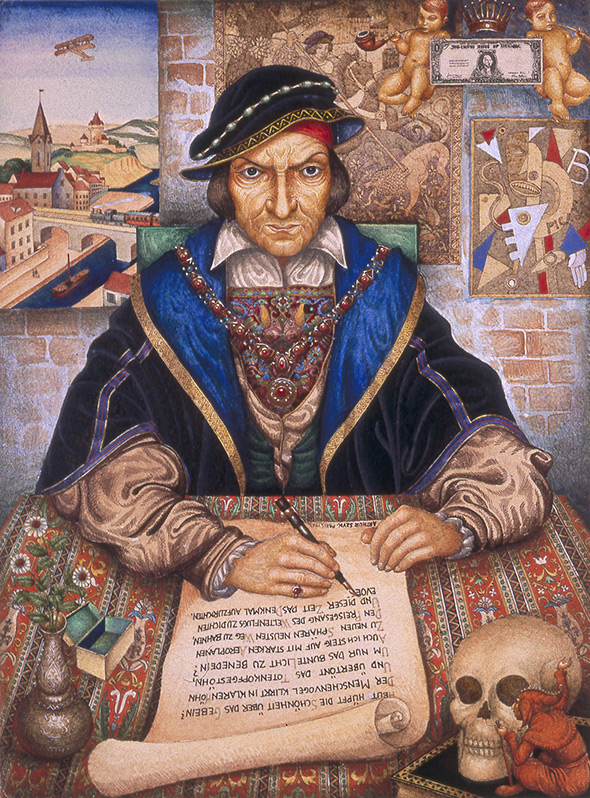
The Scribe. Paris, 1927.
Szyk’s Brilliant and Illuminating Juxtaposition of the Modern World with the Renaissance
SZYK, Arthur. Le Scribe. [The Scribe.] Paris: 1927. Signed and Dated “Arthur Szyk Paris 1927.” Original watercolor and gouache painting. Image size: 7 1/2″ x 5 1/4″. Original period frame with affixed, metallic title plate: 14 1/2″ x 12 1/4″.
SZYK AS A RENAISSANCE MAN. Between the 14th and 16th centuries, the Age of the Renaissance saw a world awakening from the plagues of superstition and feudalism. After a long period of economic stagnation came financial growth along with a fresh start to artistic, social, and scientific advancements. A long suppressed freedom of thought was unleashed to the world. There seems always to exist in times of stupendous change, an extraordinarily prescient observer who is able to link the old and the modern, one who makes sense of their interdependence and the manner in which one builds upon the other. These are the writers, the scholars, the artists of civilization. Szyk’s life and work are ample proof that he himself was one of these unique individuals. In essence, he was a Renaissance man literally and figuratively, and not only that, but able to transpose himself back in time as a renaissance scribe writing about modern times. Szyk’s voice is the voice of experience of the ages, able to speak both from a humanist as well as a modern perspective.
His intricately allegorical illumination, The Scribe, portrays a mature medieval scholar impossibly contemplating the modern age of the airplane, the train, abstract art and printed currency. The man is paused in the writing of an enigmatic poem that seems to bend time. Like Leonardo Da Vinci, this visionary sees beyond the confines of his own civilization and into the mysterious brilliance of the future.
The poem written in modern German, likely echoes Szyk’s own approach, in his own words, to modernity:
Today does beauty leap over the mortal remains of the dead? Does the human bird [airplane] rattle in clear heights and drown out the primary groans of death merely to envy the multi-colored light? I too, ascend on strong airplanes to new realms, to travel the newest way, to compose the song of praise for world wide flight and erect, to this time, a monument.
The poem praises, even exalts modern technology as the true vehicle for attaining new worlds and attempting to conquer mortality itself. The Industrial Revolution of the 19th century which allowed the tremendous advances of the 20th to progress is likened to a new Renaissance unfolding. Will science eventually prevail over death? A small red jester crouching behind a skull seems to mock this thought, yet the airplane and train flying over a perfect medieval city indicates an immortality of man’s achievements. A regal German Renaissance style hunting tapestry is hung side by side with a brilliant Picasso-like painting. [Our research seems to indicate that the tapestry and “Picasso” are Szyk original creations]. A U.S. dollar bill is elevated to royalty by the addition of a floating crown and is flanked by fat cherubs (symbols of spiritual elevation and humorously painted with Szyk’s own visage) humanly smoking pipes.
This is one of Szyk’s most provocative illuminations, seeming almost to invoke Nostradamus in its puzzling imagery. It was painted during his early Paris period, a time of immense fertility and experimentation of style.
Historical Significance: THIS MAY VERY WELL BE SZYK’S QUINTESSENTIAL WORK THROUGH WHICH HE REVEALS HIMSELF AS A DEEP AND BRILLIANT THINKER ALLOWING HIS VIEWERS TO COMTEMPLATE THE CHANGING WORLD WITHIN A SINGLE MASTERPIECE.
Provenance: Le Scribe was purchased by Harry Glemby in Paris in the mid 1920’s. Glemby was Arthur Szyk’s first serious patron and collector of Szyk’s art.
Exhibition History: Deutsches Historisches Museum Berlin, 29 August 2008–4 January 2009; Fine Arts Museums of San Francisco, Palace of the Legion of Honor, December 4, 2010–March 27, 2011.
Publishing History: Newsletter, The Arthur Szyk Society, Burlingame, CA, Summer 2004, p.5; Drawing Against National Socialism and Terror, Deutsches Historisches Museum, Berlin, 2008 exhibition catalogue, pp. 56-57; Still Biting: 21st-Century Szyk, Forward newspaper, New York, May 1, 2009, p. 15; J. The Jewish News Weekly, San Francisco, December 17, 2010, p. 27; Artur Szyk: Man of Dialogue [Polish and English editions], Centrum Dialogu, Lodz, 2011, p. 9; Miniature Paintings and Modern Illuminations, Fine Arts Museums of San Francisco, Palace of Legion of Honor, 2011 exhibition brochure, back cover.
Online: Steven Heller, “Illuminating Arthur Szyk: An Interview with Irvin Ungar,” AIGA, November 24, 2010.
Literature: Excerpt from entry in Deutsches Historisches Museum catalogue by art historian and curator Katja Widmann: “This is one of only a few works that Szyk did not create as an illustration for a text or a political statement. In the figure of the scribe, he positions himself face to face with modernity. Dressed in renaissance period garments, the scribe has written an expressionist poem on a roll of parchment using a modern fountain pen. Through his merging of the traditional with the contemporary, of the real with the fictional , Szyk created a painting that is surrealist in manner. Yet, it is possible to take the message literally: through the avant-garde poem and the modern-day objects the scribe—and thus the painter—identifies himself with the present. Bur rather than negate tradition, he appropriates it—with self-confidence and an unflinching gaze.”
Excerpt from online review by A.J. Goldman, columnist for Forward newspaper, April 20, 2009: “One striking work from the Paris period is “The Scribe” (1927). In the painting, an old man in medieval garb sits at a desk, writing a Dadaist poem in dense, near-impenetrable German on a parchment scroll, with a modern pen. Out a window behind him is a modernist landscape with a highway and a plane overhead. The image is awash is decoration and detail. The main figure stares directly at the viewer, with deep, pendulous eyes. His purple-and-blue robe is offset by an oriental breastplate and a medallion. Behind him is a brick wall, fat cherubs smoking pipes, a dollar bill, a medieval tapestry, a cubist painting with the name “Picasso” written across it. Like the various objects depicted, the painting itself is a fascinating synthesis of the old and the new. The over-saturation of symbols, along with the collagelike composition of disparate elements, brings to mind surrealism, while the grotesque style is reminiscent both of the Neue Sachlichkeit and the works of Bosch and Bruegel. With his oddball synthesis of ancient techniques and modern themes, Szyk deliberately uses medieval and renaissance styles to comment on the present age.”