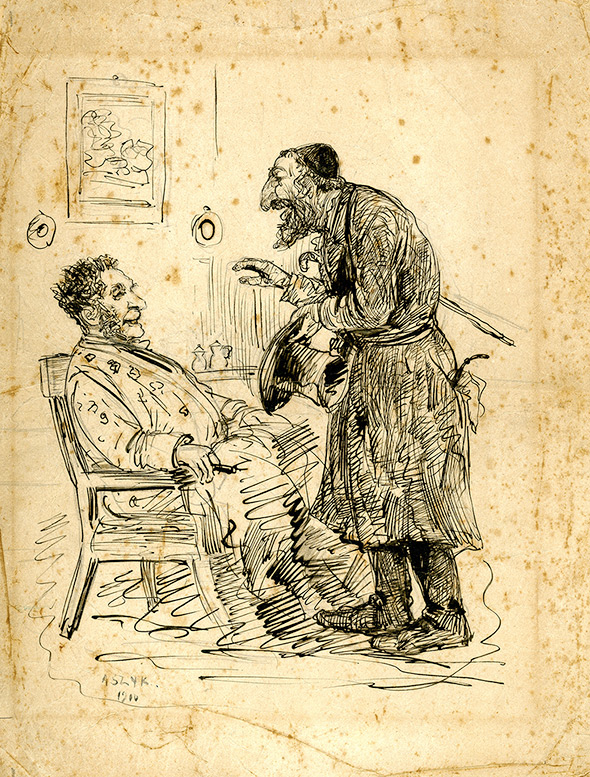
Two Figures in Conversation. Paris, 1910.
A Delicately Rendered Early Drawing by Arthur Szyk
SZYK, Arthur. Two Figures in Conversation. Signed and Dated “A Szyk, 1910” (Paris). Pen and ink on paper. Sheet size: 11 3/8″ x 8 1/2″. Image size: 9″ x 7 1/8″. Extensive spotting, Fair condition.
This drawing is an extremely early example of the amusing but perceptive caricature art of Arthur Szyk. The artist has made acute observations of two men who are very differently dressed but engrossed in conversation with one another.
The man at left has mutton chop whiskers and is seated in an armchair, leaning back and grasping a cigarette in his right hand. His interlocutor at the right of the drawing stands and wears the yarmulke, forelocks, and beard of a traditional Jew. Szyk has drawn the latter man with a prominent nose that emphasizes his Jewishness. Facing the seated man, this standing figure holds a top hat in his left hand and a cane under his right arm, as he gestures with his right hand. With smiles on their faces, the two men seem to be enjoying their time chatting together. The background of a large painting that hangs on the wall between two small oval pictures, all above a table with items for tea or coffee, gives the scene a friendly, domestic air.
The piece typifies Szyk’s early work in its close attention to the quotidian details of life in early-twentieth-century Eastern Europe. Many of Szyk’s drawings from this period, including this one, examine the relations between Jews and their non-Jewish neighbors. During World War I, for instance, Szyk created a postcard-sized drawing depicting a Jewish merchant speaking from behind a bar with two Russians. The distinctive hats of each of the three men demonstrate Szyk’s sensitivity to the prevailing cultural and religious differences of the time and place. An even stronger contrast of styles and personas occurs in Szyk’s pre-World War I sketch of extravagantly mustachioed soldiers in pompous poses and hats that are absurdly cocked at all angles, beside a subdued profile portrait of an elderly Jew with a large nose, long beard, and plain yarmulke.
In the 1910 piece showing two figures in intimate conversation in a parlor, Szyk has proved an equally keen observer of distinctions of dress and manner in his portrayal of the man with mutton chops who converses with the traditional Jew in a long black coat. These contrasts in Szyk’s drawings of different characters have a parallel in the wide range of the artist’s own professional influences, which, as Szyk biographer Joseph Ansell has suggested, extended from political caricature and Jewish religious motifs to medieval manuscript illumination and the orientalizing aspects of traditional Polish art.