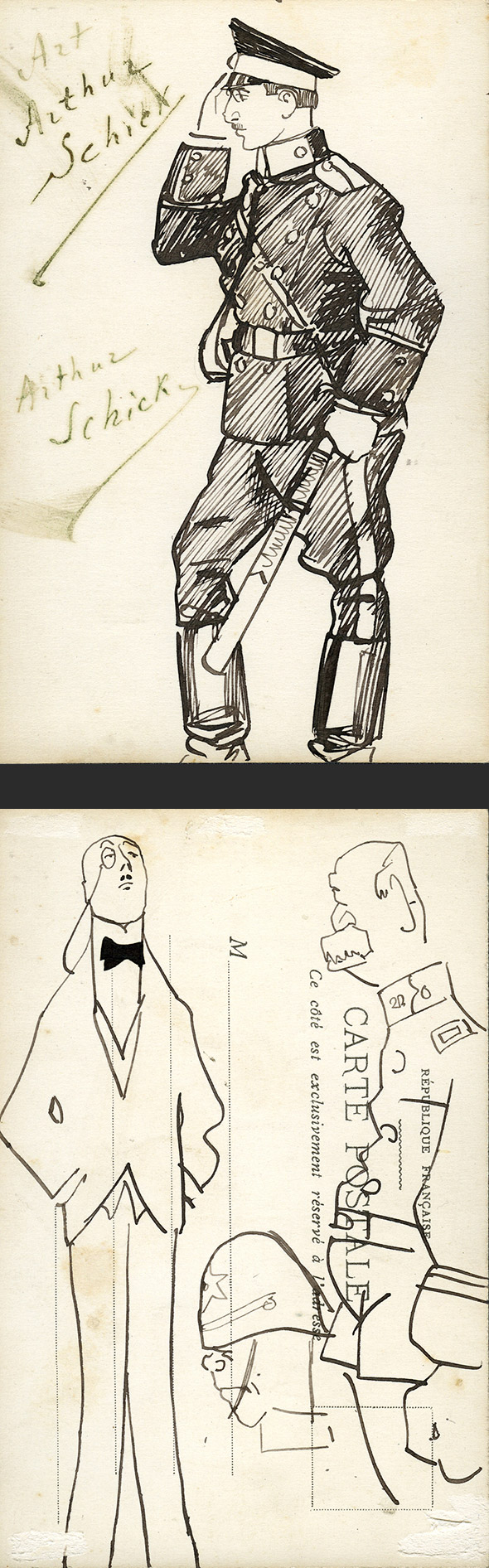
Self-Portrait as Soldier. Lódz, 1915.
SZYK, Arthur. Self-Portrait as Soldier, with sketches on verso. Signed “Arthur Schick” twice. (Lódz, 1915.) Original pen and ink on postcard stock. Sheet size: 5 1/2″ x 3 1/2″. Image size: 5 1/4″ x 2″. Very Good condition.
Self-Portrait as a Soldier showcases Szyk’s unerring ability to render the human form in a variety of attitudes and costumes, as well as his early and slightly self-conscious attempts at formulating his persona as a young expatriate artist in Paris. In later years, Szyk would be heralded as a “soldier in art” by European and American fans for his outspoken criticism of the Nazi regime. Self-portrait as Soldier is one of the earliest examples of Szyk actively shaping this identity.
The artist strikes a heroic pose, saluting with his right hand and firmly gripping his sword with his left hand. Standing with his legs spread and his face in profile, he is the quintessential picture of a virile and righteous hero-type. It is quite likely that Szyk had already been conscripted into the Russian army at this time; the uniform appears to be that of a low-level Russian infantry man. It is clear from this image that Szyk is in the beginning stages of realizing his calling not only as an artist, but also as an activist and a protector of the people.
On the verso, Szyk once again experiments with sketching exaggerated caricatures as he develops a visual vocabulary for describing different “types” of people. He seems to be interested in how external, physical traits can convey the internal personality of character. This intense study of different characters would serve him well in his later years when he developed a career as a political cartoonist in the United States.
On the left, a gentleman with a black bowtie and a monocle stands with his hands in his pockets. His slender frame, pinched nose, sparse moustache, and raised eyebrow all combine to lend an air of haughtiness to his character. On the right, two soldiers in profile face the snobby gentleman. Their features are less refined, with big, blocky noses and squinted eyes. The soldier on the far right has a large, bushy moustache rendered in a similarly chunky fashion to the rest of his face. These men look more substantial, focused, and even potentially brutish. They pose with outstretched necks and hunched shoulders, indicating they are tired or suffering low spirits.
Publishing History: Art History Publication Series No. 4, The Arthur Szyk Society, Burlingame, CA, 2010, p. 7.
Literature: Essay by Tamara Poniatowska, Ader Auctions, Catalogue, Paris, 18 November 2009.