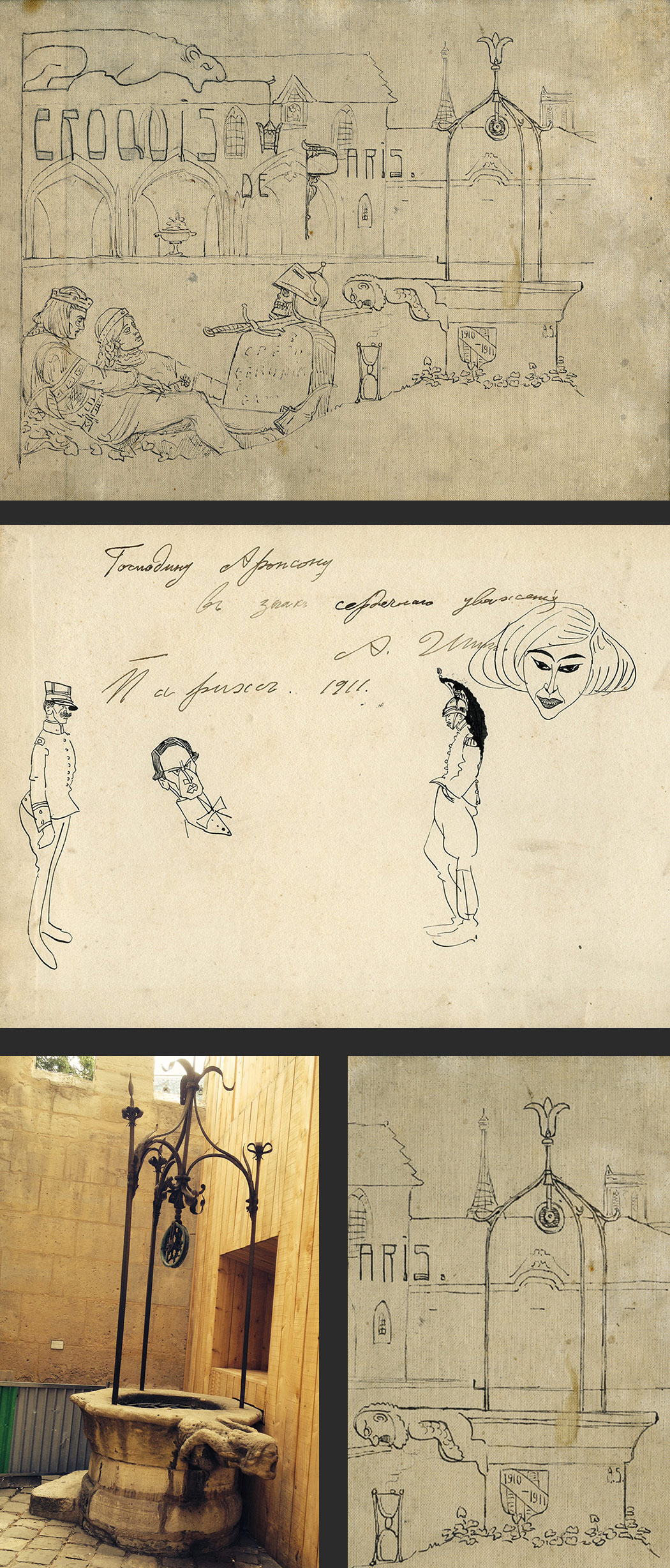
Croquis de Paris. Paris, 1911.
Cover Design of Szyk’s Earliest Paris Sketchbook
SZYK, Arthur. Croquis de Paris [Musée de Cluny] with sketches on verso. Signed and Dated “A.S. 1910-1911.” (Paris, 1911.) Pen and ink on linen-covered board. Sheet size: 12″ x 8 5/8″. Image size: 9 1/2″ x 7 1/4″. Very Good condition.
Croquis de Paris is the original cover design for Arthur Szyk’s earliest known book of drawings from his first Paris period. In addition to this sketchbook cover there are several other individual leaves which are present in our collection. The young artist decorated both recto and verso of the sketchbook’s front cover with the originality and confidence that brought him fame in his later career.
On the recto, the heading “Croquis de Paris” — that is, “sketches of Paris” — is scrawled in ornate lettering, and a heraldic shield bears the dates “1910-1911”, presumably demarcating the years in which young Szyk created these drawings. In the foreground, a man and woman recline together at the edge of a gravestone. Dressed in royal medieval garb, the man wears a crown and clutches a flower in his right hand. Their features and movements are completely static, suggesting they may be stone sculptures, or perhaps even dead. A human skull rests atop the gravestone, wearing a knight’s helmet. A sword balances precariously beneath the skull, in the attitude of severing the skull from its perch. An hourglass appears next to the assembled figures on the grass, a symbol of time and its passage. The combination of the skull, tombstone, and hourglass could be interpreted as a “memento mori,” or a reminder of our own mortality.
Further along the grassy slope sits a well, topped with the fleur-de-lis (a symbol of the French monarchy) and covered with a strange gargoyle-inspired lid. The well is old and defunct, indicated by the plants growing up around its base and the absence of a rope or bucket on the pulley. The background consists of realistically rendered buildings; indeed it is the courtyard of the cathedral at Cluny. The Eiffel Tower rises beyond the cloistered walls, and a single, decorative lamp hangs over the composition on the left. The panther-shaped lamp is probably a gargoyle, given that this scene occurs on the grounds of a church. Overall, this lush montage of disparate imagery creates a haunting, dreamlike scene.
On the verso, the viewer can appreciate the characteristic contents of Szyk’s sketchbooks: quick, deftly rendered sketches of different types of people, sometimes exaggerated to the point of caricature. At the top of the page, his loose scrawl reads, in Russian, “To Mr. Aronson as a token of sincere respect. A. Szyk. Paris 1911”.
Below the inscription, on the left, is a guard or perhaps a policeman. His uniform is clearly official, but the lack of gun or sword indicates that he is not a soldier. Next to the guard, Szyk sketches the head of an aristocratic-looking man, using highly stylized lines to create a geometricized, symmetrical countenance. Further along to the right is a second guard. This man wears an ornate helmet and epaulettes on his shoulders. Based on Szyk’s fidelity to costume, it is likely this figure is meant to be a member of the French Republican Guard. Lastly, a woman’s face looms above the other figures. She wears dark eye makeup, and the angular sweep of her eyebrows, chin, and the creases around her nose and mouth lend a rather menacing sharpness to her face. In contrast to the scene on “Recto,” it is quite possible that these figures are real people Szyk observed in Paris.
Historical Significance: The building and the well in front courtyard still stand today and are The Cluny Museum in Paris. It is absolutely clear that the Cluny was a place which Szyk frequented during his teenage years, and which exposed him to early tapestries, medieval art and architecture, and to illuminated manuscripts. Szyk’s rendering of The Cluny is a highly important work of art as it both dates his time in Paris and clearly shows a place of great significance in his life and its development.
Literature: Essay by Tamara Poniatowska, Ader Auctions, Catalogue, Paris, 18 November 2009.
Exhibition History: Fine Arts Museums of San Francisco, Palace of the Legion of Honor, December 4, 2010–March 27, 2011.
Publication History: Art History Publication Series No. 5, The Arthur Szyk Society, Burlingame, CA, 2010, p. 2.