Political Caberet Dancers. Paris, 1912.
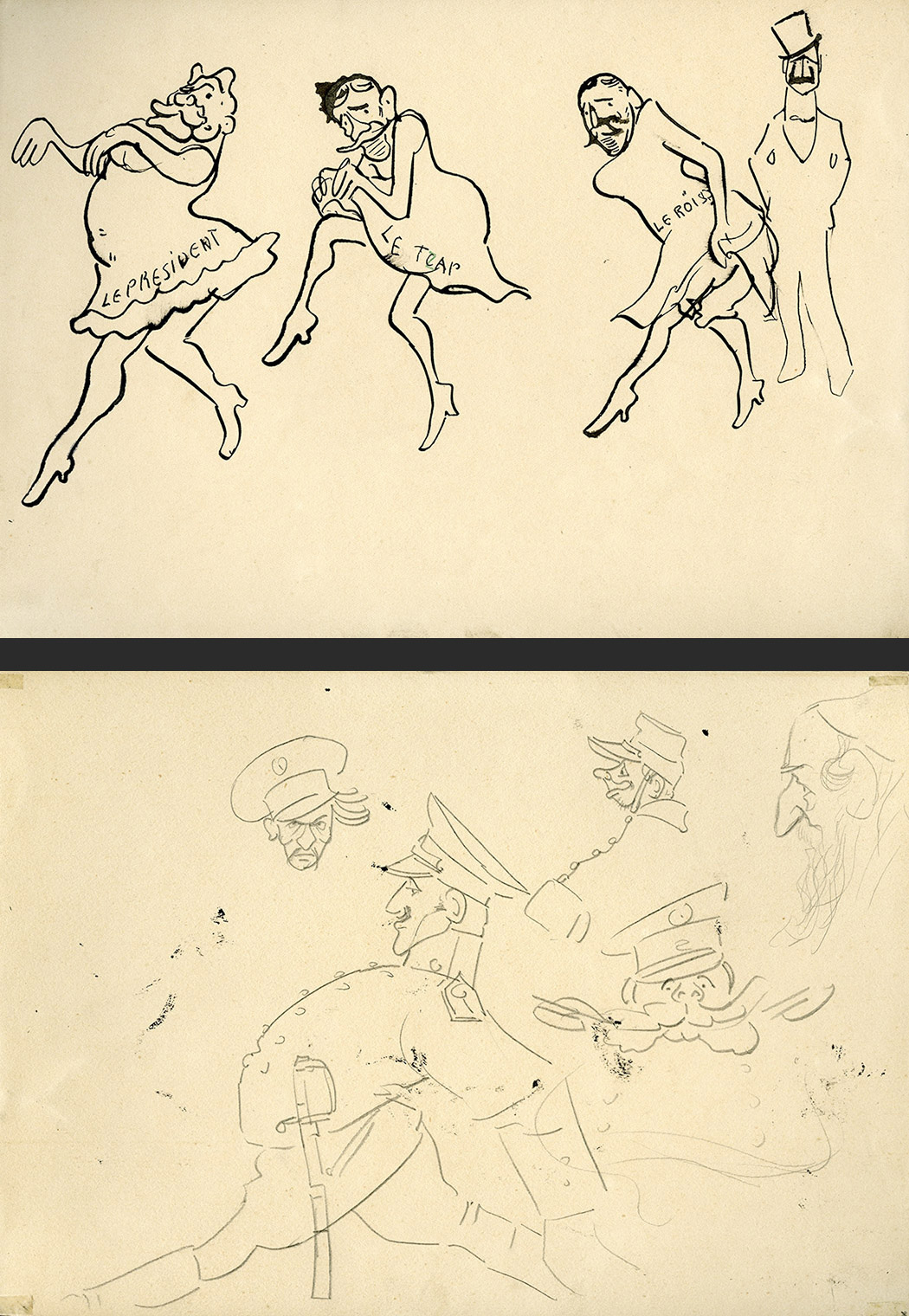
SZYK, Arthur. Political Cabaret Dancers [recto] and Caricatures of Soldiers and Old Man [verso]. (Paris, 1912.) Original pen and pencil drawings on paper. Sheet size: 11 3/4″ x 8 1/4″. Very Good condition.
The two drawings on this sheet offer an early glimpse into Szyk’s most enduring artistic endeavor: caricature and political cartoon. Szyk created these sketches long before he made a name for himself as a “soldier in art” with his nationally syndicated political cartoons in the U.S., however his nascent interest in political satire is evident in these early drawings. On recto, three figures parade across the picture plane, rendered in bold black ink strokes. A fourth figure stands somewhat apart, at the right of the picture plane. The three primary figures are men with droopy mustaches and furrowed eyebrows, attired in frilly dresses and assuming silly, trouncing poses. They totter on delicate ladies heels, looking somewhat sheepish and bewildered. They are each labeled (from left to right): Le President, Le Tzar, and Le Roi, or The President, The Tzar, and The King. Szyk was new to France at the time he created this cartoon, and he makes a few spelling mistakes in his labels. He appears to be mocking the ineffectual governments represented by these three absurdly attired men.
Caricatures of Soldiers and Old Man
On verso, Szyk experiments with caricature in a series of penciled sketches of soldiers and an old man. The main figure, a striding soldier in profile is so exaggerated his limbs seem to scissor away from his body in an impossibly aggressive stance. His head appears disembodied on this thick neck and his knees hyperextend to emphasis his gruff, rigid posture. Encircling the striding figure are sketches in which Szyk experiments with distorting and embellishing different facial features. One man has a protuberant nose and belly, while the other has a mustache that spans the width of his shoulders. The final figure is a more naturalistic sketch of an old man in profile. He is faintly rendered and posses more true-to-life features than the soldiers. He is probably Jewish, due to the presence of his sidelocks, cap, and exaggerated nose. Szyk appears to be poking fun at the soldiers with their ungainly features and awkward stances, whereas he renders the old man with more gentleness and attention to his individuality.